









Lenze Ac Tech I550 Protec Variable Frequency Drives Vfds: Le

Estimated reading time: 11 minutes
Introduction: Why a Decentralized VFD Is Your Best Solution
In modern industrial settings, optimizing space and simplifying machine architecture are paramount. For this reason, many engineers are turning to decentralized drive technology, and the Lenze i550 Protec VFD stands out as a premier solution that moves motor control from crowded central cabinets directly onto the machine. This approach fundamentally streamlines system design, as noted in documentation from Precision-Elec. Consequently, a decentralized VFD drive not only saves valuable panel space but also significantly reduces the complexity and cost associated with long, shielded motor cables and the labor required to install them.
The primary benefit of a decentralized AC Tech motor controller is its installation flexibility, which in turn leads to major cost savings. By placing the drive near the motor, you can utilize shorter, more affordable cabling, which also minimizes potential electromagnetic interference (EMI) and voltage drop issues. For instance, Lenze SMVector Migration highlights that this strategy is ideal for modular machine concepts, as it minimizes installation expenses and simplifies wiring. This modularity makes scaling production lines or reconfiguring equipment a much faster and more efficient process, reducing downtime and adapting quickly to changing production needs. Ultimately, this leads to a lower total cost of ownership over the machine’s lifecycle.
Furthermore, the Lenze i550 Protec inverter is specifically engineered to thrive outside of a protective electrical cabinet. Its robust construction features a high degree of housing protection, typically an IP66 or NEMA 4X rating. In other words, this IP66 variable frequency drive is fully protected against dust ingress and powerful water jets from any direction, making it suitable for washdown environments common in the food and beverage or packaging industries. As described by Lenze, this resilient design ensures reliable performance in harsh conditions without the need for additional enclosures, proving that a decentralized solution offers both logistical and operational advantages.
Core Features of Lenze AC Tech I550 Protec Variable Frequency Drives (VFDs)
The Lenze i550 Protec VFD is defined by its robust, decentralized design, which allows for installation directly on or near the motor, outside of a protective control cabinet. This decentralized VFD drive features a rugged housing with an IP66 and NEMA 4X protection rating, making it completely dust-tight and resistant to powerful water jets from any direction. Consequently, this design significantly reduces engineering costs, simplifies installation, and saves valuable space within a facility. According to Lenze smvector Migration, this approach minimizes cable lengths and simplifies the overall machine architecture, representing a core advantage of the platform.
In terms of performance, the i550 Protec inverter is exceptionally versatile, handling power ranges up to 75 kW (100 HP). It supports multiple control schemes to accommodate various application demands, including V/f (volts-per-hertz) for simple tasks and sensorless vector control for more dynamic performance requirements. As noted by Precision Electric, this flexibility ensures that the drive’s output is precisely matched to the motor’s needs. Therefore, this AC Tech motor controller is an ideal solution for a wide array of equipment, for instance, conveyor systems, traveling drives, packaging machines, pumps, and fans, as highlighted by Lenze i550 Protec.
The Lenze i550 Protec VFD, mounted near the motor, demonstrates a decentralized approach that saves valuable control cabinet space and simplifies machine wiring.
From an integration standpoint, the Lenze AC Tech i550 Protec variable frequency drives VFDs excel with modern communication capabilities. The drive features an integrated IO-Link master (v1.1), enabling direct connection of smart sensors and actuators, which simplifies machine wiring and enhances diagnostic data collection. In addition to IO-Link, it supports all major fieldbus protocols, including PROFINET and EtherNet/IP, ensuring seamless integration into existing automation networks. Lenze i550 Protec Integration explains that this feature set positions the IP66 variable frequency drive as a future-proof component for advanced manufacturing environments. Commissioning is also made easy through various interfaces, such as a keypad, PC software, or a smartphone app.
Installation and Wiring Best Practices
Proper installation and wiring are foundational to the performance and longevity of Lenze AC Tech i550 Protec variable frequency drives (VFDs). Due to its decentralized design, this AC Tech motor controller is mounted directly on or near the motor, which consequently simplifies cabinet design and reduces cable lengths. When selecting a mounting location, it’s crucial to ensure adequate ventilation to manage heat dissipation, even though the drive is built for harsh conditions. As an IP66 variable frequency drive, the i550 Protec is well-suited for dusty and humid environments, as noted by Lenze. Therefore, adhering to the spacing requirements outlined in the AC Tech i550 manual is essential for thermal management and operational reliability.
Safe Wiring & Emi Prevention for Lenze I550 VFDs
Adherence to electrical codes like the NEC is non-negotiable during the wiring phase. For instance, using correctly sized conductors for both power and motor connections prevents overheating and ensures safety. A critical best practice, recommended by sources like Precision-Elec, is to maintain physical separation between power and control wiring to mitigate electromagnetic interference (EMI). Furthermore, running motor cables in a grounded metal conduit provides an effective shield against electrical noise that can disrupt sensitive control signals. Proper grounding of the VFD chassis is another vital step for both safety and noise immunity, a key consideration in any project planning phase detailed in guides like this one from Com.
Finally, before energizing the system, all connections must be meticulously verified. Technicians should confirm terminal torque specifications to prevent loose connections, which can lead to hazardous arcing or intermittent operation. Implementing strict lockout/tagout procedures in accordance with OSHA and NFPA 70E standards is mandatory to ensure personnel safety during installation and maintenance. The i550 Protec features accessible connection points, as seen in documentation from Lenze i550 Protec Inverter, which aids in a secure and efficient wiring process. Ultimately, these practices ensure the decentralized VFD drive operates safely, reliably, and to its full potential.
Basic Programming and Commissioning the I550 Protec Inverter
Commissioning the i550 Protec inverter is a straightforward process designed for efficiency and ease of use, regardless of your preferred method. To begin with, Lenze offers multiple intuitive interfaces for setup, including a pluggable keypad, a USB interface for PC connection, and a modern smartphone app paired with a WLAN module. This flexibility ensures that technicians can quickly configure the drive in various field conditions, whether on the plant floor or from a remote, safe location. Consequently, the initial setup time is significantly reduced, allowing for faster deployment of this decentralized VFD drive into your system architecture. The choice of interface allows personnel to use the tool they are most comfortable with, ultimately minimizing configuration errors and ensuring a smooth start-up.
Lenze I550 Protec VFD Motor Data Entry for Performance

The Lenze i550 Protec VFD’s decentralized design allows for installation directly on the machine, showcasing its robust construction and saving valuable cabinet space for industrial applications.
The first and most critical step in programming the Lenze i550 Protec is accurately entering the motor nameplate data into the drive’s parameter set. This fundamental procedure ensures the VFD’s control algorithm is perfectly matched to the motor’s characteristics, which is vital for both optimal performance and long-term reliability. Key data points include the motor’s rated voltage, full load amperage (FLA), frequency, and base speed (RPM). According to technical documentation from Precision-Elec, this step is mandatory for proper motor control and protection. In other words, skipping or incorrectly entering this data can lead to inefficient operation, nuisance tripping, or even motor damage over time. Therefore, always double-check these values before proceeding with further configuration.
For more detailed configuration, Lenze provides powerful yet user-friendly software tools. The EASY Starter software, for instance, offers a guided commissioning process, online diagnostics, and a clear overview of all parameters. This tool is invaluable for setting up application-specific functions and for troubleshooting. Furthermore, project planning guides like those found at FCRmotion Project Planning provide essential parameter lists. For ultimate convenience, the smartphone app essentially turns your phone into a wireless keypad, which is particularly useful for drives installed in hard-to-reach locations. As noted by Lenze i550 protec, the entire system remains focused on the essentials, simplifying what can often be a complex process. Consulting the AC Tech i550 manual is also recommended for detailed parameter descriptions.
Advanced Diagnostics and Lenze I550 Troubleshooting
Effective Lenze i550 troubleshooting is crucial for maintaining operational uptime, and thankfully, the i550 Protec inverter is equipped with comprehensive diagnostic features designed for rapid fault identification. This decentralized VFD drive provides detailed feedback, allowing technicians to move beyond guesswork and pinpoint the root cause of an issue swiftly. For instance, the drive’s ability to log events is invaluable for understanding the sequence of events that led to a trip. According to Precision Electric, these diagnostic capabilities help to significantly reduce mean time between failures. This proactive approach ultimately minimizes costly production stoppages.
On-the-spot diagnostics are facilitated through the drive’s clear interface. The optional keypad, for example, can display explicit fault descriptions like “Overcurrent,” immediately guiding maintenance personnel toward the problem. In addition, status LEDs provide a quick visual check on the drive’s condition, indicating states like “Ready” or “Running,” as noted by sources like Precision Electric. Consulting technical documentation similar to an AC Tech i550 manual is essential for interpreting the full range of error codes. Always ensure proper lockout/tagout procedures compliant with NFPA 70E and OSHA standards are followed before inspecting the AC Tech motor controller.
For deeper analysis, the EASY Starter software provides powerful tools. By connecting the i550 Protec inverter to a PC, technicians can monitor critical data in real-time, such as motor current and DC bus voltage. This capability is especially useful for diagnosing intermittent faults that are otherwise difficult to capture. The software also simplifies backing up parameters and commissioning replacement drives, a best practice noted in guides from Com. This advanced insight ensures the Lenze variable speed drive is optimized for performance and longevity.
Integrating Fieldbus Communications (ethernet/ip, Profinet)
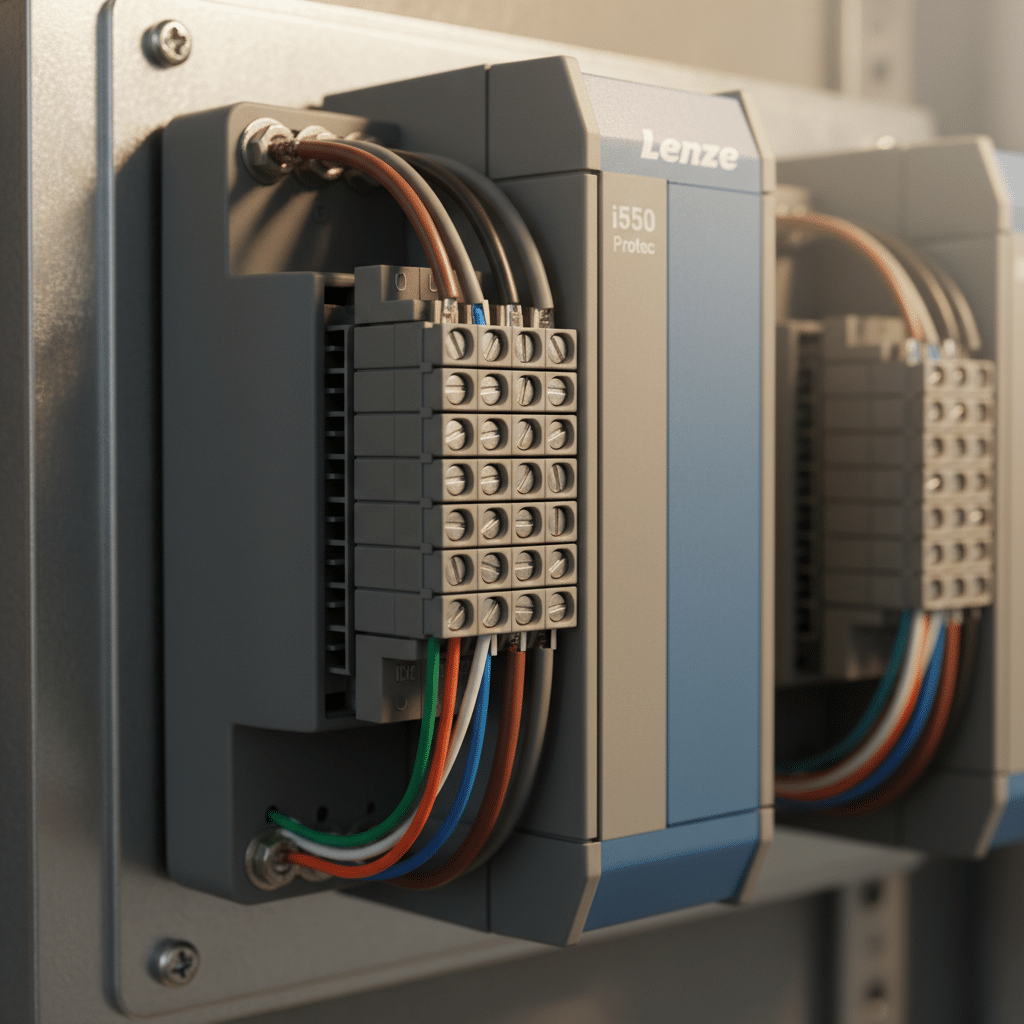
Following the wiring diagram in the AC Tech i550 manual ensures a safe and correct installation, preventing faults and maximizing the drive’s lifespan. Proper grounding is critical.
Seamless integration into modern automation networks is a hallmark of the Lenze AC Tech i550 Protec variable frequency drives (VFDs). The drive’s architecture is fundamentally designed for communication, supporting major industrial Ethernet protocols like EtherNet/IP and PROFINET right out of the box. This built-in capability is crucial for creating cohesive and responsive control systems where the VFD acts as an intelligent node on the network. According to Precision Electric, these extensive communication options allow the decentralized VFD drive to integrate effortlessly into systems coordinated by a central PLC. Consequently, this simplifies the overall machine architecture and enhances data visibility from the motor all the way to the control room.
I550 Protec VFD Fieldbus: Reduce Costs & Complexity
Implementing a fieldbus network with the i550 Protec inverter significantly reduces system complexity and installation costs. For instance, instead of running extensive point-to-point wiring for start/stop signals, speed references, and status feedback, a single Ethernet cable can manage all data exchange. This approach not only minimizes material and labor expenses but also drastically reduces potential points of failure associated with complex wiring. Moreover, as noted by Lenze i550 protec, the design philosophy focuses on the essentials, which streamlines both installation and commissioning processes. The result is a cleaner, more reliable, and more easily maintainable installation.
The modularity of the i550 Protec extends to its communication options, allowing for flexible adaptation to specific application needs. Different fieldbus modules can be easily plugged in, ensuring the drive remains compatible with various control platforms and legacy systems. This facilitates streamlined data flow directly between the drive and the PLC or HMI, a key advantage highlighted by industry comparisons from KEB America and Lenze i-VFD Comparison. In other words, engineers can transmit operational commands, modify parameters, and receive detailed diagnostic feedback in real-time. This high level of integration is essential for implementing advanced control strategies and predictive maintenance schedules, ultimately boosting operational efficiency and reducing downtime.
Preventive Maintenance for the Ip66 Variable Frequency Drive
To ensure the long-term reliability of your IP66 variable frequency drive, a consistent preventive maintenance schedule is crucial. Even though the Lenze i550 Protec VFD is engineered for durability with its high NEMA 4X protection, regular inspections prevent unexpected failures. For instance, its robust construction is designed to withstand demanding conditions, which according to Lenze i550 protec, includes dusty and humid applications. Before performing any checks, always follow strict lockout/tagout (LOTO) procedures. Subsequently, perform a thorough visual inspection for damage to the housing or connectors and verify that all electrical connections are tight and corrosion-free.
In addition, keeping the unit clean and operationally sound is a key aspect of maintenance. It is critical to periodically clean the heatsink fins, as debris can impede airflow and cause overheating, a common issue for any AC Tech motor controller. Furthermore, you should verify that input and output voltages align with specifications and listen for any unusual sounds from the drive’s fan or motor. A crucial step in proactive Lenze i550 troubleshooting is to regularly review the drive’s internal fault log for recurring errors. As noted by Precision Electric, monitoring the drive’s status is essential to its performance and lifespan. Consequently, taking these simple steps helps maintain the high reliability these drives are known for, a fact supported by industry experts like Precision Electric.
Conclusion: Optimizing Your Application with the I550 Protec
Ultimately, the Lenze i550 Protec VFD stands out as a premier solution for modern industrial applications requiring robust, decentralized motor control. Throughout this article, we have explored its core features, from the tough IP66/NEMA 4X housing that eliminates the need for a control cabinet to its intuitive programming and advanced diagnostic capabilities. By moving the drive closer to the motor, this decentralized VFD drive architecture significantly reduces installation complexity, minimizes cabling costs, and improves overall system efficiency. Consequently, this design philosophy, as highlighted by Lenze i550 Protec, is ideal for modular machine concepts.
Whether you are commissioning a new conveyor system, upgrading a packaging machine, or managing pump and fan applications, the i550 Protec offers the necessary flexibility and performance. For instance, its support for modern communication protocols like EtherNet/IP and PROFINET, along with IO-Link integration described by Lenze i550 ProTec Integration, ensures it is prepared for the demands of Industry 4.0. In other words, proper installation, diligent preventive maintenance, and a clear understanding of its diagnostic tools empower engineers and technicians to maximize uptime and operational output, making it a valuable asset in diverse settings according to Precision Electric.
In conclusion, adopting Lenze AC Tech i550 Protec variable frequency drives VFDs is a strategic investment in reliability, efficiency, and future-proofing your automation systems. Its award-winning design, noted by Lenze i550 protec, combines resilience for harsh environments with the sophisticated control needed for complex tasks. By applying the best practices for installation, programming, and maintenance outlined here, your facility can fully leverage the capabilities of this powerful AC Tech motor controller, ensuring optimized performance and a lower total cost of ownership for years to come.