









Electric Motor Repair Guide: Vetting a Shop and Repair Steps
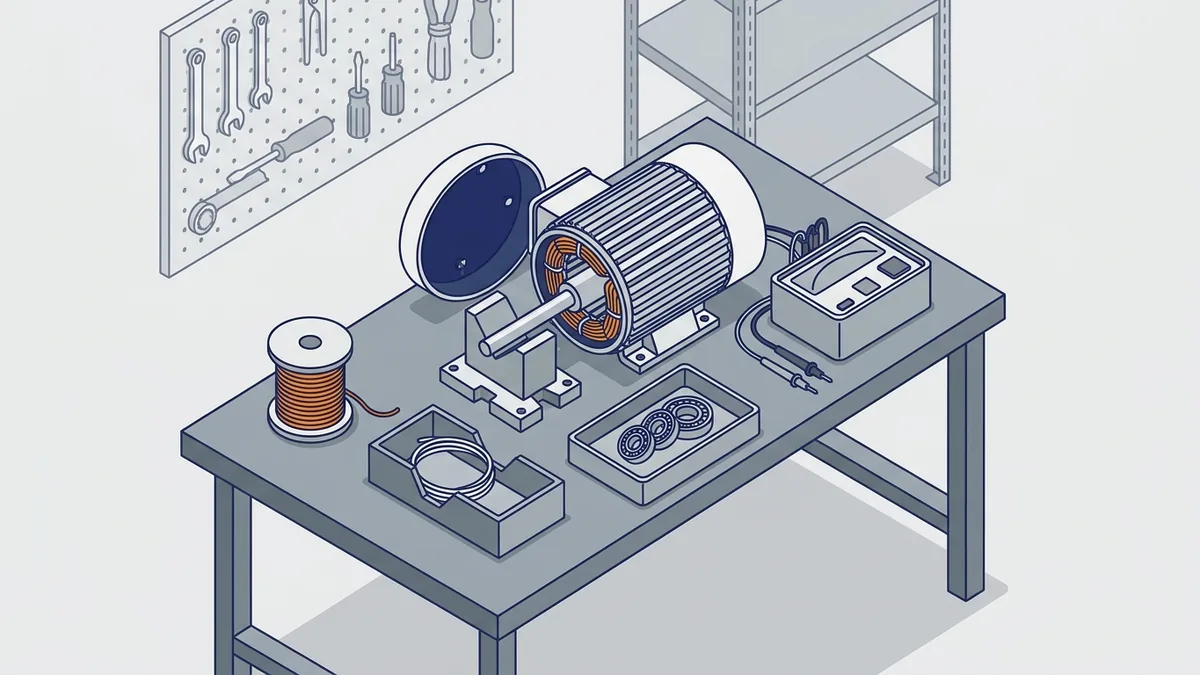
Electric motor repair gets a failed motor back to reliable work, but the result depends on the shop and the steps it follows. This guide shows you what a good repair includes, how to check a shop, and how to decide between repair and replacement. It also gives honest cost and turnaround ranges, so you can defend your decision.
On this page
- What Electric Motor Repair Includes
- Who Rebuilds Electric Motors?
- How to Find an Electric Motor Repair Shop Near You and Vet It
- Why Motors Fail and Signs a Motor Needs Repair
- How a Motor Is Repaired, Step by Step
- What is the ANSI/EASA AR100 standard and where do I get it?
- Step 1: Incoming inspection, records and testing
- What insulation-resistance readings pass, and what test voltage should I use?
- Step 2: Teardown and failure analysis
- Step 3: Winding removal and core checks
- What core-loss change is acceptable after burnout?
- Step 4: Rewind, insulation and varnish
- Step 5: Mechanical repair, bearings and balance
- Step 6: Final testing and paperwork
- Does Rewinding an Electric Motor Reduce Efficiency?
- Repair or Replace: How to Decide
- How Much Does Electric Motor Repair Cost and How Long Does It Take?
- What to Do While Your Motor Is Out
- What to Do When the Repaired Motor Comes Back
- Common Mistakes That Cause Repeat Motor Failures
- When to Call a Repair Shop
- Frequently asked questions
What Electric Motor Repair Includes
What is electric motor repair?
Electric motor repair restores a failed or failing motor to working, reliable condition. The job can be small, such as a bearing swap. It can also be large, such as a full stator rewind plus machining and balancing.
The recommended practice for this work is ANSI/EASA AR100. It covers record keeping, tests, analysis and general repair guidelines for induction, synchronous and DC machines. It does not replace the instructions from you or the motor maker.
Repair, rewinding, rebuild and refurbishment: what is the difference?
The terms overlap, and shops use them in slightly different ways. In general, a rewind replaces the winding. A motor rebuild or electric motor overhaul goes further and also covers bearings, shaft, housing and balance work.
Electric motor refurbishment usually means cleaning, testing, new bearings and mechanical checks, sometimes with a rewind. Because scope varies, always ask for the work in writing on the quote.
Are “electic motor repair” and “motor repairing” the same service?
Yes, for search and buying purposes they point to the same service. “Electic motor repair” is a common misspelling, and “electric motor repairing” and “motor repairing” are wordier ways to say it. Whatever name you use, check what the quote actually covers.
What about special machines?
Some motors need more than the general process. AR100 says hazardous-location, hermetic, submersible, traction and similar machines need additional requirements. Tell the shop up front if your motor is one of these.
For details on specific work, see our separate posts on AC stator winding repair, DC motor repair and bearing housing repair. We do not repeat them here.
Who Rebuilds Electric Motors?
Motor service centers and rewind shops rebuild electric motors. Some manufacturers run service channels, and some industrial distributors, including Precision Electric, have repair shops. Precision Electric rebuilds industrial AC and DC motors.
The key is the standard the shop follows. Look for a shop that does industrial motor repair to ANSI/EASA AR100. EASA also runs an accreditation program for shops that have proven they repair in accordance with AR100.
How to Find an Electric Motor Repair Shop Near You and Vet It
Who rebuilds electric motors near me?
Start with EASA’s accredited service center list at easa.com/find. Filter it by state or city. Then call two or three shops and compare answers.
What does EASA accreditation mean and how do I verify it?
Accreditation means a shop has proven it repairs motors in accordance with AR100. EASA re-approves accredited shops through a third-party audit. The list page also links to the accreditation checklist.
Check the shop’s listing in the directory instead of trusting a logo on its website. Then ask whether it repairs to AR100-2025, the current version. If a shop says it follows AR100 but is not listed, ask which core-loss tester it uses. Also ask whether it will attach before and after watts-loss numbers to the job traveler (the paperwork that follows your motor through the shop). That tip comes from a directory site, not from an EASA rule.
What should I ask a motor repair shop before sending my motor?
- Which version of AR100 do you repair to?
- Can you show before and after core-loss results?
- What records come back with the motor, such as as-received test data, final test data and a balance record?
- Is there a warranty, and what does it cover?
- Can you handle my motor’s size, voltage, DC armature or hazardous-location rating?
- Do you have crane capacity, and do you offer pickup and delivery?
- Do you have a loaner or rental motor while mine is out?
Only count what the shop confirms in writing.
What information does a shop need to quote my motor?
Have the nameplate data ready. You need the manufacturer, model, hp, voltage, full-load amps, rpm, frame size, NEMA design letter, service factor, enclosure type and insulation class. Frame size also tells you whether a replacement will bolt in.
Next, describe the symptoms and history. Say whether it tripped, threw a ground fault, ran hot or made noise. Note whether a VFD feeds it, what the load is, and any megohm or vibration readings from before removal. Finally, send photos of the nameplate, the motor as removed, and any hazardous-area marking.
What should a repair warranty cover, and what should the written quote spell out?
Warranty length and coverage vary by shop, so we do not give a typical term. Ask for the terms in writing and compare them between shops. A clear quote should state:
- The warranty length, when it starts, and whether it covers workmanship, parts, labor or all three
- What voids it, such as VFD operation, misapplication or poor installation
- Who pays for freight, removal and reinstallation if a warranty claim comes up
- The scope of work, the AR100 version, and the tests and reports that come back with the motor
- Whether the price is fixed or itemized, and how the shop will get your approval for extra work it finds
- The standard and rush turnaround times
Why Motors Fail and Signs a Motor Needs Repair
Why do electric motors fail?
Fluke says winding insulation breakdown and bearing wear are the two most common causes of motor failure. Once a bearing starts to fail, the damage cascades and speeds up motor failure. Published shares vary by study. Bearings appear at 13 percent on Fluke’s US page, 41 percent in a 1985 EPRI study of three-phase induction motors, and about 40 to 50 percent in shop-cited surveys. Because the sources differ, treat any single number with care.
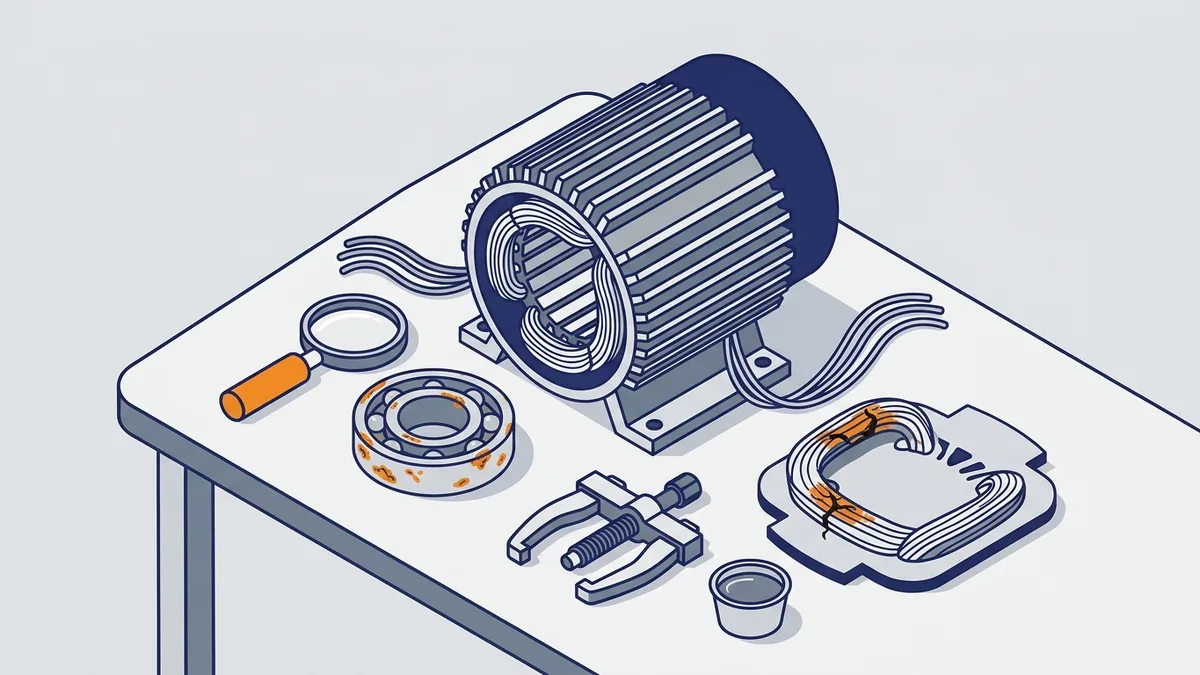
Winding threats include these:
- Transient voltages, such as adjacent loads switching or power factor correction capacitor banks
- Voltage imbalance and harmonic distortion
- Overload and heat
- Moisture and contamination
- VFD effects
Bearing threats include inadequate lubrication, soft foot (a motor foot that does not sit flat, often from pipe strain), misalignment, imbalance and looseness. VFDs can also add bearing currents from common-mode voltage.
How do I know if my motor needs repair?
Watch for heat, rising vibration, bearing noise, tripping and low insulation resistance. First, lock out the motor. Then measure insulation resistance from each phase to ground to rule out a winding fault.
Root cause matters here. If a repaired motor goes back into the same misalignment, overloaded drive or unmitigated VFD, it will fail again.
How a Motor Is Repaired, Step by Step
What is the ANSI/EASA AR100 standard and where do I get it?
AR100 is the American National Standard for repair of rotating electrical apparatus. ANSI first approved it in 1998. It has been revised in 2001, 2006, 2010, 2015, 2020 and 2025, and ANSI approved AR100-2025 on November 20, 2025.
You can download AR100-2025 at no cost from EASA’s Electromechanical Resource Center at easa.com/erc. EASA’s president says end users should make sure their service centers repair in accordance with it. Note that AR100 is a repair document, not an installation guide.
Step 1: Incoming inspection, records and testing
The shop records the nameplate data and as-received condition, and photographs the motor. Next it runs electrical tests before teardown. These can include insulation resistance to ground, winding resistance and surge tests, depending on what the shop performs. Vibration data helps if you have it.
AR100 includes recommended minimum insulation resistance values at 40 °C. In AR100-2020 this is Table 4-2, so check the numbering in the 2025 edition.
What insulation-resistance readings pass, and what test voltage should I use?
Pick the test voltage from the winding’s rated voltage. IEEE 43 guidance, which AR100 follows closely, uses these DC test voltages:
| Winding rated voltage | DC test voltage |
|---|---|
| Below 1,000 V | 500 V |
| 1,000 to 2,500 V | 500 to 1,000 V |
| 2,501 to 5,000 V | 1,000 to 2,500 V |
| 5,001 to 12,000 V | 2,500 to 5,000 V |
Apply the voltage for one minute, then read the result. Correct the reading to 40 °C, because resistance roughly halves for every 10 °C rise in winding temperature. The common IEEE 43 minimums at 40 °C are 5 megohms for random-wound windings and for form-wound machines rated 1 kV or less. Newer form-wound machines above 1 kV need 100 megohms. Older windings use “rated kV plus 1 megohm.”
A reading below the minimum is a fail, so dry or clean the winding and retest, or send the motor out. A steady downward trend across readings matters as much as one number. Always confirm the exact values in the AR100 table your shop uses.
Step 2: Teardown and failure analysis
Next, the shop inspects the windings and the rotor squirrel cage. Cracked rotor bars matter because the rotor is an electrical part, not just a spinning mass. The shop should also find the root cause, such as overload, contamination, moisture, a voltage problem or bearing currents. A written root cause lets you fix the problem before the motor returns.
Step 3: Winding removal and core checks
The old winding must come out without harming the stator core. In the 2003 EASA/AEMT study, controlled burnout at 680 to 700 °F (360 to 370 °C) caused no significant efficiency change in the 7.5 hp motors tested. Ask your shop for its actual oven setpoint. I did not find an AR100 temperature limit, so do not quote one.
Core-loss testing before and after stripping shows whether the core took damage. The study found its biggest changes in core loss and stray load loss.
What core-loss change is acceptable after burnout?
We do not quote a pass or fail percentage here, because we cannot confirm the exact AR100 limit. The method is simple, though. The shop tests the core at a set flux level with a core-loss tester or a loop test, and records watts loss before and after stripping. A rise in loss after burnout points to core damage, such as shorted laminations.
So ask your shop for its acceptance limit in writing, and check it against the AR100 text. Also ask for both readings on the job paperwork.
Step 4: Rewind, insulation and varnish
AR100 says a new winding should have the same electrical characteristics as the original. If a shop changes the design on purpose, it should tell you. Ask the shop to describe its insulation system and varnish method, since these vary from shop to shop.
Step 5: Mechanical repair, bearings and balance
Then comes the mechanical work. This covers shaft, housing and bearing seat repair, new bearings, and rotor balance. Ask for the fits, balance grade and bearing brand that the shop actually uses. Our bearing housing repair post covers this work in more depth.
Step 6: Final testing and paperwork
Finally, the shop runs a final electrical test and a run test with current and vibration readings. It should tell you which reports come back with the motor. On receipt, check the nameplate and rotation, confirm the shaft turns freely, and make sure the paperwork matches the motor.
So, what tests are done before and after repair? Expect insulation and winding checks and core-loss results at the start, then electrical and run tests with vibration at the end.
Does Rewinding an Electric Motor Reduce Efficiency?
Not when the work follows best practice. Two studies back this up, and the results apply to rewinds done to good practice, not to every rewind.
- 2003 EASA/AEMT study: It used 23 large motors, 50 to 300 hp. A summary says best practice kept efficiency within ±0.2 percent, and multiple rewinds had no cumulative effect.
- 2019 EASA/AEMT study: It tested 10 new low-voltage premium-efficiency/IE3 motors, 40 to 100 hp. Each was tested at full load, rewound by an EASA accredited service center to AR100-2015, and retested. The results showed no significant efficiency change.
Both studies used third-party testing laboratories. EASA’s guidelines name the variables that can raise losses: core burnout temperature, winding design, bearing type, air gap and winding resistance. This matters because motors use as much as two-thirds of the electricity generated in industrialized nations, according to EASA’s president.
Repair or Replace: How to Decide
Should I repair or replace my electric motor?
It depends on cost, size, run hours and downtime. A common rule says rewind when the repair costs less than about 50 to 75 percent of a new motor. A government-hosted study notes that rewinding gets more economical as size grows, because new motor prices rise much faster with horsepower than rewind cost.
A simple payback formula helps:
(new motor cost + extra installation cost − repair cost − utility rebate) ÷ annual energy and demand savings
If the payback is short, replace with a premium-efficiency motor. This often fits an older pre-EPAct motor with high run hours.
What does a worked repair-versus-replace example look like?
The numbers below are assumptions for illustration, not quotes. Swap in your own values. The motor is 100 hp, runs at 80 percent load for 6,000 hours a year, and power costs $0.10 per kWh. The old motor is 93.0 percent efficient, and a new premium motor is 95.4 percent.
- Output power: 100 hp × 0.746 × 0.80 = 59.7 kW.
- Input power, old motor: 59.7 ÷ 0.930 = 64.2 kW.
- Input power, new motor: 59.7 ÷ 0.954 = 62.6 kW.
- Savings: about 1.6 kW × 6,000 hours = about 9,700 kWh a year.
- Dollar savings: 9,700 kWh × $0.10 = about $970 a year.
Now say the new motor, installation and any extra cost, minus the repair cost and rebate, comes to $2,500 more than repairing. Then payback is $2,500 ÷ $970, or about 2.6 years. If your plant needs payback within two years, repair. If it accepts three, replace.
Keep in mind that a good rewind keeps the original efficiency, so the savings come from the new motor’s higher rating. Demand savings can add a little more.
At what horsepower is repair no longer worth it?
There is no universal cutoff. The break-even point depends on your electric rate, run hours, payback requirement, load and supplier discount. Plant rules of thumb say small general-purpose motors, about 15 to 25 hp and under, are often cheaper to replace. One source reports a DOE sourcebook figure of 15 hp, but confirm that in the primary document before you quote it.
| Factor | Leans toward repair | Leans toward replace |
|---|---|---|
| Size | Large motors | Small general-purpose motors |
| Cost | Repair under about 50 to 75 percent of new | Repair near or above that share |
| Design | Special, obsolete or OEM-discontinued | Standard, easy to buy |
| Lead time | Long; one directory cites 12 to 20 weeks above 250 hp | Short |
| Run hours and efficiency | Low run hours | High run hours, older design |
| Downtime | Cost per hour is modest | Cost per hour tops twice the price of a new motor |
In that last case, Advanced Energy advice is to replace at the next scheduled outage and keep a dedicated spare.
How Much Does Electric Motor Repair Cost and How Long Does It Take?
How much does electric motor repair cost?
There is no single price. Horsepower, voltage, damage to the core, rotor or shaft, parts, rush service and freight all change the number. The figures below come from one third-party directory for 2025 to 2026. They are industry indications, not Precision Electric prices.
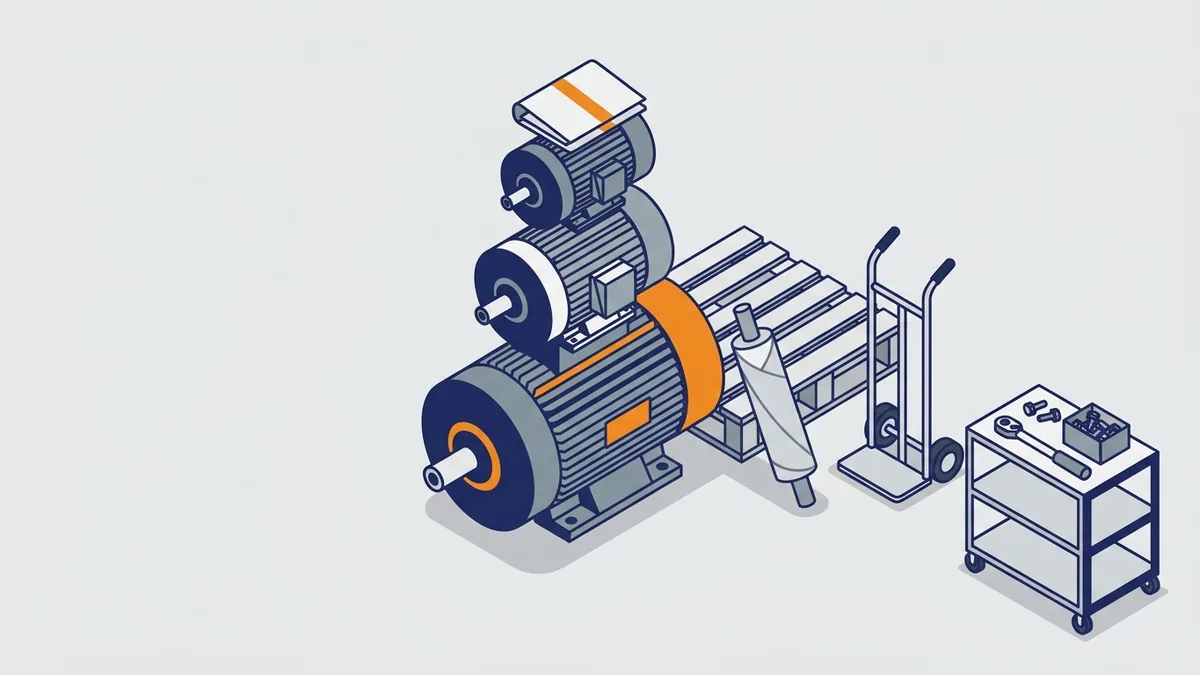
- Rewinding a 1 to 10 hp motor fully: about $400 to $900
- A 10 to 50 hp full rewind: about $1,200 to $3,500
- For a full rewind at 50 to 200 hp: about $3,000 to $9,000
- Bearing replacement, fractional to 25 hp: about $150 to $600
- Freight or pickup: about $150 to $600
A distributor also says a quality rewind from an EASA-accredited shop often runs 30 to 60 percent of replacement cost above 75 hp. Core damage that needs restacking can add to the bill.
How long does motor repair take, and can it be expedited?
The same directory gives about 5 to 10 business days for standard repair. It lists emergency work within 24 to 72 hours at a 25 to 50 percent premium. Treat this as a general guide, not a promise from any shop.
To compare shops fairly, ask for an itemized quote, a stated scope and the core-loss results. Then ask for that shop’s own standard and rush turnaround.
What about motors above 200 hp, medium-voltage motors and DC motors?
We have no reliable price or time ranges for these, so we do not give any. Cost and lead time swing widely with size, voltage, winding type, commutator or armature work and parts. The one data point we have is a directory’s 12 to 20 weeks above 250 hp.
For these motors, send the nameplate data and symptoms and ask for a written quote with an estimated time. Ask early about a loaner or rental, since lead times are long.
What to Do While Your Motor Is Out
Can I rent or borrow a motor during the outage?
Ask the shop about a loaner or rental motor when you send yours in. Availability depends on size, voltage and frame, so ask before you commit. Also check whether a stocked replacement is a faster fit than waiting.
What interim fixes are safe?
- Fit a spare motor of the same frame, speed and rating if you have one.
- Borrow a matching motor from a less critical service, then restore it later.
- Do not restart a tripped motor again and again, and do not run one with low insulation resistance.
- Keep the original mounting hardware, coupling half and nameplate photos so the swap goes smoothly.
- Use the downtime to fix the root cause, such as alignment, base or drive settings.
Also check that any temporary motor has the right voltage, enclosure and overload settings before you start it.
What to Do When the Repaired Motor Comes Back
What installation checks come first?
First, compare the nameplate and paperwork with your order. Then turn the shaft by hand to confirm it spins freely. Next, test insulation resistance before you connect power, and compare it with the shop’s final test data.
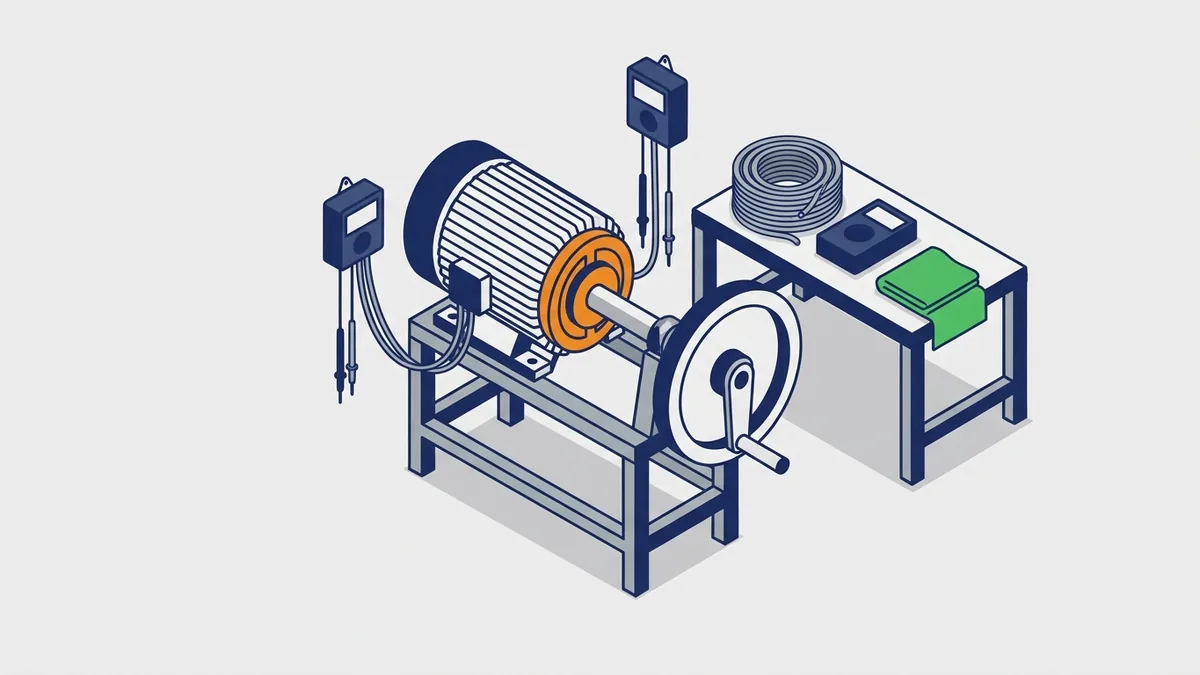
Set the motor on a clean, flat base and check for soft foot. A commonly cited limit is about 0.002 inch (0.05 mm) of foot movement when you loosen each bolt. Fix it with shims before you align.
What alignment tolerances apply?
Tolerances depend on speed and coupling type, so use the coupling maker’s or your plant’s alignment limits. Faster motors need tighter alignment. Use a laser or dial indicator, check both offset and angle, and recheck after the motor warms up if the load is hot.
What should I check at first start?
- Confirm the overload and protection settings match the nameplate.
- Lubricate the bearings as the shop and maker direct.
- Run the motor uncoupled, if you can, and confirm the rotation.
- Check for odd noise, heat and vibration over the first minutes.
- Couple the load and check running amps against the nameplate on all three phases.
- Watch bearing temperature as it settles over the first hours.
Allow the motor to cool between repeated start attempts.
How do I take baseline vibration readings?
Once the motor runs at normal load and temperature, record vibration at each bearing in the horizontal, vertical and axial directions. Write down the speed and load, and the units you used. Compare your readings with the shop’s run-test numbers. Then repeat the same points at set intervals, so a rising trend warns you early.
Common Mistakes That Cause Repeat Motor Failures
What mistakes cause a repaired motor to fail again?
- Returning the motor to service without fixing the cause, such as misalignment, soft foot, overload, poor lubrication or contamination
- Choosing a shop on price alone, with no accreditation or test records
- Burning out windings without temperature control, or skipping core-loss tests
- Skipping a pre-repair vibration or motor circuit test, then guessing at repair versus replace
Any one of these can turn a good rewind into a repeat outage.
Does a VFD affect motor repair and motor life?
Yes. VFDs can add stress such as harmonics, reflected-wave voltage and bearing currents from common-mode voltage. These can damage windings and bearings. So tell the shop if the motor runs on a drive, and fix the cause on the drive side. Our drive repair post covers that side.
What extra repair steps does a VFD-fed or inverter-duty motor need?
Start with the winding. Ask the shop for an insulation system suited to drive duty, such as inverter-rated magnet wire and added phase and ground insulation. NEMA MG 1 Part 31 sets voltage-spike limits for inverter-duty motors, so ask what the rewind is built to meet.
Then address bearing currents. Options include these:
- An insulated bearing or insulated bearing housing at the non-drive end
- A shaft grounding ring or brush at the drive end
- An insulated coupling, where the driven machine needs protection
- Proper cable and grounding practice on the drive side, plus output filters where the cable run is long
Which mix fits depends on frame size and drive setup, so give the shop your drive details and ask it to put the choices on the quote.
When to Call a Repair Shop
Call when insulation resistance to ground is low or falling, or when a ground fault trips the motor. Call too when vibration and bearing noise rise, or when the motor runs hot after you rule out the basics. A critical motor with no spare is another reason.
Better still, plan ahead. Schedule rewinds, bearing work and spares before an outage forces your hand. Then send your nameplate details and symptoms, and ask which evaluation, pickup and warranty terms apply.
Frequently asked questions
Who rebuilds electric motors?
Motor service centers and rewind shops rebuild electric motors. Look for one that repairs to ANSI/EASA AR100 and appears on EASA’s accredited service center list. Precision Electric rebuilds industrial AC and DC motors.
Who rebuilds electric motors near me?
Use the EASA accredited service center list at easa.com/find and filter by state or city. Check the shop’s listing rather than a website logo. Ask whether it repairs to AR100-2025 and request before and after core-loss results, with your nameplate data ready.
Does rewinding an electric motor reduce its efficiency?
Not when it is done to best practice. The 2019 EASA/AEMT study rewound 10 premium-efficiency/IE3 motors (40 to 100 hp) to AR100-2015 at an EASA accredited service center. It found no significant efficiency change, as the 2003 study of larger motors did.
Is it better to repair or replace an electric motor?
It depends on cost, size, run hours and downtime. A common rule is to rewind if repair costs less than about 50 to 75 percent of a new motor. Small motors are often cheaper to replace, while large, special or obsolete motors usually favor repair.
How much does electric motor repair cost and how long does it take?
One directory gives about $1,200 to $3,500 for a 10 to 50 hp rewind and $3,000 to $9,000 for 50 to 200 hp. Standard turnaround is about 5 to 10 business days. Treat these as indications and get an itemized quote from the shop.
Good electric motor repair comes down to a shop that follows AR100, tests before and after, and finds the root cause. With that, and a clear repair-or-replace calculation, you can decide quickly and defend it. If you have a failed motor or want a quote, contact Precision Electric and we will help you work out the next step.






Trackbacks & Pingbacks
[…] Electric Motor Repair: Commercial & Industrial Guide […]
[…] Electric Motor Repair: Commercial & Industrial Guide […]
Comments are closed.