









Precision Electric Pro-Phase Rotary Phase Converters Guide
Estimated reading time: 11 minutes
What Are Precision Electric Pro-phase Rotary Phase Converters?
For facilities with only Single-Phase Power, operating equipment that requires Three-Phase Power presents a significant challenge. Precision Electric Pro-Phase rotary phase converters are specifically engineered to solve this problem effectively. According to Rotary Phase Converter, a rotary phase converter is a device that generates three-phase electrical power from a single-phase source. In other words, these heavy-duty phase converters allow workshops, farms, and industrial sites to run demanding machinery without the high cost of a new utility Three-Phase Power installation. The Pro-Phase series provides a reliable and robust single-phase to 3-phase solution for nearly any application.
At the core of a Pro-Phase converter is a specialized idler motor that functions as a generator to create the third power line. This process, as detailed by en.wikipedia.org, is precisely managed by an integrated control panel that uses capacitors to initiate the process and maintain Voltage Balancing across the three output lines. Consequently, this ensures the generated power is stable and safe for sensitive equipment like CNC machines. The system is designed to furnish its full rated power, so technicians do not need to worry about machinery losing performance, as confirmed by northamericaphaseconverters.com.
The primary advantage of using a 3-phase power converter is often financial and logistical, especially when compared to utility power. For instance, installing a new utility three-phase service can be prohibitively expensive and time-consuming. A Pro-Phase rotary converter, on the other hand, represents a much smaller and more immediate capital investment. Furthermore, as Rotary Phase Converters vs. Utility Power notes, a single heavy-duty phase converter can efficiently operate multiple motor loads simultaneously. This makes it a scalable and practical power source for an entire workshop without compromising reliability.
Core Principles: How Rotary Converters Generate Balanced 3-phase Power
At its core, a rotary phase converter is an electromechanical device designed to transform standard Single-Phase Power into the Three-Phase Power required by heavy-duty industrial machinery. This conversion is fundamental for facilities that lack access to utility three-phase service. According to Rotary Phase Converter, the system uses a three-phase motor/generator, often called an idler, paired with a control panel containing capacitors. In essence, the converter takes two lines of single-phase input (L1 and L2) and generates a third, manufactured line (L3) to create a complete three-phase output.
The operational principle begins when Single-Phase Power is applied to start the idler motor, a process often assisted by start capacitors as detailed by Rotary Phase Converter FAQ. Once the idler reaches its operational speed, it continues to run on the single-phase input. Consequently, due to its rotational inertia and magnetic field, the idler motor begins to function as a generator on its third, unpowered winding. This action produces a new voltage leg that is approximately 120 degrees out of phase with the original two lines, thereby completing the three-phase power circuit required by the load equipment.
Precision Electric Pro-Phase rotary phase converters are the ideal solution for converting single-phase power to three-phase, enabling heavy machinery to run in workshops without access to a utility 3-phase service.
Achieving a stable and balanced voltage across all three phases is the most critical function of a high-quality industrial power converter, because unbalanced voltage can lead to motor overheating and premature failure. Therefore, precision electric pro-phase rotary phase converters utilize carefully selected run capacitors and advanced features like the Pro-Line’s CNC Voltage Balancing to maintain phase-to-phase voltages within a tight tolerance. According to North American Phase Converters, such features provide the most balanced voltage range available. Ultimately, this precision ensures that demanding equipment receives clean power and can furnish its full rated output without compromise.
Sizing Your Converter: a Step-by-step Rotary Converter Sizing Guide
Correctly implementing a rotary converter sizing guide is the most critical step in ensuring your equipment receives stable and reliable Three-Phase Power. An undersized converter will struggle to start motors and may trip breakers, while a grossly oversized unit leads to unnecessary energy consumption and higher setup costs. Therefore, the selection process must be deliberate, accounting for the total horsepower of all motors you intend to run simultaneously. According to American Rotary, proper sizing ensures the system performs at its highest efficiency. This initial calculation is fundamental to the long-term performance of your single-phase to 3-phase power solution.
Precision Rotary Converter Sizing By Electrical Load
The primary factor in sizing a heavy-duty phase converter is the nature of the electrical load. Generally, loads are categorized as easy, medium, or hard-starting. Easy loads include machines like drill presses and fans, while medium loads might include equipment such as lathes and mills. In contrast, hard-starting loads like air compressors, hydraulic pumps, and large flywheels demand significantly more power upon startup. For instance, as detailed in documentation from Precision-Elec, a hard motor load may require you to double the size of the rotary phase converter relative to the motor’s horsepower rating. Understanding your machinery’s load type is non-negotiable for accurate sizing.
As a rule of thumb, you should size your converter to be at least twice the horsepower of your largest or most demanding motor. If you plan to run multiple machines at once, a practice discussed by Phoenixphaseconverters, you must add the total horsepower of all motors that will run concurrently and then apply this sizing factor. For resistive loads like heaters, the converter’s kilowatt (kW) rating should match the load’s requirement. Ultimately, all installations must comply with the National Electrical Code (NEC), which provides guidelines for conductor sizing and overcurrent protection to ensure a safe and reliable system.
Evaluating Pro-phase Models: Key Features and Technical Specifications
When conducting Pro-Phase converter reviews, it becomes clear that these units are engineered for reliability and performance in demanding settings. A key differentiator is the industrial-grade control panel, which, according to Precision Electric, includes integrated magnetic motor starters and power-on indicator lights for straightforward operation and diagnostics. Consequently, this robust construction ensures that each heavy-duty phase converter can withstand the rigors of industrial use, providing a dependable power solution where utility three-phase is unavailable. These features collectively contribute to a system that is both powerful and user-friendly for technicians.
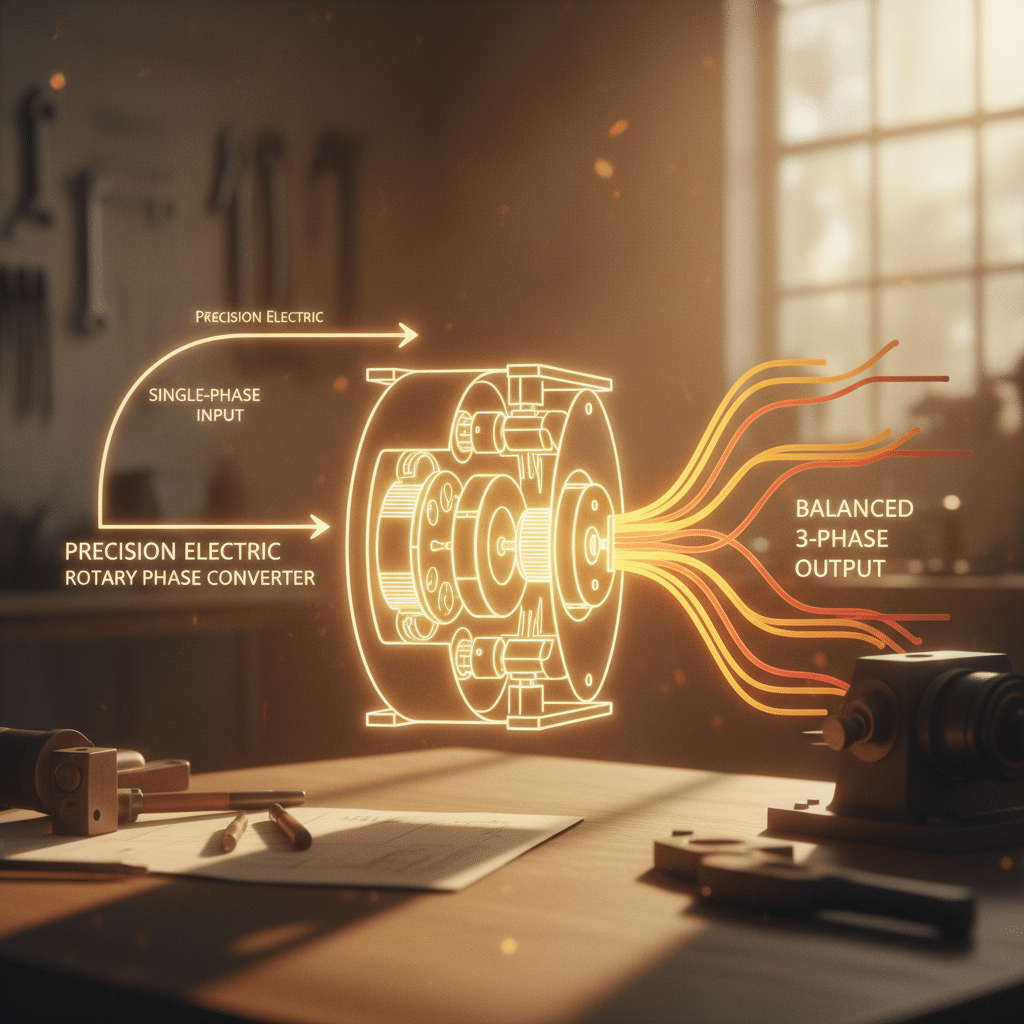
This diagram illustrates the core principle of a rotary phase converter, transforming a single-phase input into a perfectly balanced, reliable three-phase output suitable for heavy-duty machinery.
Delving deeper into the technical specifications, the idler generator motor is a core component built for longevity and efficiency. For instance, Precision Electric incorporates a Soft Start Idler Generator to minimize high inrush currents during startup, which protects both the converter and other connected equipment. Furthermore, for applications involving sensitive electronics, such as CNC machinery, precise voltage regulation is paramount. The Pro-Phase series excels with its CNC Voltage Balancing, a feature highlighted by Pro-Line Rotary Phase Converters as essential for achieving the tightest voltage balance on the market. This ensures equipment runs smoothly and without risk of damage from power irregularities.
The physical design of each rotary phase converter also reflects a commitment to durability. Most models utilize a Totally Enclosed Fan Cooled (TEFC) idler motor, a design standard that Rotary Phase Converter FAQ confirms is ideal for dusty, damp, or dirty environments. In other words, these enclosures protect sensitive internal components from contaminants, significantly extending the unit’s operational lifespan. Adherence to NEMA ratings and the use of high-quality, often USA-made, components further solidify the Pro-Phase line as a premier choice for industrial power conversion needs, backed by substantial warranties for peace of mind.
Installation and Safety: Wiring Your Single-phase to 3-phase Converter
Properly installing your single-phase to 3-phase converter is paramount for both safety and optimal performance. Before beginning any wiring, it is crucial to de-energize and lock out the single-phase power source feeding the unit. All installation practices must strictly adhere to the latest edition of the National Electrical Code (NEC) and any local regulations. For instance, correctly sizing the input circuit breaker and wiring is the first step to protecting the equipment and ensuring a reliable power source. A qualified electrician should always perform or, at the very least, review the installation plan to mitigate risks associated with high-voltage equipment.
Wiring Your Precision Electric Rotary Phase Converter
The wiring process involves connecting the single-phase input and the three-phase output. First, connect the two hot wires (L1, L2) and the ground from your single-phase supply to the corresponding terminals on the rotary phase converter’s control panel. It is essential to select the appropriate wire gauge based on the converter’s full-load ampere rating to prevent overheating. Next, connect the three output lines (T1, T2, T3) from the converter to your three-phase equipment. According to NEC Article 455, conductor sizing must be carefully calculated, especially when a converter supplies specific fixed loads. Always ensure all connections are tight and secure before restoring power.
Beyond the basic connections, grounding is a critical safety component. The converter’s chassis and the idler motor frame must be connected to an earth ground to prevent electrical shock hazards. As explained by Rotary Phase Converter, a rotary phase converter is an electromechanical device, making proper grounding essential. Furthermore, ensure the unit is installed in a dry, well-ventilated area to allow for adequate cooling, preventing thermal overload. The setup costs, as noted by Rotary Phase Converters vs. Utility Power, can be significant, so protecting your investment with a correct and safe installation is a logical priority. Finally, double-check all wiring against the manufacturer’s diagram before initial startup.
Real-world Applications: Where to Use a Heavy-duty Phase Converter

Use this step-by-step rotary converter sizing guide to match your equipment’s horsepower requirements with the right single-phase to 3-phase power converter, ensuring optimal performance and safety.
A heavy-duty phase converter is essential in any scenario where Three-Phase Power is required but only Single-Phase Power is available from the utility. For instance, this situation is common in residential workshops, rural farms, and small commercial facilities where the cost of installing a dedicated three-phase service is prohibitive. According to Rotary Phase Converters vs. Utility Power, the setup costs for utility three-phase can be substantial, making an industrial power converter a financially sound alternative. Consequently, these devices bridge a critical power gap for countless operations, enabling the use of powerful, efficient three-phase machinery without expensive infrastructure upgrades.
Pro-phase Rotary Converter Applications
The versatility of a rotary phase converter extends across numerous industries. In woodworking and metalworking shops, for example, they power large equipment such as CNC machines, lathes, mills, and industrial table saws that cannot run on single-phase electricity. Similarly, agricultural operations rely on these converters for grain dryers, irrigation pumps, and automated feeding systems. The key is that a properly sized converter provides stable and reliable power, ensuring that machines operate at their full rated capacity without performance loss, a fact confirmed by Rotary Phase Converter FAQ. This makes them a practical backbone for powering critical, high-demand equipment.
Beyond the workshop and farm, other commercial applications frequently benefit from a single-phase to 3-phase converter. For instance, food service businesses with commercial-grade mixers and ovens, automotive shops with vehicle lifts, and printing companies with large presses all depend on consistent Three-Phase Power. A Rotary Phase Converter article defines a rotary phase converter as a device that uses an induction generator motor to create a third AC phase, highlighting its role as a power solution. Therefore, whether for a primary production line or a single piece of critical equipment, these converters provide an accessible and dependable method for powering industrial machinery in almost any location. In other words, they are an alternative that avoids increased costs from utility upgrades, as noted by Rotary Phase Converter.
Maintenance and Troubleshooting Common Rotary Phase Converter Issues
Precision Electric Pro-Phase rotary phase converters are engineered for longevity and minimal upkeep, representing a significant advantage for workshops relying on Three-Phase Power. A key reason for their reliability is the use of high-quality components, such as sealed bearings that eliminate the need for regular greasing. According to Precision Electric, this design feature significantly reduces routine maintenance tasks. Consequently, most maintenance is preventative, focusing on keeping the unit clean and ensuring its environment is free from excessive dust or moisture that could impede performance over time. This robust construction ensures that the industrial power converter remains a dependable asset.
Troubleshooting Common Pro-phase Converter Issues
However, in the rare event of an issue, a systematic approach to troubleshooting is essential. For instance, if the rotary phase converter fails to start, the first step should be to verify the Single-Phase Power input voltage and check all fuses or circuit breakers. As explained by northamericaphaseconverters.com, the starting mechanism relies on capacitors, which should be inspected by a qualified technician if the unit hums but doesn’t rotate. Another common issue involves voltage imbalance between the three output lines; this requires measuring the voltage on each leg under load to diagnose whether the issue lies with the converter or the connected machinery. Always perform such diagnostic work with the power disconnected, following proper lockout/tagout procedures.
Effective preventive maintenance primarily involves environmental control and periodic inspections. In other words, ensuring the converter has adequate ventilation is critical for dissipating heat and preventing an overload condition. Many heavy-duty phase converters utilize a “totally enclosed fan cooled” (TEFC) motor, which, as noted by Rotary Phase Converter FAQ, is designed to keep contaminants out while managing temperature. Regularly check that the fan is operational and that the cooling fins are free of debris. Additionally, it is good practice to periodically inspect all electrical connections for tightness, as vibrations can cause them to loosen over time. Adhering to installation guidelines outlined by sources like TheNECwiki ensures that the unit operates safely and efficiently from the start.
Conclusion: Powering Your Operations with the Right Converter
Selecting the right rotary phase converter is a foundational decision for any facility that requires reliable Three-Phase Power from a Single-Phase Power source. Throughout this guide, we have explored how precision electric pro-phase rotary phase converters stand out as a premier solution for bridging this common power gap. As explained by sources like Rotary Phase Converter, these devices are essential for generating a third AC phase, and the Pro-Phase series executes this function with exceptional reliability and precision for demanding industrial and commercial machinery. Ultimately, investing in a high-quality converter ensures your equipment operates at peak performance without interruption.
In conclusion, the key to a successful implementation lies in meticulous planning and adherence to established standards. This includes accurately sizing the unit using a detailed rotary converter sizing guide, ensuring precise voltage balancing for sensitive loads, and following all National Electrical Code (NEC) requirements for installation. When properly sized, a quality converter will furnish full rated power to your machinery, a concern addressed by Rotary Phase Converter FAQ. Consequently, by prioritizing correct specifications and safe wiring practices as outlined by resources such as The NEC Wiki, you establish a safe and efficient power system. This careful approach provides a robust alternative to potentially high utility setup costs, as noted by Rotary Phase Converters vs. Utility Power, making it a sound long-term investment for your operations.