ABB Motors Guide: NEMA, IEC Ranges and How to Choose
If you need to pick, replace or order ABB motors, the brand can look confusing at first. ABB sells its NEMA motors under the Baldor-Reliance name and its IEC motors under type codes such as M3BP. Below, you will learn the lines and ratings, how to pair them with ABB drives and starters, and what to check before you order.
On this page
- What ABB motors are and how the brand is organized
- Are ABB and Baldor the same? ABB Baldor motors explained
- ABB NEMA motors (Baldor-Reliance) by type
- ABB IEC low voltage motors by range
- Efficiency classes of ABB motors: IE2, IE3, IE4, IE5 and NEMA Premium
- Which ABB motor fits which application
- ABB drives and motors: pairing them
- How do ABB drives and motors work together?
- Inverter-duty versus standard motors
- What does inverter duty mean in practice?
- ABB drive families at a glance
- Which ABB drive suits a small 0.5 hp motor in a washdown area?
- Check the input phase, or pick a panel-mount ACS180
- Size the drive to motor full-load current
- ABB motor starters: manual motor starters, contactors and soft starters
- Connecting ABB motors: voltage, leads and brakes
- Buying ABB motors: cost, lead time, mistakes and repair
What ABB motors are and how the brand is organized
What are ABB motors?
ABB motors are electric motors that ABB builds for machines, pumps, fans and process plants. Overall, the range covers AC induction motors, synchronous reluctance motors, DC motors and EC motors. EC (electronically commutated) motors use onboard electronics in place of brushes. In addition, the ABB NEMA Motors page lists servo motors, which use feedback for precise speed and position control.
Most buyers, though, work with ABB low voltage motors on three-phase AC power. On ABB’s IEC line card, these ranges cover supplies from 220 V up to 690 V. So when someone at your plant says “ABB motors,” they usually mean a three-phase induction motor driving a pump, fan or conveyor.
What is the difference between NEMA and IEC ABB motors?
ABB builds motors to two dimension systems. First, NEMA motors follow the North American standard from the National Electrical Manufacturers Association. In addition, they use frame numbers such as 56C or 449T, power in horsepower, and most often 60 Hz supplies. Second, IEC motors follow the International Electrotechnical Commission system, with frames based on shaft height in millimeters and power in kilowatts.
On the NEMA side, ABB sells its motors as ABB and ABB Baldor-Reliance motors. Meanwhile, the IEC side is the ABB low voltage range, with types such as M2BAX, M3BP, M3AA, M3AL and M3BL. Because the two systems use different mounting dimensions, you cannot swap one for the other without changing the base or coupling. So find out which system your machine uses before anything else, and then stay in it.
How do NEMA frames map to IEC frames?
If you must convert a machine from one system to the other, start with shaft height. An IEC frame number is the shaft height in millimeters. For a NEMA T frame, the first two digits divided by four give the shaft height in inches. For example, 143T gives 3.5 in, which is about 89 mm, so the closest IEC frame is 90. The table shows the closest match by shaft height.
| NEMA frame | Shaft height | Closest IEC frame |
|---|---|---|
| 56C, 143T, 145T | 3.5 in | 90 |
| 182T, 184T | 4.5 in | 112 |
| 213T, 215T | 5.25 in | 132 |
| 254T, 256T | 6.25 in | 160 |
| 284T | 7 in | 180 |
| 324T | 8 in | 200 |
| 364T | 9 in | 225 |
| 404T | 10 in | 250 |
| 444T, 449T | 11 in | 280 |
However, a matching shaft height does not make a drop-in swap. Shaft diameter, foot hole spacing and face dimensions differ between the systems. Also, IEC frames 71 to 80 sit below NEMA 56, and IEC 315 and 355 go beyond 449T. So treat the table as a starting point, then compare the dimension drawings before you order.
How this guide fits with our other ABB posts
In short, this page is a hub for ABB motors and the gear that controls them. Also, it puts the whole picture of ABB industrial motors in one place and points you to deeper posts. For example, our soft starter posts, the ABB VFD Guide, ABB VFDs: Drive Classes, Type Codes, and ABB Multi-Motor Setup With ABB Micro Drives each cover one topic in depth. Also, our motor basics articles explain the theory when a section here stays brief.
Are ABB and Baldor the same? ABB Baldor motors explained
Yes, in effect. First, ABB bought Baldor Electric in 2011 for US$4.2 billion, including debt. Then, on March 1, 2018, ABB dissolved the Baldor name into the ABB brand. Because these history details come from Wikipedia, a secondary source, treat them as background.
However, the Baldor-Reliance name lives on as ABB’s NEMA motor brand. As a result, ABB Baldor motors are the same family you knew as Baldor and Reliance Electric. According to the same Wikipedia entry, the business sells ABB and Baldor-Reliance branded motors in IEC and NEMA builds, from fractional horsepower up to 100,000 hp.
What the merger means when you replace a motor
For buyers, the merger shows up on nameplates and quotes. In practice, old Baldor catalog numbers and Reliance part numbers still appear on motors in service, on spare-parts lists and in cross-references. So check the nameplate data and the catalog number, not only the brand cast into the frame. Also, expect a replacement to carry an ABB or ABB Baldor-Reliance label, which is normal for ABB motors today.
How do I match a replacement for an older Baldor or Reliance motor?
First, start with the nameplate on the old motor, because it holds the data you need. Also, write down the catalog number, any spec number, horsepower, speed, voltage, full-load amps, frame, enclosure and duty. Then add the service factor and the efficiency rating if they are printed there.
Next, compare the frame and shaft size, since they decide whether the new motor bolts onto your base and fits your coupling. After that, match the enclosure and duty, such as washdown, severe duty or brake. Finally, send us the nameplate data. As a result, we can check it against the ABB Baldor-Reliance catalog and cross-references before you buy.
How do I read a Baldor-Reliance number or an ABB type code?
On a Baldor-Reliance motor, the catalog number names a standard model. The spec number points to the exact build, including any changes from the standard design. So give us both numbers, because the catalog number alone may miss a special shaft or winding.
On an IEC motor, the type code describes the motor in plain parts. Take M3BP 160MLA 4 as an example:
- M3BP: the range, here process performance cast iron.
- 160: the frame size, which is the shaft height in millimeters.
- MLA: the housing length and variant letters, such as S, M or L for short, medium and long.
- 4: the number of poles, which sets the speed.
The article number, which starts with 3GBP for this range, is ABB’s product code for the exact motor. It also appears on the nameplate. Because the type code can match several builds, quote the article number when you need an exact replacement.
ABB NEMA motors (Baldor-Reliance) by type
This section covers the NEMA side of ABB motors. In general, ABB NEMA motors include single-phase and three-phase AC designs, from general purpose to severe duty. Across the portfolio, ABB lists motors that meet IEEE 841, API 661 and NEMA Premium standards. For context, IEEE 841 covers severe duty motors for petroleum and chemical plants, while API 661 sets rules for air-cooled heat exchangers and their fan motors.
What ABB Baldor-Reliance motor types are there?
ABB groups its NEMA AC motors by job, and its NEMA Motors page also lists DC, EC and servo motors. The main AC families are:
- General purpose: single- and three-phase motors for everyday machines, including the three-phase open line and the SP4 line.
- Severe duty: rugged motors for harsh process plants, including designs that meet IEEE 841.
- Washdown: motors for wet and food areas; distributor listings also show food-safe stainless steel versions.
- HVAC: motors for fans, blowers and air handling equipment.
- Marine: motors built for saltwater exposure.
- Farm and grain: motors for agricultural equipment.
- Unit handling: conveyor and material handling motors, with standard or brake options.
- Brake motors, clutches and brakes: motors with spring-set brakes for loads that must hold when stopped.
- Grinders, buffers and polishers: shop tools sold in the same portfolio.
- Definite purpose: automotive duty, U-frame, two-speed and ammonia refrigeration motors, in NEMA Premium and Super Premium options.
How ABB brake motors keep standard dimensions
In addition, brake motors come in general purpose, washdown duty and explosion-proof versions, in single- and three-phase designs. ABB mounts the spring-set brake opposite the drive end. As a result, the BA dimension (the distance from the shaft shoulder to the nearest mounting holes) stays standard. So the shaft end lines up with your base the same way a plain motor’s does.
What horsepower and frame sizes do ABB NEMA motors cover?
However, ratings depend on the family. This table shows what ABB publishes for four common lines.
| Line | Power range | Frames | Efficiency | Best fit |
|---|---|---|---|---|
| General purpose three-phase open | 1/4 to 450 hp (0.18 to 336 kW) | 48 to 449T | NEMA Premium | Clean, dry indoor machines |
| Unit handling | 1/2 to 1 hp single phase; 1/2 to 7.5 hp three phase | 56C to 215TC | NEMA Premium | Conveyors and material handling, standard or brake |
| Automotive duty | 1 to 60 hp (0.75 to 45 kW), 460 V | 182 to 405U, cast iron | NEMA Premium | Auto plants |
| SP4 general purpose | See the 501 catalog | See the 501 catalog | NEMA Super Premium | Across the line or inverter duty; 48-month warranty |
For the full range, open the ABB Baldor-Reliance 501 Standard Motor Catalog. ABB’s definite purpose pages name this ABB motor catalogue as the reference for ratings and options. So use it to confirm any NEMA rating, frame or option before you order.
NEMA Premium versus NEMA Super Premium
First, NEMA Premium is the efficiency label on ABB’s general purpose open, unit handling and automotive duty lines. One step higher, Super Premium appears in ABB’s SP4 Severe Duty text, which equates it with IE4. For example, the SP4 line reaches Super Premium across the whole line, with or without a drive. That matters because some high efficiency designs, such as synchronous reluctance motors, cannot run without a drive at all.
What NEMA MG1 Part 31 means for drive-fed motors
To start, NEMA MG1 is the main U.S. motor standard. Next, Part 31 covers motors meant to run on an inverter, another name for a variable frequency drive (VFD). ABB states that its three-phase unit handling motors suit inverter use under NEMA MG1 Part 31.4.4.2. In addition, distributors describe Baldor-Reliance variable speed motors the same way. So when a motor will run on a drive, look for that Part 31 reference in the catalog data.
ABB IEC low voltage motors by range
What are the ABB IEC motor ranges (M2BAX, M3BP, M3AA, SynRM)?
On the IEC side, ABB motors come in four main low voltage ranges. ABB’s 2024 IEC line card (document 9AKK107668) supplies most figures below, and the process performance catalog supplies the M3BP frames and power. In the table, DOL means direct on line (started straight from the supply), and VSD means variable speed drive. Also, the IP code shows how well the enclosure keeps out dust and water.
| Range | Build | Efficiency | Frames | Power | Voltage and frequency | Protection | Starting |
|---|---|---|---|---|---|---|---|
| M2BAX general performance | Cast iron | IE2 to IE4 | 71 to 355 | 0.18 to 355 kW | 220 to 690 V, 50 Hz | IP55 | DOL or VSD |
| M3BP process performance | Cast iron | IE2 to IE4 (line card) | 71 to 500 | 0.09 to 1300 kW | 230 to 690 V, 50/60 Hz, 2 to 12 poles | Up to IP66 | DOL or VSD |
| M3AA | Aluminum | IE2 to IE3 | 56 to 250 | 0.09 to 90 kW | See catalog | Up to IP66 | See catalog |
| M3AL and M3BL SynRM | Synchronous reluctance | IE5 | 132 to 315 | 5.5 to 350 kW (line card) | 1000 to 3000 r/min; see catalog | IP55 | VSD only |
Where ABB’s own figures differ
ABB’s own documents differ in two places. First, the line card lists M3BP at IE2 to IE4, while ABB’s web page says process performance motors reach IE5. Second, the line card gives SynRM power as 5.5 to 350 kW, but the SynRM catalog (9AKK107743) says 5.5 to 315 kW. So confirm the exact rating in the current catalog before you order.
In addition, ABB lists both M3BP and M3AA as marine certifiable. That makes them the first ranges to check for shipboard or offshore work.
Ex motors for hazardous areas
For explosive atmospheres, you need Ex versions of ABB motors. The 2024 line card lists flameproof, increased safety and dust-ignition-proof types in IE2 and IE3. A flameproof motor contains any internal explosion inside its housing, while an increased safety motor avoids sparks and hot spots in the first place. Power ranges vary by type. Flameproof motors run from 0.55 to 950 kW, and increased safety and dust-ignition-proof motors both run from 0.25 to 1000 kW.
How do NEMA and IEC hazardous-area ratings compare?
North America sorts hazardous areas into Classes and Divisions. IEC and ATEX use Zones. The two do not map exactly, but this rough guide helps you read a nameplate:
- Class I, Division 1: gas or vapor likely present in normal operation, close to Zone 1 (and Zone 0 where it is continuous).
- Class I, Division 2: gas present only in abnormal conditions, close to Zone 2.
- Class II, Division 1 and 2: combustible dust, close to Zones 21 and 22.
However, a motor approved under one system is not automatically approved under the other. Look for the certification marks on the nameplate, such as Class and Division for North America, or ATEX and IECEx for IEC use. ABB’s article above lists explosion-proof brake motors on the NEMA side and Ex motors on the IEC side. For any other motor family, check the catalog for its certificate before you order.
Specialty and regional IEC catalogs
ABB also publishes catalogs for narrower jobs. For example, the ABB Library lists roller table motors, flameproof motors and process performance motors with imperial (inch) dimensions. In addition, it holds an aluminum process performance catalog and an Asian-market M2BAX catalog that covers IE1 to IE4. So if your motor serves a special duty, find its own catalog before you rely on the general one.
Efficiency classes of ABB motors: IE2, IE3, IE4, IE5 and NEMA Premium
What efficiency classes do ABB motors offer?
However, each range of ABB motors tops out at a different class. This table lists what ABB publishes.
| Range | Efficiency classes |
|---|---|
| M2BAX general performance (IEC) | IE2, IE3, IE4 |
| Asian-market M2BAX (IEC) | IE1 to IE4 |
| M3BP process performance (IEC) | IE2 to IE4 on the line card; ABB says process performance reaches IE5 |
| M3AA aluminum (IEC) | IE2, IE3 |
| Ex motors (IEC) | IE2, IE3 |
| M3AL and M3BL SynRM (IEC) | IE5 in the catalog; ABB’s web page says IE6 |
| General purpose open, unit handling and automotive duty (NEMA) | NEMA Premium |
| SP4 (NEMA) | NEMA Super Premium (ABB equates it with IE4) |
Why the efficiency class matters
In general, a higher class means lower losses, so less of your power turns into heat. For example, the SynRM catalog lists a 5.5 kW M3AL motor at 3000 r/min with 92.8% efficiency. By comparison, it gives 87.8% for a typical IE3 motor of the same output. So on a pump or fan that runs most of the day, that five-point gap adds up on your power bill.
IE5 SynRM motors run on a drive only
Briefly, synchronous reluctance (SynRM) motors use a rotor with no magnets or windings. ABB calls them a drop-in replacement for induction motors, with lower energy losses. However, unlike most ABB motors, they start only on a variable speed drive. So you cannot wire a SynRM across the line through a contactor or manual motor starter.
IE classes versus NEMA labels
IE classes come from the IEC, and ABB’s SynRM catalog cites IE5 under IEC TS 60034-30-2. In contrast, Premium and Super Premium are North American NEMA labels. ABB treats Super Premium as IE4, and Premium generally lines up with IE3. Before you buy, confirm the legal minimum efficiency for your region and application, because the rules differ by country and motor type.
What minimum efficiency rules apply in the US and the EU?
In the US, the Department of Energy (DOE) sets minimum efficiency for many general purpose motors, and the level matches NEMA Premium. A newer DOE rule for motors, with a 2027 compliance date, widens the list of motor types that must meet a minimum. In the EU, the Ecodesign rules require IE3 for most three-phase motors from 0.75 to 1000 kW. They also require IE4 for 75 to 200 kW motors in many cases.
The rules include exceptions, such as some Ex motors and motors built only for drive use. So we cannot say that every ABB range complies for every motor. ABB offers NEMA Premium, IE3 and IE4 lines, as the tables above show. Check the nameplate and the catalog for the exact motor, and read the current rule for your region.
Which ABB motor fits which application
Which ABB motor is best for pumps, fans, conveyors, washdown or hazardous areas?
In short, the right choice depends on the load, the room and the power system. Use this table as a starting map for ABB motors, then confirm the details in the catalog.
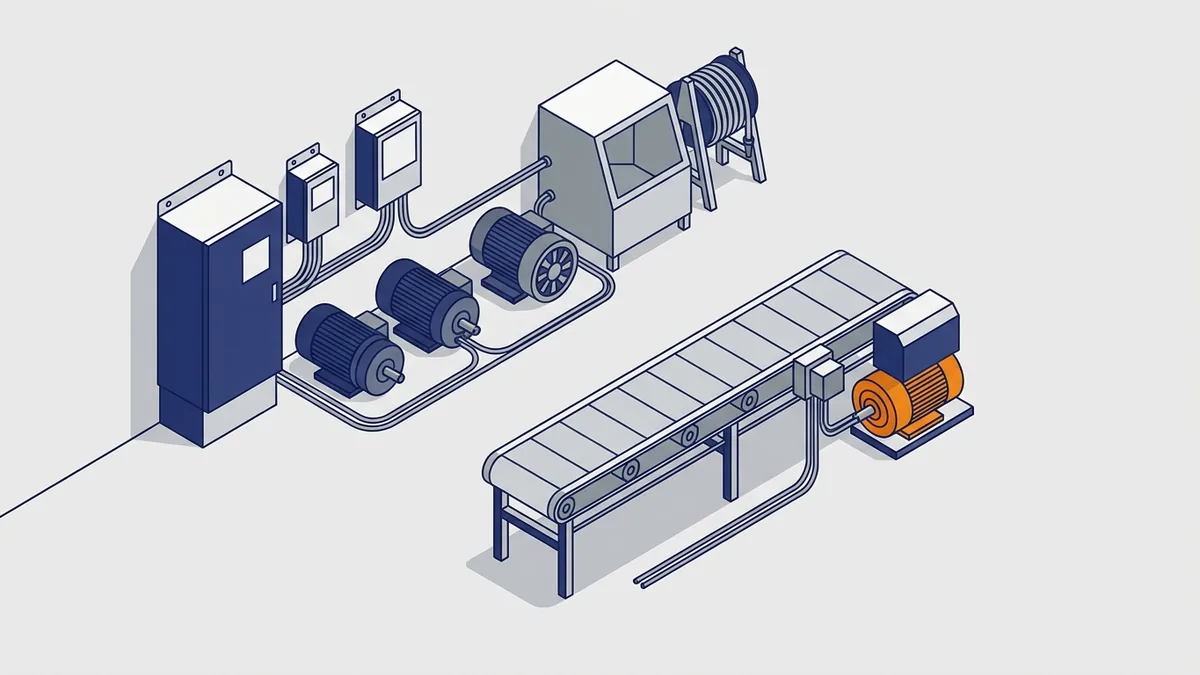
| Application | NEMA choice | IEC choice |
|---|---|---|
| Pumps and fans | General purpose or SP4 | General performance M2BAX; SynRM on a drive |
| Conveyors and unit handling | Unit handling motors, standard or brake | General performance M2BAX |
| Washdown and food | Washdown motors and washdown brake motors | Ranges up to IP66 (M3BP, M3AA); confirm washdown use in the catalog |
| Corrosive and marine | Marine (saltwater) or severe duty motors | M3BP or M3AA, both marine certifiable |
| HVAC | HVAC motors | General performance M2BAX |
| Farm and grain | Farm and grain motors | General performance M2BAX |
| Hazardous areas | Explosion-proof brake motors; check the catalog for other certified motors | Ex motors: flameproof, increased safety, dust-ignition-proof |
| Automotive plants | Automotive duty U-frame motors | Check the IEC catalogs |
| Loads that must hold when stopped | Brake motors, clutches and brakes | Check the catalogs for brake options |
| Process and petrochemical | Severe duty motors to IEEE 841; API 661 motors | Process performance M3BP |
| Variable speed, top efficiency | SP4 on a VFD | SynRM IE5 (drive only) |
A five-step path to the right ABB motor
To start, use this order of questions to narrow the choice. For more application detail, see our post ABB Motor Control Applications.
- First, choose the system: NEMA for most North American equipment, IEC for metric machines.
- Next, set the duty: general purpose, severe duty, washdown or a definite purpose line.
- Then select the efficiency class: NEMA Premium, Super Premium, or IE2 to IE5.
- After that, decide how it starts: across the line, on a soft starter, or on a VFD.
- Finally, add options: brake, hazardous area certification, or a special enclosure or mounting.
ABB drives and motors: pairing them
How do ABB drives and motors work together?
In short, a VFD changes motor speed by changing the frequency and voltage it feeds the motor. ABB drives and motors pair well when two things line up. First, the motor must suit drive duty. Next, the drive must handle the motor’s full-load current at your supply voltage.
Inverter-duty versus standard motors
A standard motor mainly expects to start across the line. In contrast, an inverter-duty motor is rated to run on a drive’s switched output across a speed range. So before you put ABB motors on a VFD, check for an inverter rating; ABB references NEMA MG1 Part 31 for its inverter-ready NEMA motors. If the nameplate or catalog shows no drive rating, ask ABB or our team before you connect it.
What does inverter duty mean in practice?
A drive sends fast voltage pulses to the motor. These pulses stress the winding insulation, especially with long cables. An inverter-duty motor has insulation built to take those spikes. NEMA MG1 Part 31 sets the voltage limits, and the catalog or nameplate should state the rating.
Speed range matters too. A self-cooled motor has a shaft-mounted fan, so at low speed it moves less air and runs hotter. As a result, a motor may need a separate blower or a lighter load at low speed. Check the catalog for the speed range at constant torque.
Drives can also push current through the bearings and damage them over time. For this reason, larger drive-fed motors often use an insulated bearing or a shaft grounding ring. Ask for these options when you order, and confirm the exact limits for your motor in the catalog.
ABB drive families at a glance
Next, ABB makes several drive families for its motors. Our ABB VFD buying guide supplies the ACS180 and ACS580 ranges, and the notes mark third-party views as such.
| Drive | Power range | Typical fit |
|---|---|---|
| ACS180 | 0.25 to 22 kW (0.3 to 30 hp) | Entry-level machinery drive; STO, EMC filter and Modbus built in |
| ACS255 Micro | 0.5 hp models in our catalog | Compact NEMA 4X/IP66 drive; third-party reviews place it in tight spaces and washdown or dusty areas |
| ACS580 | 0.75 to 500 kW (1 to 700 hp) | General purpose line; third-party reviews call it the standard industrial choice |
| ACS880 | From 0.55 kW; upper limit differs by source | High performance; third-party sources cite DTC and regenerative braking |
Also, STO (Safe Torque Off) is a safety input that removes motor torque, and an EMC filter cuts electrical noise. Third-party reviews also say the ACS180 runs open-loop vector and V/f control, but not DTC (Direct Torque Control, ABB’s high-performance method). For the ACS880, sources give the top of the range as 1,300, 6,000 or 8,000 kW. So check ABB’s own catalog before you quote an ACS880 size.
Which ABB drive suits a small 0.5 hp motor in a washdown area?
For a 0.5 hp motor in a wet or dusty spot, the ACS255 Micro series fits well. Every ACS255 model we list carries a NEMA 4X/IP66 rating. NEMA 4X means the enclosure resists hose-down water and corrosion. Here is how our 0.5 hp ACS255 models break down:
- Indoor or outdoor: +B063 marks the indoor version and +B068 the outdoor version.
- 100-120 V single-phase input: ACS255-01U-02A3-1, 240 V three-phase output, 2.3 A, indoor or outdoor.
- 208-240 V single-phase input: ACS255-01U-02A3-2, 2.3 A, indoor or outdoor.
- 208-240 V three-phase input: ACS255-03U-02A3-2, 240 V output, 2.3 A, indoor.
- 400-480 V three-phase input: ACS255-03U-01A2-4, 480 V output, 1.2 A, indoor.
- +F278 option: adds an integrated disconnect, speed pot and forward/reverse switch on most of these models.
Check the input phase, or pick a panel-mount ACS180
One caution: a few of our listing titles show “240 VAC 3 Phase Input” on 01U models. However, the 01U code and the matching listings point to single-phase input, so check the type code before you wire. For a dry control panel instead, the ACS180-04S-02A4-2 suits a 0.5 hp motor on 200-240 V three-phase, rated 2.4 A.
Size the drive to motor full-load current
So always match the drive to the motor’s full-load amps (FLA) on the nameplate, not to horsepower alone. Two motors with the same horsepower can draw different current at the same voltage. For example, our 0.5 hp ACS255 models are rated 2.3 A at 240 V and 1.2 A at 480 V, so the motor FLA must fit within that rating. For selection depth, see the ABB VFD Guide, ABB VFDs: Drive Classes, Type Codes, and ABB Multi-Motor Setup With ABB Micro Drives.
ABB motor starters: manual motor starters, contactors and soft starters
What is an ABB motor starter?
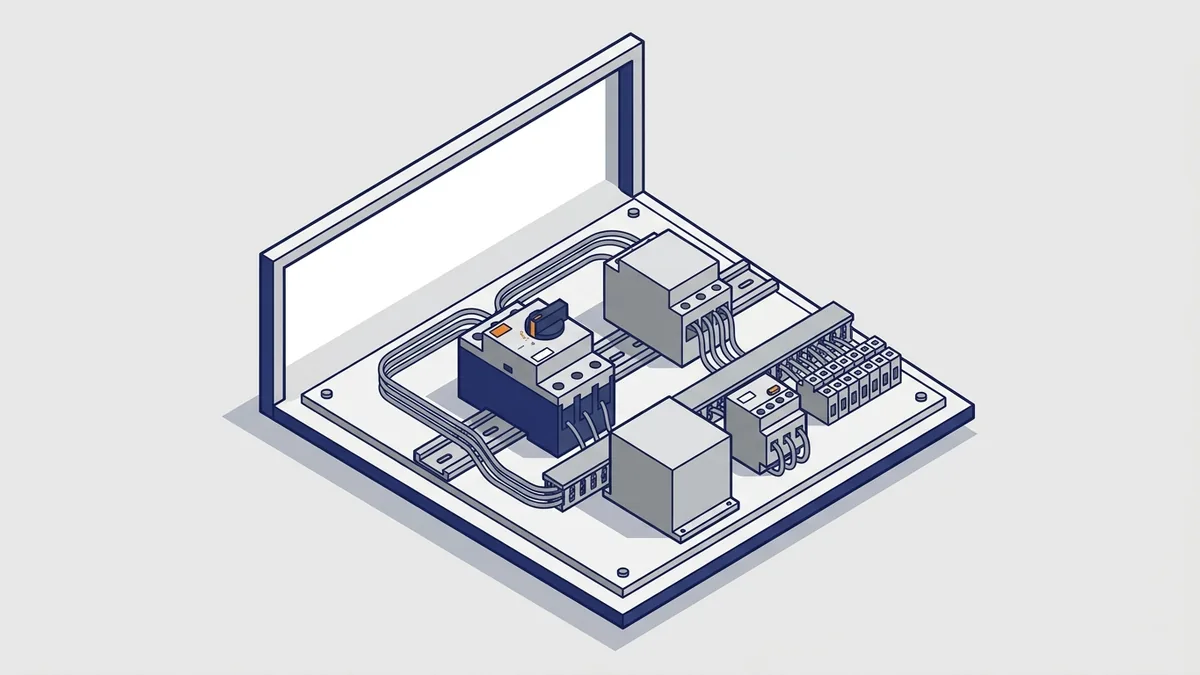
When people search for an ABB motor starter, they usually mean a manual motor starter. That device is a motor protection circuit breaker with thermal (overload) and magnetic (short-circuit) trips in one compact unit. ABB makes three ranges: MS116, MS132/MO132 and MS165/MO165. The MO types are magnetic-only, so they need a separate overload device, and the MS132-T version protects transformers.
What is the difference between MS116, MS132 and MS165?
All three ranges sense phase loss, which helps protect ABB motors when one supply phase drops out. This table shows how they differ.
| Model | Current range | Width | Motor size | Handle | Trip indication |
|---|---|---|---|---|---|
| MS116 | Up to 32 A | 45 mm | Up to 15 kW at 400 V | ON/OFF | Not listed |
| MS132 | Up to 32 A | 45 mm | See the guide | ON/OFF/TRIP, lockable without accessories | Magnetic trip indication |
| MS165 | 10 to 80 A (2021 guide); 10 to 65 A in older documents | 55 mm | Up to 45 kW | ON/OFF/TRIP, lockable without accessories | Magnetic trip indication |
In short, MS116 is the standard, compact choice. Meanwhile, MS132 and MS165 are ABB’s high performance ranges, with trip indication and a lockable handle.
How do I size an ABB manual motor starter?
First, size the starter on the motor’s rated current, which UL calls full-load amps (FLA), for NEMA and IEC ABB motors alike. Then pick the model whose setting range brackets that current. For example, ABB’s coordination table pairs an MS132-10 (6.3 to 10 A) with a 4.0 kW motor and an MS165-32 (23 to 32 A) with a 15 kW motor. For magnetic-only MO types, choose the device with a rated current (Ie) equal to the FLA or the next size above.
Check the short-circuit rating and the guide revision
However, short-circuit ratings differ by model. In ABB’s coordination table, the MS132-10 and MS165-32 examples reach 100 kA, while the MS165-80 is rated 30 kA. So compare the table with the fault current available at your panel. Also, check the guide revision, because older documents list MS165 at 10 to 65 A while the 2021 guide goes to 80 A.
In North America, check the guide for the accessories your installation needs before you order. Then confirm the starter matches the motor’s FLA and your panel’s fault current.
Which ABB contactors, overload relays and soft starters pair with my motor?
For larger motors, ABB offers AF contactors, TF thermal overload relays and EF electronic overload relays. For smooth starts, ABB offers the PSR, PSE and PSTX soft starter families. We do not list a fixed pairing for each motor size here, because it depends on voltage, duty and start type. Instead, use these rules:
- Contactor: choose one whose AC-3 rating (the rating for starting and stopping squirrel-cage motors) is at or above the motor FLA.
- Overload relay: choose one whose setting range includes the motor FLA, then set it to the nameplate value.
- Soft starter: size it to the motor FLA and your start duty, such as a heavy pump or fan load.
Then check ABB’s coordination tables for the exact device combination and short-circuit protection. Also, remember that a SynRM motor cannot use a contactor or soft starter, because it needs a drive.
Connecting ABB motors: voltage, leads and brakes
How do I connect an ABB motor to the right voltage?
First, lock out and tag the supply. Then open the terminal box and read the connection diagram on the nameplate or inside the lid. The diagram is the final word for your motor. Use the nameplate voltage and wiring diagram, not a general rule.
On IEC motors with six terminals, the nameplate often shows two voltages, such as 400 V delta and 690 V star. For star, join the three ends (W2, U2 and V2) together and feed U1, V1 and W1. For delta, fit the links between U1 and W2, V1 and U2, and W1 and V2. Then feed the supply to the three link points.
How do I wire a nine-lead NEMA motor?
A nine-lead motor is wired for two voltages, and the leads are numbered T1 to T9. For the low voltage connection, join T4, T5 and T6 together. Then join T1 with T7, T2 with T8 and T3 with T9, and connect L1, L2 and L3 to those three pairs. For the high voltage connection, join T4 with T7, T5 with T8 and T6 with T9. Then connect L1 to T1, L2 to T2 and L3 to T3, and insulate each joint.
To reverse rotation, swap any two supply leads. If a motor has a different number of leads, follow its own diagram.
How do I wire a brake coil when the motor runs on a VFD?
Do not power the brake coil from the drive’s output. That voltage and frequency change with speed, so the brake may not release properly. Instead, feed the brake from a separate supply that matches the coil rating on the brake nameplate. Control it with a contactor or relay, timed with the drive’s run signal. Follow the wiring diagram that ships with the brake.
Buying ABB motors: cost, lead time, mistakes and repair
How much do ABB motors cost and how long do they take to arrive?
However, we do not post prices in this article, because cost depends on the exact motor. Horsepower or kilowatts, frame, enclosure, efficiency class and options such as a brake all change the number. Likewise, a stainless washdown motor or an Ex motor costs differently from a general purpose one.
Lead time also depends on the line and on whether the motor is in stock or built to order. So send us the nameplate data or the catalog number. As a result, we can quote the price and the delivery time for your exact motor.
What about stock, build-to-order and warranty?
Standard catalog motors are the most likely to ship from stock. In contrast, special voltages, shafts, brakes or certifications are often built to order and take longer. As for warranty, the one term we can state here is 48 months for the SP4 line. Terms for other lines vary, so ask us for the warranty on the exact motor you plan to buy.
What mistakes do buyers make with ABB motors?
In fact, most errors come from skipping a check. Here are the common ones:
- Mixing systems: a NEMA motor will not bolt onto an IEC base without changes.
- Trusting the brand on the frame: the nameplate and catalog number hold the real data.
- Skipping the inverter rating: a standard motor on a VFD may not suit drive duty.
- Sizing by horsepower alone: drives and starters need the motor’s FLA.
- Starting a SynRM across the line: these motors run only on a drive.
- Relying on one document: ABB’s own catalogs sometimes differ, so confirm in the current one.
In addition, some buyers forget the local efficiency rules. Because those rules differ by country and motor type, check them before you order.
When should I repair rather than replace an ABB motor, and when do I call for help?
First, repair often makes sense when the damage is limited, such as worn bearings, a failed seal or a winding fault on a larger motor. In contrast, replacement is usually better when the frame or shaft is badly damaged, or when the repair cost comes close to a new motor. Also, a new, higher efficiency motor can lower your power bill on a unit that runs all day.
Call for help when the motor is in a hazardous area, because the repair must keep its certification. Likewise, call us when the nameplate is unreadable, when a motor keeps failing on a drive, or when you are unsure which choice fits. Precision Electric repairs motors as well as selling them, so we can advise on both paths.
ABB motors cover NEMA and IEC builds, many efficiency classes and a wide range of duties. Once you know your system, your duty and how the motor will start, the choice gets much easier. If you need help matching a motor, pairing it with a drive or starter, or arranging a repair, contact Precision Electric for a quote or browse our ABB products.