Fan and Blower Motor Guide: Types, Sizing and Fault Finding
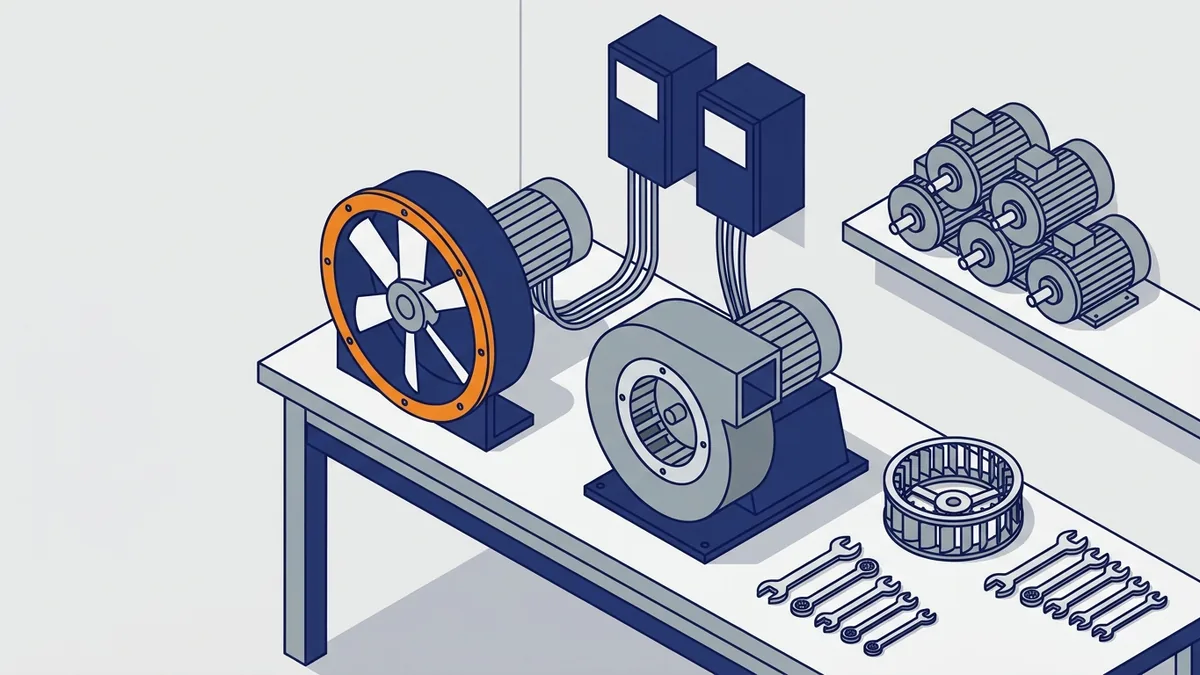
A fan and blower motor turns the wheel that moves your air, and picking or fixing the wrong one wastes time and energy. This guide shows you which type fits the job, how to size and replace it, and how to find a fault in a sensible order. It also helps you decide when to repair and when to replace.
On this page
- What a fan and blower motor is
- Types of fan and blower motors
- PSC vs ECM: which blower motor is better?
- How fan load works: the fan laws and why speed matters
- Controlling fan and blower motor speed
- How to choose or replace a fan and blower motor
- How do I choose a replacement fan or blower motor?
- How do I size a replacement motor from airflow and static pressure?
- How do I wire a PSC motor’s speed taps?
- Can a PSC motor replace a shaded pole motor?
- What size capacitor does a blower motor need?
- Which ECM type fits which replacement?
- Extra steps for an ECM swap
- Troubleshooting a fan and blower motor that will not run or runs poorly
- Maintenance that extends motor life
- Repair or replace a fan and blower motor
- Efficiency rules and standards that affect fan and blower motors
- Where to find manuals, wiring diagrams and replacement motors
- Frequently asked questions
What a fan and blower motor is
What is a fan and blower motor?
A fan and blower motor is the driver that spins a fan wheel or propeller. It turns electrical power into the shaft rotation that pushes air through a space, a duct or a process. In addition, you will hear it called a fan motor or a blower fan motor.
The motor is only one part of the system. The wheel, housing, drive, controls and ductwork all shape the load. As a result, you can only size the motor correctly once you know the fan’s operating point, which is the airflow and pressure it actually works at.
What is the difference between a fan motor and a blower motor?
In everyday use, a fan moves a lot of air at low pressure. A blower is usually a centrifugal wheel inside a housing, and it builds more pressure. So a fan motor often drives a propeller, while a blower motor drives an enclosed wheel.
The motor itself can be the same type in both cases. For that reason, this guide treats the two as one subject. Likewise, the Department of Energy (DOE) groups them together as “fans and blowers” in its rules.
Where you find these motors
You meet a fan and blower motor in many places. Here are the common ones:
- Furnace and air handler blowers
- Rooftop units and fan coils
- Refrigeration equipment
- Plant ventilation
- Process air systems
However, if you only need cooling-fan specifics for electronics or small equipment, see our Motor Fan Guide. This page covers the motor that drives the airstream.
Types of fan and blower motors
Five motor families cover most fans and blowers. Each suits a different duty. First, use the table to compare them at a glance.
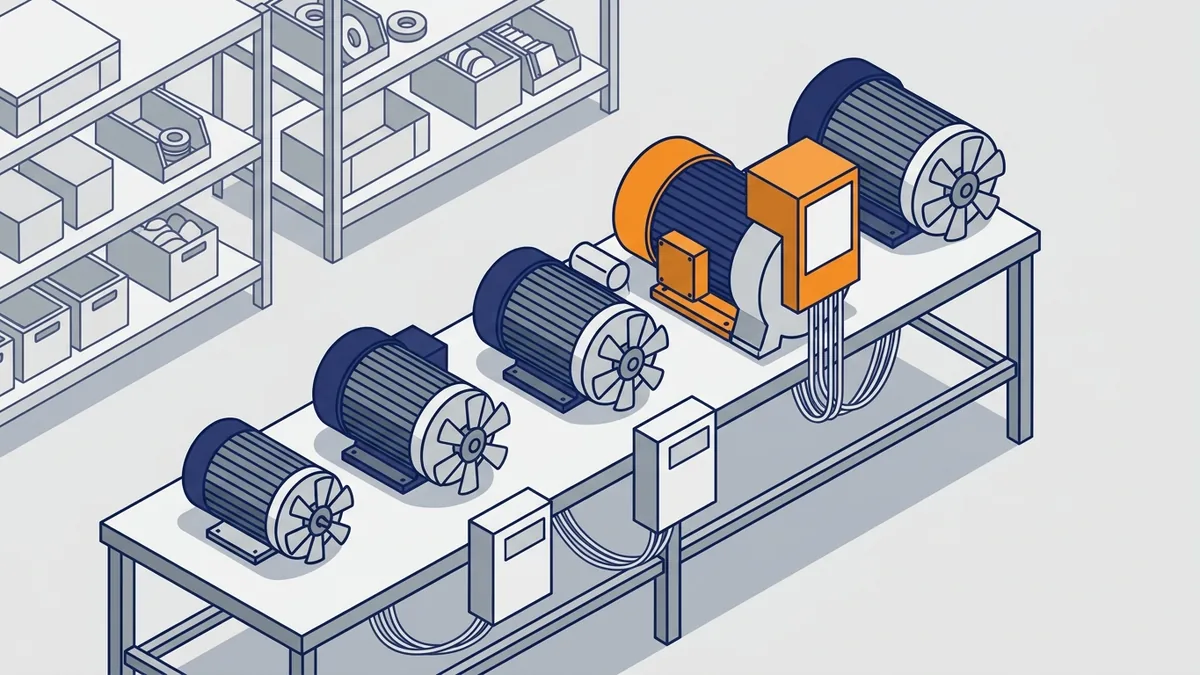
| Type | Starting torque | Efficiency | Speed control | Typical use | Check on the nameplate |
|---|---|---|---|---|---|
| Shaded pole | Low | Low | Taps on some models | Small direct-drive fans | Voltage, rotation, mounting |
| PSC | Low to moderate | Higher than shaded pole | Speed taps | Furnace and air handler blowers | Capacitor µF and voltage, taps |
| Split-phase and capacitor-start | Moderate to high | Moderate | Fixed speed | Harder-to-start fans and blowers | Start type, thermal protection |
| ECM / BPM | Set by electronics | High | Electronic control | Modern air handlers | Control type, model number |
| Three-phase induction | High | High | Fixed or VFD | Larger plant fans and blowers | HP/kW, RPM, frame, enclosure |
Shaded pole motors
Shaded pole motors have low starting torque, low cost and low efficiency. They have no capacitor and no start switch. Because of that, you find them on small direct-drive fan and blower jobs.
You can spot one by its stator. Each pole has individual coil windings and a single copper band, called a shading coil, around part of the pole. In addition, typical sizes are very small, roughly 1/300 to 1/20 kW.
A shaded pole motor must never replace a PSC motor. It cannot give the same performance, so the fan can end up under-driven and hot.
Permanent split capacitor (PSC) motors
A PSC motor is an AC induction motor that keeps a run capacitor in the circuit all the time. The capacitor helps the motor start and run smoothly, so no start switch is needed. Compared with shaded pole, a PSC motor runs at higher efficiency and draws 50 to 60 percent less current, according to Regal Rexnord.
For multi-speed fans, the maker wires speed taps from the main winding. You choose a tap at installation, and the fan then runs at that fixed speed. Also, if you see a run capacitor wired to the blower, you are almost certainly looking at a PSC motor.
Split-phase and capacitor-start motors
Split-phase motors give moderate starting torque. They typically run about 1/20 to 1/2 kW and drive some fans and blowers. In contrast, capacitor-start versions suit loads that are hard to start. For the theory behind these designs, read our Electric Motor Basics post.
ECM / BPM (electronically commutated) blower motors
An ECM, also called a BPM motor, is a brushless DC motor with built-in electronics. The electronics hold a target torque, speed or airflow. Unlike a PSC, it has no run capacitor.
Its efficiency and low-watt operation make it popular in modern air handlers. Next, we compare it with PSC in the following section, including one caution about static pressure.
Three-phase induction motors on industrial fans
Three-phase induction motors are the standard choice for larger plant fans and blowers. They can drive the wheel directly or through belts. Also, you can run them at fixed speed or on a variable frequency drive (VFD).
Frame size, enclosure and service factor all matter on these motors. For that reason, take those details from the manufacturer’s catalogue or NEMA MG 1, not from a general guide. For drive setup, see our VFD posts.
Frame and efficiency class on three-phase fan motors
NEMA sets standard frame sizes for general-purpose three-phase motors, and the frame number fixes the mounting dimensions and shaft size. As a result, a motor with the same frame number as the old one bolts in without new mounting work. Frame letters, such as T, also matter, so copy the full frame code from the nameplate.
For efficiency, look for the NEMA Premium mark on the nameplate. Many general-purpose three-phase motors also fall under separate DOE motor efficiency rules, which are different from the fan rules covered below. Because the exact class depends on the horsepower and speed, confirm it in the maker’s data.
PSC vs ECM: which blower motor is better?
What is the difference between a PSC and an ECM blower motor?
A PSC is an AC induction motor with a run capacitor and fixed speed taps. An ECM is a brushless DC motor with electronic control that holds a target torque or airflow. That one difference drives most of the points below.
| Point | PSC | ECM |
|---|---|---|
| Speed | Single speed per tap | Variable |
| Typical power | 500 to 550 W when heating and cooling (PNNL) | Can run on as little as 80 W (PNNL) |
| Fan-only power | Baseline | About one-fourth of PSC (PNNL) |
| Capacitor | Run capacitor | None |
| High static pressure | Airflow drops | Works harder to keep airflow |
How efficient is each one?
Sources disagree on the exact numbers, so treat them as a range. The PNNL Building America Solution Center says a PSC motor is at best about 60 percent efficient and an ECM about 80 percent. By contrast, one retailer page puts PSC near 45 percent and ECM at 65 to 75 percent.
Either way, the ECM wins. It also runs cooler, and its brushless design removes failures from worn brushes.
The static-pressure catch
PNNL notes that a PSC motor simply stops pushing when pressure gets too high. An ECM, however, keeps working harder to push air through. That wastes energy and can eventually burn the motor out.
So duct and filter condition matter more with an ECM. For example, check for dirty filters and blocked coils before you blame the motor.
Can I replace a PSC blower motor with an ECM?
Not as a simple plug-and-play swap. First, the frame, shaft, mounting and blower wheel must match. Next, the control wiring differs, because a PSC takes line voltage on a speed tap while an ECM expects a low-voltage control signal.
Finally, someone has to commission the airflow after the swap. Because of this, check all of it against the equipment’s wiring diagram before you order.
How fan load works: the fan laws and why speed matters
Why does fan power drop so much when speed drops?
The fan laws, also called affinity laws, explain it. Flow changes in direct proportion to speed. Pressure changes with the square of speed, and power changes with the cube.
So halving the speed halves the flow, cuts pressure to a quarter and cuts power to an eighth. Cubing is the reason small speed cuts save so much energy. Next, the table shows the numbers.
| Speed | Flow | Pressure | Power |
|---|---|---|---|
| Rated speed (100%) | Flow at 100% | Pressure at 100% | Power at 100% |
| 90% | 90% | 81% | about 73% |
| 80% | 80% | 64% | about 51% |
| 50% | 50% | 25% | about 12.5% |
Why a damper saves far less than slowing the fan
A damper adds restriction, so the fan keeps working against it. A constant-speed fan with a damper cutting flow by 20% might still use about 90% of full power. In comparison, the same fan on a VFD at the same flow uses about 50%, because 0.8 cubed is about 0.51.
For that reason, slowing the fan is the better way to cut airflow. The fan motor does less work instead of fighting a closed damper.
Limits of the fan laws
The fan laws are a quick estimate, not an exact answer. They assume a fixed system curve, meaning the same ducts, filters and dampers, and constant efficiency. However, real fans drift from that.
Therefore, verify your numbers against the manufacturer’s fan curve. Interpolating from accurate fan data beats the affinity laws.
Air density and altitude
Air density changes the load too. At altitude, the same fan moves less air mass and draws less power. For example, one worked case at 5,000 feet shows about 87 percent of sea-level pressure and power for the same flow.
Controlling fan and blower motor speed
How can I control the speed of a fan or blower motor?
You have four main options. Each fits a different motor type:
- Multi-speed taps on a PSC motor. You pick a fixed speed at installation.
- ECM control input. A low-voltage signal sets the torque, speed or airflow.
- A VFD on a three-phase motor. This gives smooth speed control across a wide range.
- A damper or inlet vanes. These work, but they are the inefficient option.
For wiring and parameter setup, see our VFD post and the ABB ACS310 pump and fan post. We do not repeat those steps here.
Do I need a VFD on a three-phase fan motor?
No, not always. A fan that runs at one steady flow all day can run fine at fixed speed. However, a VFD earns its cost when the load changes, because the cube law turns small speed cuts into large power savings.
Also, some motors need to be suited to drive use. Check the motor’s data sheet for inverter-duty details before you pair it with a drive.
What does inverter-duty mean, and how do I size a VFD and its cable?
An inverter-duty motor has an insulation system built to handle the fast voltage spikes a VFD creates. NEMA MG 1 covers general-purpose motors on drives in Part 30 and definite-purpose inverter-fed motors in Part 31. So look for “inverter duty” on the nameplate or data sheet, especially on 460 V motors and long cable runs.
Size the drive by the motor’s full-load amps, not by horsepower alone. The drive’s rated output current should meet or beat the nameplate amps. Also, keep the cable between drive and motor as short as you can. Long leads raise the voltage spikes at the motor, so the drive maker’s maximum cable length applies, and an output reactor or dv/dt filter may be needed.
Because fan load falls fast as speed drops, a motor on a fan rarely struggles with cooling at reduced speed. Still, check the data sheet for the lowest speed the maker allows.
How to choose or replace a fan and blower motor
How do I choose a replacement fan or blower motor?
Start with the nameplate on the old motor. Photograph it before you remove anything. Then work through this list:
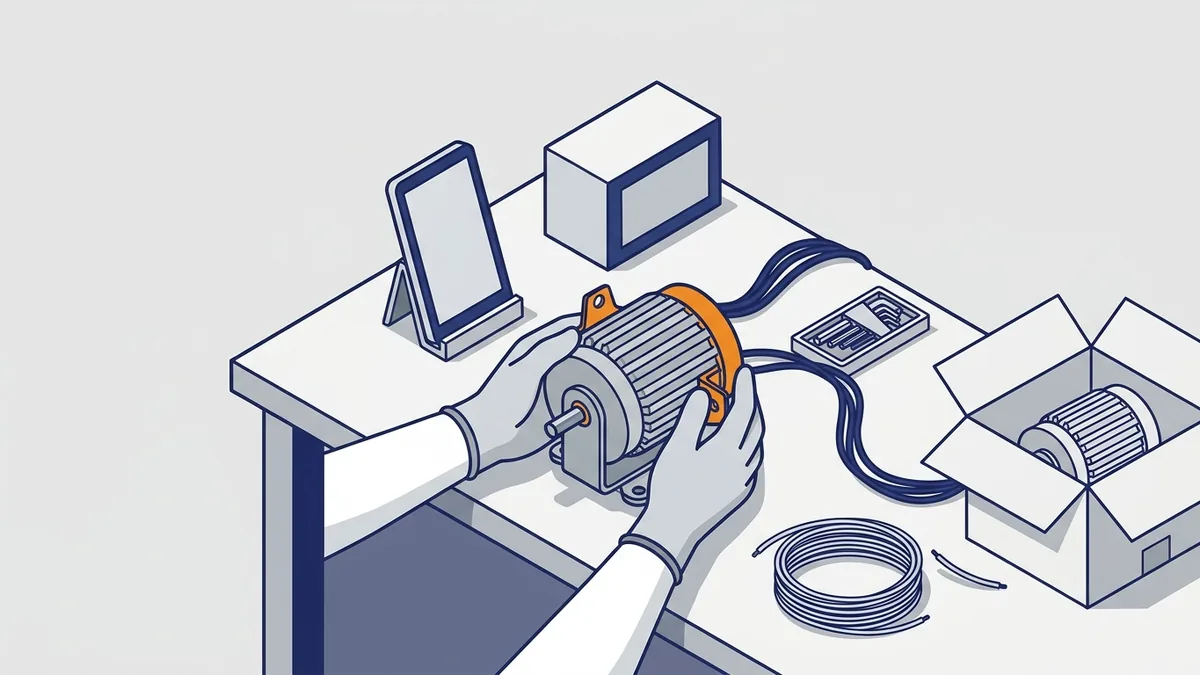
- Record voltage, phase, frequency (Hz), HP or kW, and RPM.
- Note the frame, rotation direction and enclosure.
- Write down the capacitor rating and any thermal protection.
- Find the wiring diagram on the motor or the equipment.
- Match the drive style, direct drive or belt.
- Confirm shaft diameter and length, mounting and wheel fit.
Next, confirm the fan’s real load before you upsize. A fan curve or measured amps will tell you more than a guess. After all, a bigger motor does not fix a clogged filter or a bad duct.
How do I size a replacement motor from airflow and static pressure?
Use this formula for brake horsepower (BHP), the power the fan shaft needs:
BHP = (CFM × static pressure in inches of water) ÷ (6356 × total efficiency)
Take the efficiency from the fan curve, written as a decimal. For example, a fan moving 10,000 CFM at 2.0 inches of water with 65 percent efficiency needs 20,000 ÷ (6356 × 0.65), or about 4.8 BHP. A 5 hp motor covers that on a direct-drive fan.
On belt drives, add the drive loss, which is often a few percent. Also, pick the next standard motor size up from your result.
The service factor is a margin for brief overloads. For example, a 1.15 service factor lets the motor carry 15 percent over its rating for a short time. However, do not plan to run there all day. Size so the normal load sits at or below the rated horsepower.
How do I wire a PSC motor’s speed taps?
Wire the neutral to the common lead, and the hot line to the one speed tap you want. Then cap each unused tap with an insulated wire nut so it cannot touch metal or another lead. Wire the capacitor as the motor’s diagram shows.
Many furnace blower motors use black for high, blue for medium, red for low and white for common. However, colour codes vary by maker and by model, so the wiring diagram on the motor label always wins. Photograph the old wiring before you disconnect anything.
If the diagram is missing, you can measure winding resistance with the power off and the capacitor disconnected. On a tapped winding, the high-speed tap usually reads the lowest resistance to the common lead, and the low-speed tap reads the highest. Still, confirm with the maker before you power up.
Can a PSC motor replace a shaded pole motor?
Usually yes on direct-drive fans, because Fasco guidance says a PSC can replace an equivalent shaded pole motor. However, it is not safe on belt-driven fans, which need more starting torque than a PSC gives. Never go the other way and replace a PSC motor with a shaded pole motor.
What size capacitor does a blower motor need?
Use the capacitor rating on the motor label, both the µF value and the voltage. Do not guess and do not “round up.” An undersized capacitor gives weak starting torque. In contrast, an oversized one causes excess current, overheating and early failure.
Which ECM type fits which replacement?
Match the ECM type to the original. Constant-torque ECMs hold a set torque, while constant-airflow ECMs adjust to hold a target airflow. So a constant-airflow blower needs a replacement motor and control module made for that function and for that equipment.
Programming and commissioning vary by maker. Often you set the airflow, heating and cooling speed choices, or the module’s switch settings, then check the actual airflow. Because the steps differ, follow the replacement motor’s instructions and the equipment’s wiring diagram.
Extra steps for an ECM swap
If you move to an ECM, add the steps from the PSC vs ECM section. Match the frame and wheel, rewire the control, and commission the airflow. Also, if the nameplate does not give you enough to go on, send us photos and we can help.
Troubleshooting a fan and blower motor that will not run or runs poorly
Work in order, and keep safety first. Most blower motor failures trace to the capacitor, relay, resistor or control module, the bearings, or the power supply. As a result, checking in order stops you from replacing a good motor.
- Isolate power. On industrial fans, apply lockout/tagout.
- Check that the control is calling for the fan and that power reaches the motor.
- Check filters and airflow for restrictions.
- With power off, spin the wheel by hand.
- Test the run capacitor.
- Then check bearings and windings.
Because capacitors store charge, only qualified people should do this work.
Motor hums but will not start
If your blower motor hums but will not start, the run capacitor is the first suspect. Seized bearings or a jammed wheel come next. Still, a humming motor needs a control call, power, a working relay and a healthy capacitor.
Test the capacitor first, because a weak one can mimic a bad motor. Then, with power off, spin the wheel by hand. If it is stiff, grinding or barely moves, the bearings are shot. However, if the capacitor tests good and the motor has power, the motor is the problem.
Motor runs slow, weak or short-cycles
A weakening capacitor can leave the motor at only 50 to 75 percent of rated speed. That brings humming, high current and fast overheating, sometimes within 5 to 15 minutes. In addition, check the belt, low supply voltage, a dirty wheel and restricted airflow.
Most blower motors have a built-in thermal overload. It shuts the motor off when it gets too hot and resets by itself once it cools. For that reason, a motor that runs, then stops, then restarts often points to overheating from poor airflow.
Noise, vibration and overheating
Grinding or squealing points to worn bearings or a wheel that rubs. Dirt, moisture, lost lubrication, heat and age all wear bearings. Likewise, fouled wheels and blocked filters cause overheating, and a clogged filter is one of the top causes.
If the capacitor passes, inspect the mechanical parts before you condemn the motor. Look at wheel fouling, the bearings and any airflow restriction.
Testing a run capacitor
Here is how to test a blower motor run capacitor:
- Turn power off at the breaker.
- Locate the capacitor and discharge it with an insulated screwdriver.
- Remove it and measure capacitance in µF with a meter.
- Compare the reading with the label.
A healthy capacitor reads within about 5 to 10 percent of the label value. If it reads outside that range, replace it with the same µF and voltage rating.
Capacitor voltage rating, safe discharge and PPE
Match the µF value exactly, but the voltage rating only needs to meet or beat the original. Common ratings are 370 V and 440 V. A 440 V capacitor can replace a 370 V one at the same µF, but a 370 V part must never replace a 440 V one.
A screwdriver discharges a capacitor, but it can spark and damage the terminals. A safer way is a bleeder resistor, commonly about 20,000 ohms, held across the terminals with insulated leads. Then confirm with a meter that the capacitor reads zero volts before you touch it.
First, de-energize the circuit and lock it out. Next, test for voltage with a meter you trust. Wear safety glasses and insulated gloves where your risk assessment calls for them. NFPA 70E sets the electrical safety rules and PPE categories by task and equipment, so follow your site’s program.
Testing windings and bearings
For three-phase motors, start with an insulation resistance test between the windings and the frame. Use 500 V DC on motors rated under 1,000 V, with the motor disconnected from the drive. IEEE 43 gives a minimum of 5 MΩ for random-wound windings, though older shop rules used 1 MΩ. Also, track readings over time, because a steady drop warns you before a failure.
Next, measure winding resistance phase to phase. The three readings should be close to each other, and a difference of about 5 percent or less is a common rule. Compare them with the maker’s data when you have it.
Then run the motor and measure amps on each phase. Current should not exceed the nameplate full-load amps, and the phases should be fairly balanced. High amps on a normal load often point to a mechanical drag or a voltage problem.
For bearings, listen for grinding, feel for heat and check for shaft play with the power off. If the motor is noisy or hot but the electrical readings are good, the bearings are the likely cause.
Maintenance that extends motor life
How do I maintain a fan and blower motor?
Heat and dust cause most failures, so clean air is your best protection. Keep filters changed and wheels clean. Because a clean wheel stays balanced, and a free-flowing airstream keeps the motor cool, both help.
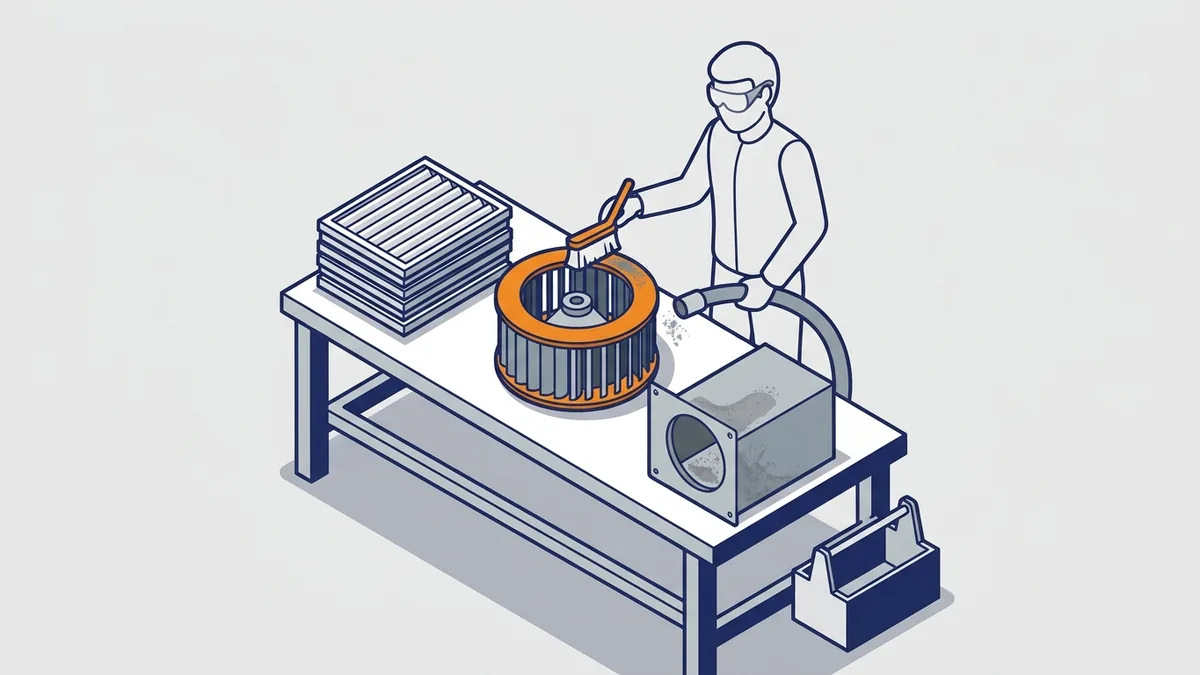
Also record amps, capacitor values and vibration at each service. A slow trend shows a problem long before the motor fails. For example, rising amps on the same load often mean a tightening bearing or a dirty wheel.
How often should blower motor bearings be lubricated?
It depends on the motor. Many modern blower motors have sealed bearings that need no lubrication at all. In that case, do not drill or pry into a sealed motor to add grease.
Where the motor has lubrication ports, the bearings are typically greased about once a year. Use the maker’s recommended grease. However, avoid over-greasing, because too much grease can cause overheating.
Grease type, amount and interval for industrial motors
For larger industrial motors, the lubrication label or the maker’s manual sets the grease, amount and interval. The interval depends on frame size, speed and duty. For example, hot, dusty or round-the-clock service means shorter intervals.
Many motor makers call for a polyurea-based grease. Do not mix greases unless the maker says they are compatible. Also, add grease in small amounts. If the motor has a drain plug, remove it and run the motor briefly so old grease can leave. Then refit the plug.
Repair or replace a fan and blower motor
Should I repair or replace a blower motor?
Often the motor is not the real fault. A failed capacitor, relay, control module, wheel or belt can usually be fixed without replacing the motor. Also, bearings can be replaced on serviceable motors.
Replace the motor in these cases:
- The windings are burned.
- The bearings are seized or badly worn on a sealed motor.
- The motor keeps overheating after you fix the airflow.
If you are unsure, our US Motor Guide covers repair-decision logic in more detail.
How much does a blower motor cost?
Prices vary too much for one number to help. For example, residential furnace blower motors sold at retail are a different product from industrial units. For industrial work, cost depends on the frame, horsepower and enclosure.
The best way to get a real answer is a quote. So send us photos of the nameplate and the motor, and Precision Electric can quote a repair or a replacement.
Efficiency rules and standards that affect fan and blower motors
Are there efficiency regulations for fan and blower motors?
Right now, DOE has set no energy conservation standards for fans and blowers, but the rules have changed often, so check before you rely on any of them. On 19 August 2021, DOE published a final determination in the Federal Register that classed fans and blowers as covered equipment. However, that determination did not set test procedures or energy conservation standards.
In 2023, DOE issued a test procedure rule. It said no energy conservation standards had been set at that time, and the test procedure itself sets none. Also, the earlier proposal described fan electrical input power and the fan energy index as the metrics.
A rule proposed on 19 January 2024 covered two groups, air circulating fans and general fans and blowers. However, DOE’s fans and blowers page says it withdrew that proposal, and it lists a Federal Register withdrawal dated 17 January 2025. In addition, a May 2025 Federal Register notice proposed withdrawing the covered-equipment determination itself. Because the status may change again, check energy.gov for the current position before you act on it.
One retailer says furnace makers moved toward ECM motors around 2019. Since that is a secondary source, verify it before you treat it as law.
What applies to a fan and blower motor now?
For fans and blowers as a product class, no federal efficiency limit applies today. The DOE test procedure only defines how to measure fan performance, so it does not set a pass or fail level. Even so, some states set their own energy rules, so check the rules where the equipment will run.
Other rules can still reach your job. For example, a general-purpose three-phase motor on the fan may fall under DOE’s separate electric motor efficiency rules. Residential furnace fans also have their own DOE rules. As a result, check the rule for each product, not just the fan.
Where to find manuals, wiring diagrams and replacement motors
Where can I find manuals, wiring diagrams and replacement fan motors?
Start with the motor nameplate and the wiring diagram on the equipment. Then go to the fan maker’s data and the motor manufacturer’s library. Because those sources list the exact specs for your unit, they save guesswork.
These public pages also help:
- The PNNL Building America Solution Center, for ECM air handler fan guidance
- Regal Rexnord’s induction motor types guide
- Fasco Facts, the motor replacement tips PDF
- The Federal Register and energy.gov, for DOE fan and blower rules
For replacements and repairs, Precision Electric can match a fan and blower motor to your nameplate. So send us the photos and we will help you find the right fit.
Frequently asked questions
What is the difference between a PSC and an ECM blower motor?
A PSC is an AC induction motor with a run capacitor running at fixed speed taps. An ECM is a brushless DC motor with electronic control that holds a target torque or airflow. PNNL puts ECM fan-only power at about a quarter of PSC. In addition, an ECM keeps working harder against high static pressure.
Why does my blower motor hum but not spin?
A failed run capacitor is the first suspect, then seized bearings or a jammed blower wheel. First, with power off and the capacitor discharged, test the capacitor and spin the wheel by hand before condemning the motor.
Can I replace a shaded pole fan motor with a PSC motor?
Usually yes on direct-drive fans, because a PSC can replace an equivalent shaded pole motor. However, not on belt-driven fans, which need more starting torque. Never replace a PSC motor with a shaded pole motor.
How much power does a fan save when it runs slower?
Power falls with the cube of speed. For example, at 80% speed a fan draws about 51% of full power, and at 50% speed about one-eighth. Since this assumes a fixed system curve, confirm against the fan curve.
When should a blower motor be replaced rather than repaired?
Replace when the windings are burned, bearings are seized or badly worn on a sealed motor, or it keeps overheating after airflow is fixed. In contrast, a capacitor, relay, control module, wheel or belt fault can often be fixed without replacing the motor.
The right fan and blower motor depends on the duty, the drive and the real load, and a short, ordered check usually finds the fault. Test the cheap parts first, then decide between repair and replacement. If you want help with a repair, a quote or a replacement, contact Precision Electric and send photos of your nameplate.