








Motor AC Guide: How It Works, RPM, Repair and Replacement
When a motor AC supply problem stops your line, or you need to order a replacement, you want clear answers fast. This guide explains how an AC electric motor works and how poles and frequency set its speed. Next, you will learn to read the nameplate, control speed with a VFD, plan for the 2027 DOE rule, and choose between repair and replacement.
On this page
- What is an AC motor?
- How does an AC motor work?
- How fast does an AC motor run? Poles, frequency and RPM
- Types of AC motors
- What types of AC motor are there?
- Three-phase squirrel-cage induction motors
- Wound-rotor (slip-ring) induction motors
- Synchronous and permanent-magnet synchronous motors
- Single-phase induction motors
- What are the single-phase start methods?
- How can you tell which single-phase type you have?
- What is the difference between an induction motor and a synchronous motor?
- How to read an AC motor nameplate
- How do I read an AC motor nameplate?
- What is a service factor on a motor?
- What do NEMA design letters A, B, C and D mean?
- Code letter vs. design letter: what is the difference?
- How does altitude affect service factor?
- What do I need to match when buying a replacement AC motor?
- What are the NEMA frame dimensions?
- How do you cross-reference NEMA and IEC motors?
- How do voltage and frequency tolerances affect a replacement?
- How do you size overloads, breakers and starters?
- How do you pick a starter, soft starter or VFD for a Design BE motor?
- AC motor speed control
- How is AC motor speed controlled?
- Does a VFD change the service factor?
- What does an inverter-duty motor need?
- How long can the cable between the VFD and motor be?
- What are bearing currents and shaft grounding?
- What about minimum speed and cooling?
- Constant-torque vs. variable-torque loads
- Check the motor and the driven equipment
- Where to learn more about AC motor and speed control
- Choosing or replacing an AC motor: efficiency and the 2027 DOE rule
- What are IE3 and IE4 and how do they compare with NEMA Premium?
- What changes for AC motors on June 1, 2027?
- Does a repaired or rewound motor have to meet the new levels?
- Air-over motors may need a larger frame
- Design BE: higher inrush and starting torque
- How much will a more efficient motor save?
- Sample energy-savings calculation
- AC motor repair: when to repair, rewind or replace
- What safety steps come before any motor work?
- When should you call a motor repair shop?
- What do common motor faults mean?
- Which tests should you run before pulling a motor?
- Which parts of an AC motor fail?
- Should I repair, rewind or replace a failed AC motor?
- How do you compare cost and lead time?
- Does rewinding reduce motor efficiency?
- What does a good rewind include?
- What should an AC motor repair specification include?
- Common mistakes with AC motors
- Frequently asked questions
What is an AC motor?
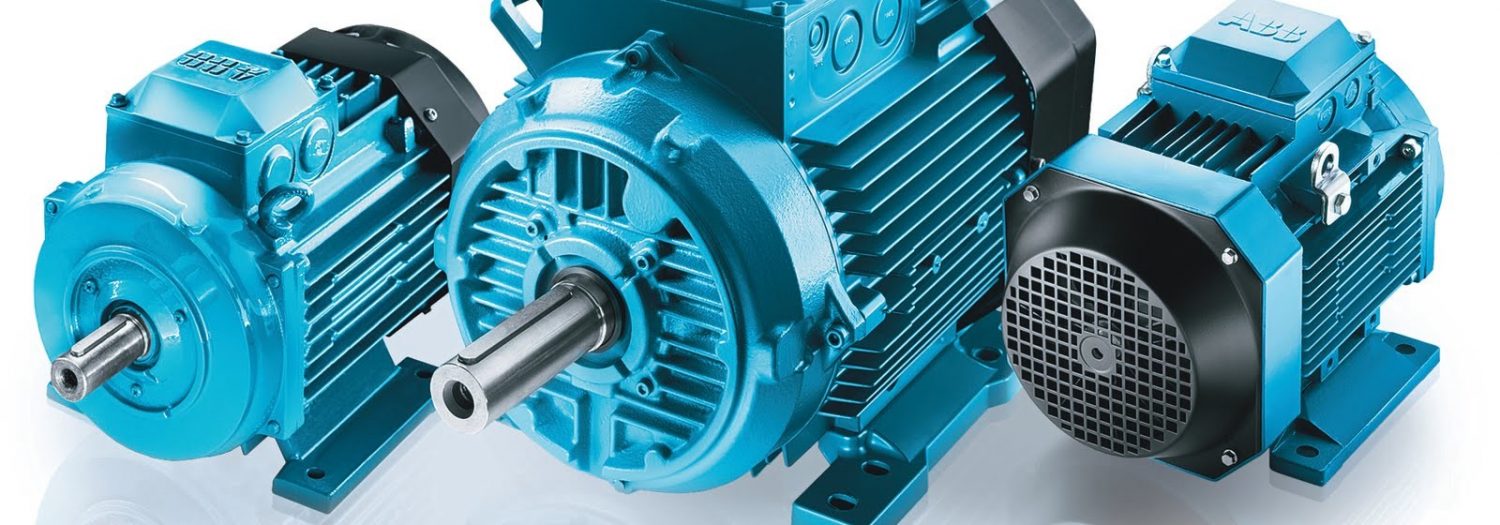
An AC motor is a motor that runs on alternating current. It has two main parts. The stator is the stationary electromagnet on the outside, and the rotor is the part that turns. The motor AC supply feeds the stator, and magnetic forces turn the rotor and its shaft.
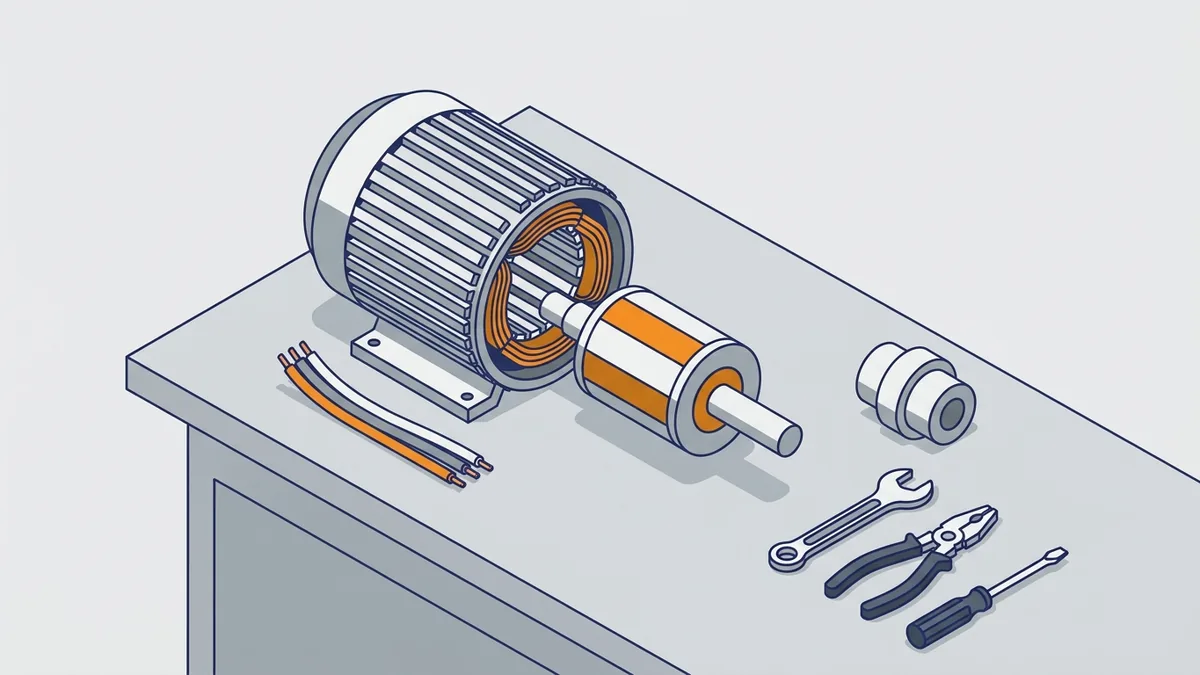
AC motors come in two main families: induction motors and synchronous motors. Of the two, induction motors are the most widely used type of AC motor. So when someone asks for a “motor AC” replacement at the parts counter, they usually mean a three-phase induction motor.
Is an AC induction motor the same as an asynchronous motor?
Yes. An AC induction motor and an asynchronous motor are the same machine. “Asynchronous” means the rotor does not turn in step with the stator’s magnetic field. Instead, it lags slightly behind, as the slip section below explains.
What this guide covers
Each section stands on its own, so you can jump to the part you need:
- How an alternating current motor works, its parts and slip
- How poles and frequency set speed, with a speed table
- The main types of AC motors and how they compare, including single-phase starting methods
- How to read a nameplate, what to match on a replacement, and how to size protection
- Speed control with a variable frequency drive (VFD)
- Efficiency classes and the DOE rule that takes effect on June 1, 2027
- Safety steps, fault meanings and tests before you pull a motor
- When to repair, rewind or replace a failed motor
- Common mistakes and quick answers to frequent questions
How does an AC motor work?
An AC motor turns electrical energy into a spinning magnetic field, then uses that field to drag the rotor around. This also answers the common question of how AC electric motors work. It comes down to three steps, and most motor AC theory builds on them.
- First, the stator makes a rotating field. Motor AC current flows through the stator windings. In a three-phase motor, the three currents peak 120° apart in time. Together, they create a magnetic field that rotates around the stator.
- Next, the field induces current in the rotor. The rotating field sweeps across the rotor bars and creates a current in them. No wires or brushes touch the rotor, because only the stator connects to the supply.
- Then the rotor makes torque. The rotor current creates its own magnetic field. That field follows the stator’s field, and the pull between the two turns the shaft.
Because the rotor chases the field, it never quite catches it in an induction motor. That small lag, called slip, keeps current flowing in the rotor.
How do AC motors work without brushes?
AC induction motors need no brushes because the rotor gets its current by induction, not through a wire. Only the stator connects to the motor AC supply. The stator’s rotating field induces current in the rotor without any contact. As a result, there is no commutator to wear out.
For this reason, people sometimes call the induction motor a rotating transformer. The stator acts like the primary winding of a transformer, and the rotor acts like the secondary. The main difference is that this secondary is free to spin.
How is a synchronous motor different?
A synchronous motor works a little differently. Its rotor locks to the rotating field and turns at exactly the field’s speed. As a result, its speed is tied to the motor AC frequency, with no slip. The types section compares the two in more detail.
Parts of an AC induction motor
What is an AC induction motor? It is an AC motor whose rotor current comes from the stator field instead of an outside supply. People also call it an asynchronous motor, and it is the most common motor in a plant.
The main parts of an AC induction motor are:
- Stator: a ring of windings around the outside. It connects to the motor AC line and creates the rotating field.
- Rotor: the turning part on the shaft. It sits inside the stator with a small air gap.
- Squirrel-cage rotor: conductive bars joined to two end rings, shaped a bit like a pet’s exercise wheel.
- Wound-rotor (slip-ring) rotor: a rotor with real windings, brought out through slip rings on the shaft.
- Shaft, bearings and end brackets: these hold the rotor in place and carry the load.
A squirrel-cage AC induction electric motor has no brushes, commutator or rotor wiring. That simple build is a big reason it is so common. However, bearings still wear, so the motor still needs routine checks.
What is slip and why does it matter?
Slip is the gap between the speed of the stator’s field and the actual rotor speed. The rotor must run slower than the field. If both turned at the same speed, the field would not cut across the rotor bars. Then there would be no induced current, no rotor field and no torque.
You can work out slip with this formula: slip = (synchronous speed − rotor speed) ÷ synchronous speed. For example, a 2-pole motor on 50 Hz has a synchronous speed of 3,000 RPM. If it runs at 2,880 RPM, slip is (3,000 − 2,880) ÷ 3,000, or 4%. Also, the current in the rotor alternates at slip × supply frequency, which here is 2 Hz.
Slip also changes with load. Typically, slip rises in proportion to load, so a loaded motor turns a little slower than an unloaded one. That is why nameplate RPM is always below synchronous speed. On a 60 Hz motor AC supply, for example, a 4-pole motor shows about 1,750 RPM, not 1,800.
At starting, slip is at its greatest. The rotor stands still while the field already turns at full speed, so slip is 100%. Then, as the rotor speeds up, slip falls until the motor settles at its loaded speed.
How fast does an AC motor run? Poles, frequency and RPM
What determines the speed of an AC motor?
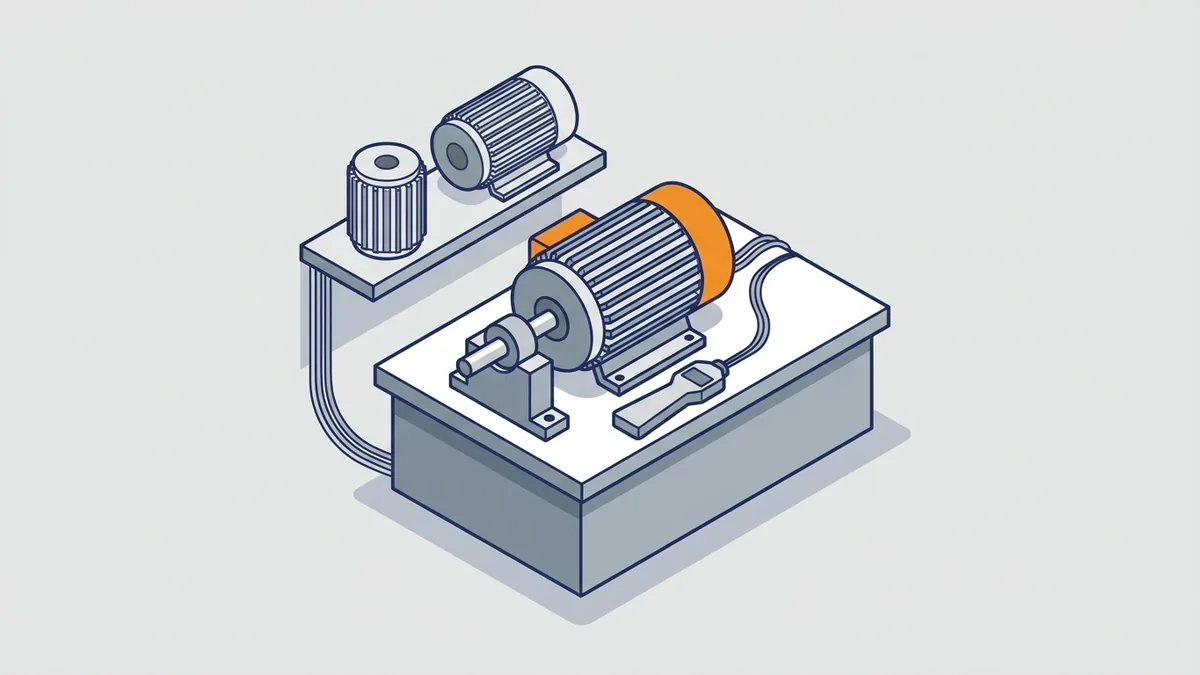
Two things set the speed of an AC motor: the supply frequency and the number of poles. Poles are the north and south magnetic points that the stator windings create. More poles mean a slower field. Voltage does not set speed, so a higher or lower motor AC voltage will not make the field turn faster.
How do you calculate AC motor RPM from poles and frequency?
Use this formula for synchronous speed: synchronous RPM = 120 × frequency (Hz) ÷ number of poles. The 120 combines 60 seconds per minute and 2 poles per pole pair. The formula works the same for single-phase and three-phase motors, because the number of phases does not affect it.
For example, a 4-pole motor on 60 Hz gives 120 × 60 ÷ 4 = 1,800 RPM. Loaded speed then runs about 2–5% lower because of slip. The table shows common values.
| Poles | Synchronous RPM at 60 Hz | Typical loaded RPM at 60 Hz | Synchronous RPM at 50 Hz | Typical loaded RPM at 50 Hz |
|---|---|---|---|---|
| 2 | 3,600 | about 3,420–3,530 | 3,000 | about 2,850–2,940 |
| 4 | 1,800 | about 1,750 | 1,500 | about 1,450–1,480 |
| 6 | 1,200 | about 1,140–1,175 | 1,000 | about 950–980 |
| 8 | 900 | about 855–880 | 750 | about 715–735 |
Most loaded speeds in the table are estimates based on 2–5% slip. So always check the nameplate for the real full-load RPM of your motor AC unit.
How to find poles or frequency from the speed formula
You can rearrange the same formula to solve other problems:
- Poles = 120 × frequency ÷ synchronous RPM
- Frequency = synchronous RPM × poles ÷ 120
To find poles from a nameplate, round the full-load RPM up to the nearest synchronous speed. For example, 1,750 RPM on a 60 Hz motor rounds up to 1,800 RPM. Then 120 × 60 ÷ 1,800 gives 4 poles. Similarly, a 60 Hz nameplate near 1,150 RPM points to a 6-pole motor.
Because frequency sets speed, changing the motor AC frequency is the cleanest way to change speed. That is exactly what a VFD does, as the speed control section explains.
Types of AC motors
What types of AC motor are there?
Most AC motors fall into a few groups. The main ones you will meet in a plant are:
- Three-phase squirrel-cage induction motors
- Wound-rotor (slip-ring) induction motors
- Synchronous motors, including permanent-magnet synchronous motors (PMSM)
- Single-phase induction motors
Three-phase squirrel-cage induction motors
The three-phase squirrel-cage motor is the industrial standard. You find it on pumps, fans, conveyors and compressors across most plants. A three-phase motor AC supply creates the rotating field directly. Also, the cage rotor has no brushes and no rotor connections.
Wound-rotor (slip-ring) induction motors
A wound-rotor motor has windings on the rotor instead of bare bars. These windings connect to slip rings on the shaft, so you can reach the rotor circuit from outside the motor. You see these less often than cage motors. Like a cage motor, though, it still works by induction and still has slip.
Synchronous and permanent-magnet synchronous motors
In a synchronous motor, the rotor turns at exactly the speed of the rotating field. There is no slip, so the motor AC frequency alone sets the speed. A permanent-magnet synchronous motor (PMSM) uses magnets in the rotor to make its field. Many servo motors use this design, and our servo motor repair post covers them in detail.
Single-phase induction motors
Single-phase motors run where only single-phase power is available, often in smaller equipment. The same speed formula applies to them. However, a single-phase motor AC supply does not create a rotating field the way three-phase power does. As a result, these motors need a starting method.
What are the single-phase start methods?
Each start method suits a different kind of load:
- Split-phase: a second start winding gives a small push, and a centrifugal switch drops it out near full speed. Starting torque is moderate, so it suits easy loads such as small fans and pumps.
- Capacitor-start: a start capacitor in series with the start winding gives high starting torque. A switch removes it after startup. Use it for hard-to-start loads such as compressors.
- Permanent-split capacitor (PSC): a run capacitor stays in the circuit all the time. Starting torque is low, so it fits fans and blowers.
- Capacitor-start, capacitor-run: it uses both capacitors for high starting torque and smooth running.
How can you tell which single-phase type you have?
First, read the nameplate, because many makers print the type there. Next, look for a capacitor housing on the motor body. A motor with no capacitor is likely split-phase. Also, listen at startup, because start switches often make a click as the motor comes up to speed. If you are still unsure, check the maker’s data before you order a replacement.
What is the difference between an induction motor and a synchronous motor?
The difference is slip. An induction motor’s rotor always turns a little slower than the field. In contrast, a synchronous motor’s rotor turns at exactly field speed. As a result, induction motor speed drops slightly as load rises, while synchronous motor speed stays locked to frequency.
| Type | Speed behavior | Rotor | Where used |
|---|---|---|---|
| Three-phase squirrel-cage induction | Slightly below synchronous; slip rises with load | Bars on two end rings, no brushes | General industrial loads such as pumps, fans and conveyors |
| Wound-rotor induction | Below synchronous; has slip | Windings brought out through slip rings | Less common; jobs that need access to the rotor circuit |
| Synchronous, including PMSM | Exactly synchronous; no slip | Locks to the field; PMSM uses magnets | Fixed-speed jobs and servo systems |
| Single-phase induction | Below synchronous; has slip | Usually squirrel cage | Where only single-phase power is available |
How to read an AC motor nameplate
How do I read an AC motor nameplate?
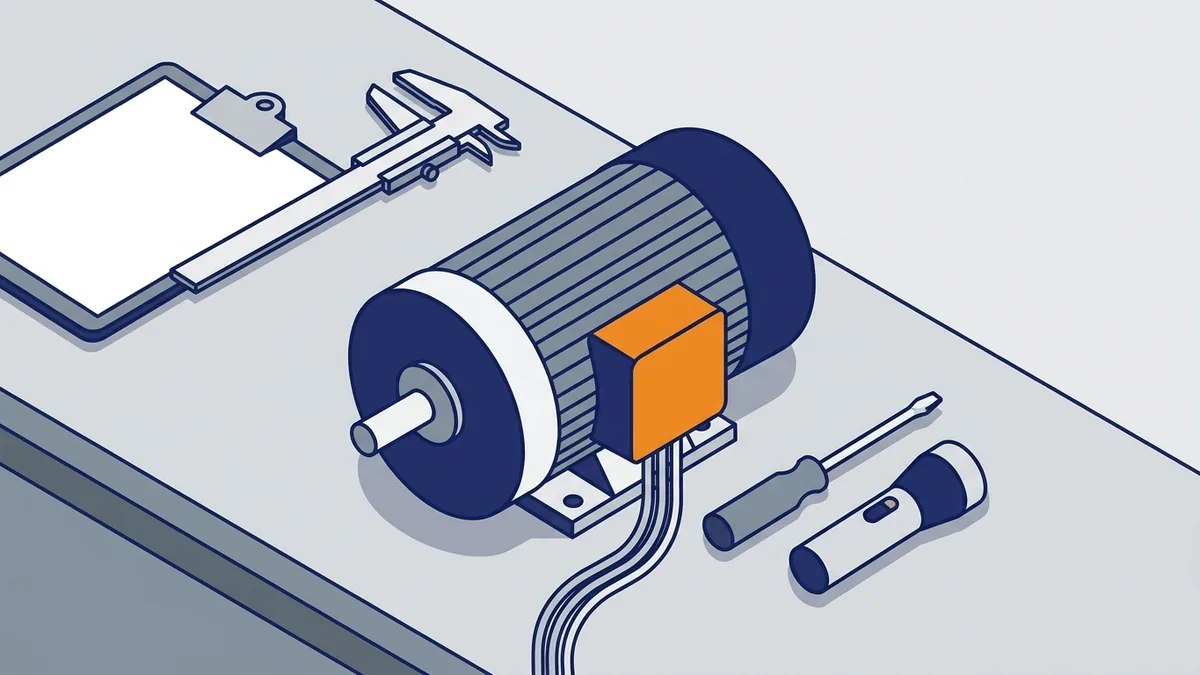
The nameplate is your motor’s spec sheet. NEMA requires a set list of items on it, and each one matters when you protect or replace the motor. Read every field before you order a motor AC replacement.
| Nameplate field | What it tells you |
|---|---|
| Rated voltage | The supply voltage the motor is built for |
| Full-load amps (FLA) | Current at rated load; used to set protection |
| Frequency (Hz) | Supply frequency, which sets speed along with poles |
| Phase | Single-phase or three-phase |
| Full-load RPM | Loaded speed; shows the number of poles |
| Horsepower (HP or kW) | Rated output power |
| Frame size | Physical dimensions; decides if motors from different makers swap |
| Service factor (SF) | Allowed continuous overload under nameplate conditions |
| Insulation class or temperature rise | How much heat the winding insulation is rated for |
| Time rating | Continuous or short-time duty |
| Design letter | Torque and starting-current behavior |
| Code letter | Locked-rotor kVA per HP, which shows starting current |
| Efficiency | Nominal full-load efficiency |
For a second reference from a motor maker, see ABB’s guide How to read a NEMA motor nameplate.
What is a service factor on a motor?
Service factor tells you the continuous overload a motor can handle under nameplate conditions without overheating or damage. A 1.0 service factor means no continuous overload. In contrast, a 1.15 service factor on a 10 hp motor allows up to 11.5 hp.
However, service factor is a safety margin, not extra rating. Running above a 1.0 service factor shortens motor life, according to NEMA MG 1. So do not run a motor continuously above the horsepower on the motor AC nameplate, even if its service factor is high.
What do NEMA design letters A, B, C and D mean?
NEMA defines four design letters by torque and current characteristics. They tell you how the motor behaves when it starts:
- Design A: similar to Design B but allows higher starting current. You see it less often.
- The general-purpose standard is Design B, with normal starting torque and current. Most general motor AC jobs use it.
- Design C: higher starting torque for hard-to-start loads, such as loaded conveyors.
- Loads like punch presses call for Design D, which has very high starting torque with high slip.
Design letters are not defined for motors larger than 500 hp at 1,800 RPM. Also, the 2027 efficiency rule brings a new letter, Design BE, which the efficiency section covers.
Code letter vs. design letter: what is the difference?
The code letter and the design letter are different things, though both are letters. The code letter identifies a range of locked-rotor kVA per horsepower. In other words, it shows how much current the motor draws at the moment it starts, called inrush. The farther the code letter is from A, the higher the inrush per horsepower.
Meanwhile, the design letter describes torque and starting-current behavior. When you replace a motor, check both letters. A replacement with a higher code letter may need a larger starter or other upstream changes.
How does altitude affect service factor?
Motors run hotter at high altitude because thin air cools them less. Above 3,300 feet, you can use the service factor to decide if a motor can still run continuously. On motors nameplated 1.15 or higher, reduce the effective service factor to 1.0 to offset the higher temperature.
What do I need to match when buying a replacement AC motor?
Use this checklist before you order a replacement motor AC unit:
- Horsepower or kW
- Voltage, phase and frequency
- Full-load RPM, which shows the pole count
- NEMA frame size, so it bolts up and the shaft lines up
- NEMA design letter, so starting torque suits the load
- Code letter and locked-rotor current, so your starter and protection still fit
- Service factor, insulation class and time rating
- The efficiency level required for the new motor
Higher-efficiency replacements can draw more inrush current. So a motor that matches on horsepower can still cause trouble at start if you skip the code letter.
What are the NEMA frame dimensions?
The frame number tells you the size. On NEMA T frames, the first two digits divided by 4 give the shaft height in inches. This is the distance from the mounting feet to the shaft centerline, called the D dimension. For example, a 184T has a 4.5 inch shaft height. The third digit shows the body length, so a 5 (as in 215T) is a longer body than a 4 (as in 213T) with the same shaft height.
| Frame | Shaft height (D) | Shaft diameter (U) |
|---|---|---|
| 143T, 145T | 3.5 in | 7/8 in |
| 182T, 184T | 4.5 in | 1-1/8 in |
| 213T, 215T | 5.25 in | 1-3/8 in |
| 254T, 256T | 6.25 in | 1-5/8 in |
| 284T, 286T | 7.0 in | 1-7/8 in |
The mounting footprint is the bolt-hole spacing of the feet, listed as the 2E and 2F dimensions. It changes with each frame, and with the last digit. Check it in the maker’s catalog or NEMA MG 1 before you drill or cut a base. Also note that 2-pole motors in some larger frames use a smaller shaft, so measure the old shaft too.
How do you cross-reference NEMA and IEC motors?
An IEC frame number is the shaft height in millimeters. For example, IEC 132 has a 132 mm shaft height. Close NEMA matches are 213T (5.25 in, about 133 mm) and 254T (6.25 in, about 159 mm, near IEC 160). The heights are close, but not identical.
In addition, the foot spacing, shaft diameter and shaft length often differ. So a swap may need shims, a new base or a coupling change. Always compare the maker’s dimension drawings before you order.
How do voltage and frequency tolerances affect a replacement?
NEMA MG 1 says a motor should run on rated voltage within ±10% and rated frequency within ±5%. The combined variation of the two should not exceed 10%, counted as absolute values. Beyond that, performance and temperature can change. So check your actual supply at the motor before you pick a rating, especially at the end of a long cable run.
Also, dual-voltage motors, such as 230/460 V, must be wired for the voltage you have. Check the connection diagram on the nameplate.
How do you size overloads, breakers and starters?
Start with the nameplate FLA. Under NEC 430.32, you generally set a separate overload at 125% of FLA for motors with a service factor of 1.15 or more, or a temperature rise of 40°C or less. For other motors, the setting is generally 115%. Confirm the details with the NEC and your local authority.
Branch-circuit protection works differently. The NEC sizes it from its own full-load current tables, not the nameplate. For an inverse-time breaker, the usual starting limit is 250% of that table current. The code allows higher ratings if the motor will not start otherwise. Because a Design BE motor draws more inrush, check that the breaker does not trip at start.
How do you pick a starter, soft starter or VFD for a Design BE motor?
NEMA does not define a starter size for Design BE. So size from the motor’s FLA and locked-rotor current, then ask the starter maker to confirm. For a soft starter or VFD, choose by the motor’s FLA, not by horsepower alone. In addition, a soft starter or VFD limits inrush, which helps when the breaker or supply is tight.
AC motor speed control
How is AC motor speed controlled?
Because frequency sets speed, the standard way to control an AC induction motor is a variable frequency drive (VFD). A VFD takes in the fixed motor AC supply and puts out a variable frequency. It changes speed without gearboxes, belts or other mechanical changes.
You can use the same 120 × f ÷ poles formula with the drive’s output frequency. For a 4-pole motor:
- 60 Hz gives 1,800 RPM synchronous
- 40 Hz gives 1,200 RPM synchronous
- 30 Hz gives 900 RPM synchronous
Actual shaft speed runs a few percent lower because of slip, just as it does on line power.
Does a VFD change the service factor?
In practice, yes. For VFD applications, treat service factor as 1.0, no matter what the nameplate shows. So size the motor to carry the load without relying on the service factor margin when it runs on a drive.
What does an inverter-duty motor need?
A VFD sends fast voltage pulses to the motor. These pulses stress the winding insulation. An inverter-duty motor under NEMA MG 1 Part 31 has an insulation system built to withstand them. For 600 V and below, the standard calls for withstanding peak voltage spikes up to 1,600 V. A general-purpose motor may have a shorter life on a drive, so choose an inverter-duty motor for new drive jobs.
How long can the cable between the VFD and motor be?
Long cables make voltage spikes at the motor worse, because the pulses reflect along the cable. The safe length depends on the drive, the motor insulation and the cable. So follow the drive maker’s limit. When a run is long, add an output reactor or a dV/dt filter, and ask the drive maker which one suits your setup.
What are bearing currents and shaft grounding?
A VFD can drive stray current through the motor bearings. This current pits the bearing races and causes early failure. Common fixes include a shaft grounding ring, an insulated bearing and good drive grounding. Because the damage builds slowly, plan for it on larger motors and on drives that run all the time.
What about minimum speed and cooling?
A fan on the motor shaft cools a typical TEFC (totally enclosed, fan-cooled) motor. At low speed, the fan moves less air, so the motor runs hotter under load. Therefore, check the motor maker’s speed range, and add a separate blower if you need full torque at low speed. Air-over motors rely on the driven fan, so check airflow at low speed as well.
Constant-torque vs. variable-torque loads
A constant-torque load needs the same torque at every speed. Conveyors and positive-displacement pumps are examples. These loads are the hardest on motor cooling at low speed. In contrast, a variable-torque load, such as a centrifugal pump or fan, needs much less torque at low speed. Its torque falls with the square of speed, and its power falls with the cube. As a result, these loads save the most energy on a drive.
Check the motor and the driven equipment
A drive makes it easy to dial in almost any speed. However, the motor and the driven equipment must both suit the frequency you choose. For example, a pump, fan or gearbox has its own speed limits. Before you widen the speed range, check the motor and drive manufacturers’ manuals for the limits that apply.
Where to learn more about AC motor and speed control
AC motor and speed control is a big topic, so we cover the details in separate posts. See AC Electric Motor Speed Control for energy use and the AC Motor Speed Controller engineering guide for drive selection. Also read AC Motor VFD benefits, and AC Motor with VFD wiring for hookup steps.
Choosing or replacing an AC motor: efficiency and the 2027 DOE rule
What are IE3 and IE4 and how do they compare with NEMA Premium?
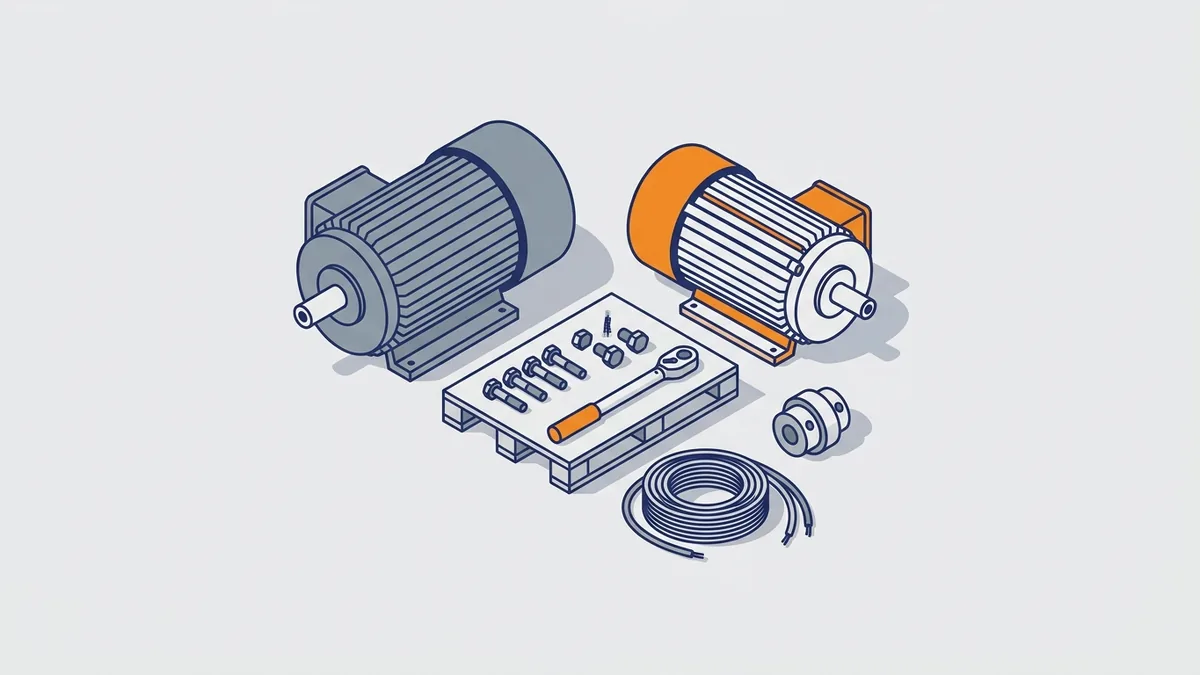
Every new motor AC purchase carries an efficiency class. The IEC rates efficiency with IE classes, while NEMA uses its own names. The classes line up like this:
| IEC class | NEMA equivalent |
|---|---|
| IE2 | NEMA Energy Efficient |
| IE3 | NEMA Premium |
| IE4 | NEMA Premium 4 (formerly NEMA Super Premium) |
The level a motor must meet depends on its type, horsepower, poles and voltage. Also, a higher efficiency rating alone does not make a motor a direct replacement in every application.
What changes for AC motors on June 1, 2027?
The DOE Medium Electric Motor (MEM) rule takes effect on June 1, 2027. Under it, most covered motors from 100 to 250 hp must meet NEMA Premium 4 efficiency. NEMA Premium 4 supersedes NEMA Premium. The rule builds on recommendations from the Motor Coalition, which includes NEMA.
The rule also brings these changes:
- Previously unregulated motors from 500 to 750 hp must meet NEMA Premium.
- Standard-frame air-over motors from 1 to 75 hp must meet NEMA Premium.
- Standard-frame air-over motors from 100 to 250 hp must meet Super Premium (NEMA Premium 4).
Industry guides read the rule as covering motors made after June 1, 2027, not motors already installed. Still, confirm the exact coverage against the DOE rule text before you plan purchases. For plain-language summaries, see ABB’s article on the 2027 DOE efficiency mandate and NEMA Premium. Also try the Nidec US Motors DOE motor rules brochure and WEG’s DOE 2027 higher motor efficiency article.
Does a repaired or rewound motor have to meet the new levels?
The DOE standards apply to new motors that a maker builds or imports and sells. A repair or rewind of a motor you already own does not make it a new motor. So the new levels are a purchase issue, not a repair issue. Still, check the DOE rule text for any case that looks unusual, such as a motor you plan to resell.
Air-over motors may need a larger frame
Air-over motors rely on air from the driven fan or blower to cool them. Reaching the new efficiency may push some of them into a bigger frame. For example, air-over specialized-frame (down-framed) motors of 1–20 hp, and air-over motors of 100–250 hp, may need to be one NEMA frame size larger. So check mounting space before you order.
Design BE: higher inrush and starting torque
NEMA Premium 4 efficiency may not fit the traditional Design B or C locked-rotor current limits. Because of this, NEMA created a new design letter, Design BE, for NEMA Premium 4 motors. Its inrush is 42% higher than a NEMA Premium Design B motor at all horsepower ratings. It also makes more starting torque.
As a result, a swap to a Design BE motor AC unit can affect your starter, overloads, breakers and driven load. Check the code letter, locked-rotor current and protection settings before you install it.
How much will a more efficient motor save?
Efficiency on any motor AC purchase pays back mainly through running hours. A motor that runs around the clock saves far more than one that runs a few hours a week. If a vendor quotes a payback figure, ask for the assumptions behind it, such as hours, load and power cost.
Sample energy-savings calculation
Use this formula: input kW = output hp × 0.746 ÷ efficiency. Then multiply the kW saved by running hours, and by your power cost per kWh. Here is an example with made-up efficiencies, not a specific motor.
- A 100 hp motor at full load runs 8,000 hours a year.
- At 94.5% efficiency, input is 74.6 ÷ 0.945, or about 78.94 kW.
- At 95.8% efficiency, input is 74.6 ÷ 0.958, or about 77.87 kW.
- The saving is about 1.07 kW, or about 8,570 kWh a year.
Multiply 8,570 kWh by your power cost to get yearly savings. Then divide the extra purchase price of the efficient motor by that number. The result is the simple payback in years.
AC motor repair: when to repair, rewind or replace
When a motor AC failure stops production, you have three choices: repair it, rewind it or replace it. This section is a decision guide. For step-by-step detail on AC motor repairs, see our stator winding repair and AC motor repair posts.
What safety steps come before any motor work?
Treat every motor circuit as live until you prove otherwise. Follow your site’s lockout/tagout (LOTO) program, which OSHA requires under 29 CFR 1910.147. Then work through these steps:
- Shut the motor down and open the disconnect.
- Lock and tag every energy source, including the disconnect and any control power.
- Test your meter on a known live source, then test the motor circuit, then test the known source again. This is the live-dead-live check for zero energy.
- Release stored energy, such as a load that can spin the motor, or a raised weight.
- Wear the PPE that your arc-flash assessment calls for, following NFPA 70E.
A motor on a VFD needs one more step. Drive capacitors hold a charge after you cut power. Wait the time printed on the drive label, then measure the DC bus voltage with a rated meter until it reads near zero. Single-phase motors can also hold charge in their capacitors, so discharge them before you touch them.
When should you call a motor repair shop?
Call a repair shop when you see any of these warning signs:
- The motor will not start
- It trips the breaker or overload
- It runs hotter than normal
- You hear new noise or feel vibration
- You smell burning
Before you pull the motor, check the motor AC supply and the windings. Our post on motor troubleshooting tools shows which meters and testers help.
What do common motor faults mean?
Each symptom points to a likely cause:
- Overload or breaker trip: the protective device opened because current ran too high for too long. Causes include an overloaded machine, a jammed load, low voltage, a lost phase or a winding fault.
- Single-phasing: one supply phase is lost, often from a blown fuse or a bad contact. A three-phase motor may hum and fail to start. A running motor draws high current on the two remaining legs and overheats fast.
- Voltage imbalance: the three phase voltages are unequal. Calculate it as the largest deviation from the average voltage, divided by the average, times 100. NEMA MG 1 says a motor should not run above 5% imbalance, and it calls for derating when imbalance passes 1%. Current imbalance is usually several times larger than voltage imbalance.
- Low insulation resistance: moisture, dirt or aged insulation lets current leak to ground. Under IEEE 43, a common minimum for random-wound windings is 5 MΩ at 40°C. A reading that falls over time is a warning, even above the minimum.
Which tests should you run before pulling a motor?
Run these checks in order, and lock out power for any test that touches the motor leads:
- Check the supply. With power on and proper PPE, measure voltage at the motor terminals on all three phases. Look for imbalance and for a missing phase.
- Check the current. Clamp each leg while the motor runs, and compare it with the nameplate FLA. Unequal currents suggest a supply or winding problem.
- Turn the shaft by hand. With power locked out, rough or stiff turning points to bearings or a jammed load.
- Check winding resistance. With power locked out and leads disconnected, measure phase to phase. The three readings should match closely.
- Test insulation resistance. Use a megohmmeter, often at 500 V DC for motors under 1,000 V. Test each winding to ground, then compare the result with past readings.
Which parts of an AC motor fail?
Failures usually hit the stator windings, stator core, rotor, shaft, bearings or end brackets. A catastrophic failure typically damages several of these at once. In that case, the repair scope grows quickly, which shifts the repair-or-replace decision.
Should I repair, rewind or replace a failed AC motor?
No single horsepower cutoff decides it. Instead, weigh the factors from EASA’s repair-or-replace guidance:
- Is the motor suitable for the application?
- What condition are the stator core and rotor in?
- How efficient is the motor?
- What is the lifecycle cost?
- How does repair cost compare with a replacement motor?
- What lead time and downtime can you accept?
For example, a motor that suits the job and has a sound core is a strong repair candidate. On the other hand, a motor that was wrong for the job gives you a chance to replace it with the right one. For more detail, read EASA’s A Guide to AC Motor Repair and Replacement, hosted by the US DOE research library, OSTI.
How do you compare cost and lead time?
Get a written repair quote and a replacement quote for the same motor. Then add the energy-savings calculation from the efficiency section. Include lost production while you wait, because downtime often costs more than the motor.
Lead times vary by motor size, type and maker. A standard motor that a supplier stocks usually arrives sooner than a special build. A repair can be quicker or slower, depending on damage and parts. So ask each shop for a firm date before you decide.
Does rewinding reduce motor efficiency?
Not when the shop follows good practice. EASA/AEMT testing found that properly repaired premium-efficiency and IE3 motors kept their efficiency. The average change was within ±0.2%, which is the accuracy of the test method itself. In several cases, efficiency even improved.
You may hear that a motor should never be rewound more than twice. One guideline says most manufacturers recommend no more than two rewinds. However, EASA’s position is that quality rewinds maintain efficiency, so judge each motor on its test results.
What does a good rewind include?
A quality shop follows these steps on a rewind:
- Record winding data first: wire size, turn count, coil pitch, connection, leads, slot dimensions and insulation details.
- Test core loss before and after burn-off: burn-off is the heating step that removes the old winding. Damaged lamination insulation can raise core losses and running temperature.
- Match the original winding: keep the average coil-extension length from growing, and keep the conductor cross-section the same or larger.
- Seal the winding: varnish or resin impregnation bonds and protects the new coils.
- Run a no-load test: after assembly, it confirms the winding connections suit the number of poles.
If a properly done core-loss test shows a rise of more than 20%, repair the core or consider replacing it, per EASA reports.
What should an AC motor repair specification include?
A repair specification tells the service center what you expect, so put it in writing. The American National Standard for repair is ANSI/EASA AR100, Recommended Practice for the Repair of Rotating Electrical Apparatus. One repair guide recommends naming ANSI/EASA AR100-2025 in the purchase order. Your specification should include:
- ANSI/EASA AR100-2025 as the repair standard
- The EASA/AEMT Good Practice Guide to Maintain Motor Efficiency, January 2021 edition
- Core-loss testing before and after burn-off, with results reported
- A rewind that duplicates the original winding data
- A no-load test after assembly, with results reported
- Warranty terms; EASA service centers back their work with, at minimum, EASA’s Limited Warranties
Then keep the test reports with the motor’s records. They give you a baseline if the motor fails again.
Common mistakes with AC motors
What are the common mistakes when running or replacing an AC motor? Most come from misreading the nameplate or skipping a check. Watch for these:
- Running above nameplate HP all the time. A high service factor is a margin, not extra rating. Continuous use above 1.0 shortens motor life.
- Mixing up design and code letters. The design letter describes torque and current behavior. The code letter shows locked-rotor kVA per horsepower.
- Matching horsepower only. Also match design letter, frame, RPM, voltage, phase and frequency.
- Ignoring inrush on a high-efficiency motor. A Design BE motor draws 42% more inrush than a NEMA Premium Design B motor.
- Working out VFD speed from voltage. Speed follows the motor AC frequency, not the motor AC voltage.
- Counting on service factor with a drive. Treat service factor as 1.0 on a VFD.
- Skipping lockout and the zero-energy check. Always prove the circuit is dead before you touch it.
- Rewinding without a spec. Skipping core-loss testing or a written AR100 specification leaves quality to chance.
Frequently asked questions
How does an AC motor work?
AC current in the stator windings creates a rotating magnetic field. That field induces current in the rotor, and the rotor’s own field follows the stator field to produce torque. In an induction motor, the rotor always turns slightly slower than the field, and that lag is called slip.
How do AC electric motors work without brushes?
Only the stator connects to the motor AC supply. The stator’s rotating field induces current in the rotor, so the motor needs no brushes or commutator. That is why people sometimes call the induction motor a rotating transformer.
What is an AC induction motor?
It is an AC motor whose rotor current comes from the stator field instead of an outside supply. People also call it an asynchronous motor. Induction motors are the most widely used type of AC motor.
How is AC motor speed set and controlled?
Synchronous speed is 120 × frequency ÷ number of poles, and loaded speed runs a few percent lower because of slip. For example, a 4-pole motor at 60 Hz has an 1,800 RPM synchronous speed and runs at about 1,750 RPM loaded. A VFD controls speed by changing the motor AC frequency.
Does rewinding an AC motor reduce its efficiency?
Not when the shop follows good-practice procedures. EASA/AEMT testing found the average efficiency change was within ±0.2%, the accuracy of the test method. So specify ANSI/EASA AR100 and core-loss testing before and after burn-off.
What do I need to match when replacing an AC motor?
Match horsepower, voltage, phase, frequency, RPM, frame size and NEMA design letter. Also check the code letter and locked-rotor current, because a higher code letter may need a larger starter. Finally, remember that higher-efficiency replacements can draw more inrush current.
An AC motor is simple at heart: a rotating field, a rotor that chases it, and a speed set by frequency and poles. Once you can read the nameplate, you can match a replacement, set up a VFD and plan for the June 1, 2027 DOE rule. When a motor fails, lock it out, run the basic tests, and let test results and a written AR100 specification guide the repair-or-replace call. If you need help choosing, controlling or repairing a motor AC unit, contact Precision Electric for a quote or repair.