Eaton CH Circuit Breakers: Types, Ratings and Selection Guide
If you need to identify, replace or specify eaton ch circuit breakers, the many catalog codes can slow you down. This guide covers what the CH line is, the type codes, the ratings, the enclosed versions and how CH compares with BR. You will also get a checklist to run before you order.
On this page
- What Eaton Type CH circuit breakers are
- Eaton CH breaker types and what the catalog codes mean
- Ratings: amperes, voltage, poles and interrupting capacity
- Specialty CH breakers: AFCI, GFCI, tandem, high-ambient and HID
- Eaton enclosed circuit breaker: the two things people mean
- Where each CH product fits
- Eaton CH vs BR and other brands
- How to pick the right CH breaker before you order
- Documents, catalogs and where to get CH breakers
- Warranty, lead time and when to call for help
- Frequently asked questions
What Eaton Type CH circuit breakers are
What are Eaton Type CH circuit breakers?
Eaton CH circuit breakers are 3/4-inch-per-pole plug-on thermal-magnetic breakers. They fit CH loadcenters in residential and light-commercial use. Eaton builds them to UL 489, and the line covers 10 to 150 A in one, two and three poles. Because multipole breakers have an internal common-trip link, a fault on one pole opens all poles at once.
Does CH stand for Cutler-Hammer, and is Eaton the same company?
The CH series traces back to Cutler-Hammer, which Eaton acquired in 1979. So a Cutler-Hammer Type CH and an Eaton CH breaker are the same product line. Older panels may carry the Cutler-Hammer name, while newer ones carry Eaton.
How can I identify a CH breaker by sight?
Look for three cues. First, the catalog number starts with “CH”. Second, the handle is tan, which Eaton calls sandalwood, on a black body. Third, the breaker is 3/4 inch wide per pole. In addition, the handle shows ON and OFF and the ampere rating.
Every Type CH breaker is also marked for HACR equipment. HACR stands for heating, air conditioning and refrigeration, so these breakers suit HVAC units listed for it.
Eaton CH breaker types and what the catalog codes mean
What do CHF, CHT, CHQ, CHH and CHP mean?
Some codes name a breaker. Others name a loadcenter or a rating. This table separates them, and the notes below it flag what we could not confirm.
| Code | What it means | Kind of code |
|---|---|---|
| CH | Standard branch breaker | Breaker |
| CHF | CH breaker with a mechanical trip flag | Breaker |
| CHT | Twin breaker, two circuits in one space | Breaker |
| CHQ | Eaton breaker classified for Square D QO panels | Classified breaker |
| CHH | Higher-rated type; H means 22 kAIC on mains | Rating suffix |
| CHP | CH plug-on neutral loadcenter | Loadcenter |
The catalog also lists CHFAFGF, CHFGFT and CHFCAF in the CH family. If you add an ST suffix, you get a shunt trip, which opens the breaker from a remote signal. CHQ comes from third-party sources, so check the panel label and Eaton’s catalog before you rely on it.
How do you decode a full CH catalog number?
Start with the prefix, then read the pole count and the ampere size. For example, CH2100CS is a two-pole 100 A breaker, and the CS suffix means a clamshell pack. In the same way, R on a loadcenter means NEMA 3R rainproof, as in CH22N125R.
Here is a safe way to read any number:
- Read the letters after CH for the breaker family, such as F for a trip flag or T for a twin.
- Read the first digit as the pole count and the digits after it as the amperes.
- Read the trailing letters as a suffix, such as CS for a clamshell pack or ST for a shunt trip.
Letters such as AF, GF and DF in a name point to arc-fault, ground-fault or combined protection. However, we could not confirm every prefix and suffix, including P, N and M, so do not guess. Match the full number against Eaton’s CH catalog or the SKU page before you order.
Ratings: amperes, voltage, poles and interrupting capacity
What amperage, pole and voltage ratings do CH breakers come in?
Eaton lists Type CH branch breakers from 10 to 150 A in single, two and three poles. The CHP plug-on neutral line runs 10 to 125 A. Typical breakers are rated 120, 120/240 or 240 Vac. Wire range depends on size. For example, the CHT2020 takes #14-8 AWG copper or aluminum, and the CH2100CS takes #10-1/0 AWG.
Single- and two-pole 15 and 20 A CH breakers have low instantaneous magnetic trip levels. That means they react fast to a sudden surge of current.
What terminal torque and conductor temperature apply?
We could not confirm one torque value for the whole line, because it changes with breaker size. Instead, read the torque printed on the breaker or its instruction sheet, and tighten with a calibrated torque tool. Also check the wire range and the copper or aluminum marking on the terminal.
For temperature, the breaker marking rules. As a general NEC rule, circuits of 100 A or less use the 60°C column unless the equipment is marked for 75°C. So confirm the marking on the breaker before you size the conductor.
What is the interrupting (AIC) rating of CH breakers?
AIC is the highest fault current a breaker can safely interrupt. Common CH breakers, such as the CHT2020, CH2100CS and CH250M50, show 10 kAIC on Eaton’s SKU pages. However, higher ratings exist for specific parts:
- H-suffix mains are 22 kAIC.
- CH 150–225 A main breakers are 25 kAIC.
- Also, an Eaton brochure mentions series ratings of 35, 42 and 100 kAIC.
One reseller claims CH is 22,000 A against 10,000 A for BR. However, do not treat that as a blanket fact. Instead, verify the exact catalog number.
Which main and branch breaker combinations give series ratings?
We could not confirm which pairings give the 25, 35, 42 and 100 kAIC series ratings, so we do not list them here. Series ratings depend on one tested pair, so a guess can leave a panel under-rated. Eaton publishes the pairings in the series-ratings table in its Loadcenters and Circuit Breakers catalog, CA08100002E.
To use the table, follow these steps:
- Write down the catalog number of the main breaker.
- Write down the catalog number of each branch breaker.
- Find the pair in the table and read the rating.
- Compare that rating with the available fault current at the panel.
If a pair is not in the table, you cannot count on a series rating.
Are CH breakers HACR rated?
Yes. Eaton marks all Type CH breakers for HACR equipment application. Still, always check the nameplate on the HVAC unit as well.
What limits the load on a CH panel?
CH loadcenters use silver flash plated copper bus. Stab ratings are 200 A throughout the line. A stab is the bus contact a breaker plugs into. As a result, the sum of breaker ratings on any one stab cannot pass 200 A.
Specialty CH breakers: AFCI, GFCI, tandem, high-ambient and HID
What AFCI, GFCI, tandem and high-ambient CH options exist?
Eaton’s catalog covers more than standard breakers. Here are the main options:
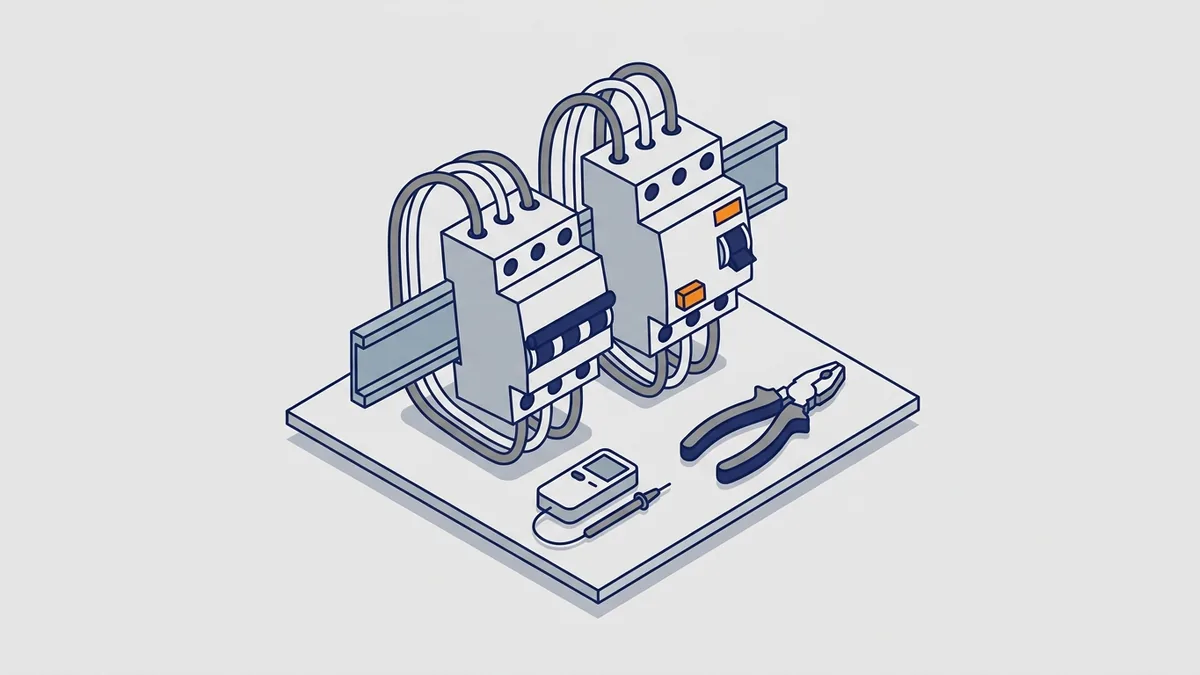
- AFCI: plug-on branch feeder breakers at 120 and 120/240 Vac, 10 kAIC. They detect arcing faults.
- GFCI: plug-on breakers, plus a 5 mA ground fault breaker at 3/4 inch per pole. They protect people from shock.
- GFEP: a 30 mA ground fault equipment protector for equipment protection.
- Twin: the CHT2020 puts two 20 A circuits in one space. It is 120/240 V, switching duty and HACR rated.
- High-ambient: the CH250M50 is a 50 A two-pole breaker that needs two 3/4-inch spaces.
- CH-HID: for HID lighting loads, at 120, 120/240 and 240 Vac, 10 kAIC.
- Switching neutral: listed in the catalog as its own section.
Which CH loadcenters accept twin (CHT) breakers?
We could not confirm a full list of loadcenters that take CHT breakers. Each loadcenter has its own limit on twins, so check three things before you order:
- The panel label, which states the allowed breaker types and any twin limits.
- The loadcenter’s catalog page or instruction sheet from Eaton.
- The 200 A stab limit, because a twin adds two circuits to one stab.
If the label does not allow twins, do not install one.
What do AFCI and GFCI trip codes and LEDs mean, and how do I stop nuisance trips?
We could not confirm the exact LED or trip-code meanings for each Eaton model. They differ between AFCI, GFCI and dual-function breakers, so read the instruction sheet that came with your breaker. Do not rely on a code chart from another brand.
To troubleshoot a repeat trip, work in this order:
- Press the test button, then reset the breaker.
- Unplug or switch off everything on the circuit, then reset.
- Add loads back one at a time to find the one that trips it.
- Check for a shared neutral or a neutral that touches ground, because both can trip these breakers.
- Look for loose connections and damaged cords.
If it still trips with no load, replace the breaker or call a qualified electrician.
Eaton enclosed circuit breaker: the two things people mean
What is an Eaton enclosed circuit breaker?
An eaton enclosed circuit breaker is a breaker mounted at the factory in a NEMA-rated box with a disconnect handle. People use the term for two different products, so confirm which one you need.
The first is the CH-style unit enclosure. Eaton’s ECB enclosures hold a single breaker at 240 V. For example, the ECB225S is a 225 A, NEMA 1, surface-mount enclosure for CSR breakers, rated 10 kAIC. Wire size depends on the installed breaker. In addition, ECC unit enclosures cover 100–225 A at 240 Vac, UL 489, in NEMA 1 (surface or flush) and NEMA 3R (surface).
The second is the industrial Power Defense enclosed breaker. It runs 15 to 1200 A, arrives fully assembled, and can be padlocked in the OFF position as standard. Also, PXR 10 and PXR 20 electronic trip units are available.
What NEMA enclosure types are available for Eaton enclosed breakers?
Power Defense enclosed breakers come in NEMA 1, 3R, 12/3R and 4X. Eaton’s Power Xpert enclosed breakers with the Arcflash Reduction Maintenance System add NEMA 4 and 4X stainless. As for use, a NEMA 1 box suits dry indoor areas. Outdoors, NEMA 3R handles rain. Where dust and dripping liquid are a concern, NEMA 12 blocks both, and 4X resists corrosion.
How do I choose between them?
Pick a unit enclosure for a single-circuit service or a subpanel in a light-commercial area. Pick a Power Defense enclosed breaker for a machine or plant feeder in an industrial area. Next, match the NEMA type to the room.
Where each CH product fits
Where does a CH breaker fit and where does it not?
Eaton CH loadcenters serve services up to 240 Vac. Eaton’s catalog lists main lugs at 40–400 A and main breakers at 100–400 A, and all 40–400 A loadcenters are 10 kAIC. Use NEMA 1 indoors and NEMA 3R outdoors. Good fits include these:
- Shop offices and utility rooms
- Outbuildings and small auxiliary panels
- Lighting circuits
- HVAC circuits, thanks to the HACR marking
The catalog ratings cover services up to 240 Vac. We found no source that supports eaton ch circuit breakers for drive input or motor branch circuits at 480 V.
What Eaton breakers suit 480 V motor, drive or industrial feeders?
Industrial panels can have high fault current, so they call for molded-case or enclosed industrial breakers. Eaton’s molded case circuit breaker catalog, CA08100005E, covers that class. For a plant feeder, the Power Defense molded case and enclosed breakers described above are a good place to start.
For a motor circuit, the choice depends on the starter. Eaton also makes motor circuit protectors for use in combination starters. For a drive, follow the drive manual, which names the fuse or breaker type it needs. We do not give a model number here, because the right part depends on the load, voltage and fault current.
Eaton CH vs BR and other brands
What is the difference between Eaton CH and BR breakers?
Eaton support lists BR at 1 inch wide with a 10-year warranty. It lists CH at 3/4 inch wide, black with sandalwood handles, with a lifetime warranty. Each is made for its own loadcenter. In addition, a third-party comparison says the two use different bus connections, mounting features, insertion depths and deadfront openings.
So the answer is no: you cannot use a BR breaker in a CH panel. Instead, follow the panel label.
Can I mix CH breakers with other brands, or use CHQ in a Square D panel?
Treat classified breakers as their own category. Third-party sources say Eaton makes CHQ for Square D QO panels and CL for Homeline panels in 15–50 A ratings. However, Eaton has not confirmed those claims in what we found. Check the panel label and Eaton’s catalog first.
Mixing unlisted breakers can void the panel’s UL listing. It also goes against NEC 110.3(B), which requires you to follow listing and labeling instructions. We do not quote price gaps, because those claims are anecdotal and change often.
Are CHF and CH breakers interchangeable?
Third-party sources say they are. CHF is a CH-family breaker with a mechanical trip flag. Still, confirm against Eaton’s catalog for your specific panel.
How to pick the right CH breaker before you order
How do I choose the right CH breaker for my panel?
Work through these steps in order:
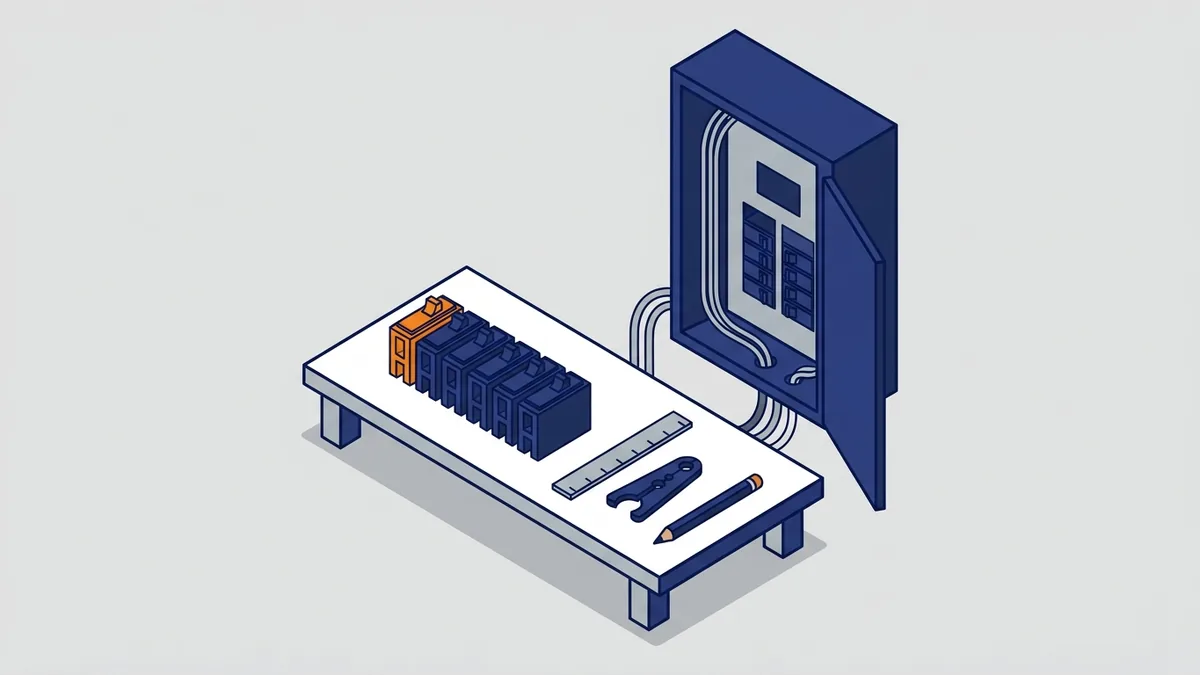
- First, read the panel label for the allowed breaker types and series.
- Next, confirm pole count, ampere rating, voltage and wire range.
- Then compare the interrupting rating with the available fault current and the series-rating table.
- After that, choose the function: standard, CHF flag, AFCI, GFCI or twin.
- Also confirm whether the loadcenter is plug-on neutral or standard. CHP panels need N versions.
- Finally, check the space. Two-pole high-ambient breakers need two 3/4-inch spaces.
What mistakes do buyers make when ordering CH breakers?
Four mistakes come up most often:
- Ordering a BR breaker for a CH panel
- Ignoring the 200 A stab limit
- Assuming a standard and a plug-on neutral loadcenter take the same breaker
- Assuming a CH breaker suits a 480 V circuit
Documents, catalogs and where to get CH breakers
Where can I find CH catalog and spec documents?
Start with Eaton’s Loadcenters and Circuit Breakers catalog, CA08100002E, Volume 1 Tab 1. Eaton also posts a Type CH catalog and a CH Loadcenters product page. For the BR and CH differences, use the Eaton Technical Resource Center. Also, individual Eaton SKU pages show UL 489 listing, wire range and warranty.
For enclosed products, see the ECB225S SKU page and the Power Defense enclosed circuit breakers catalogue. Because retail and distributor listings vary, verify catalog numbers against Eaton’s SKU pages.
Precision Electric does not list CH breakers in its product list, and we do not claim stock. However, our focus is drives, motors and controls, and we can help you match parts.
What replaces discontinued parts such as the CH250M50 and ECB225S?
The ECB225S enclosure is now the ECC225S, which fits the ECC unit enclosure family described above. Confirm that the breaker you plan to install, such as a CSR, is listed for the new enclosure.
For the CH250M50, we could not confirm a direct replacement number. Its key traits are 50 A, two poles, high-ambient rating and two 3/4-inch spaces. Look up the part on Eaton’s SKU page, which shows the current status, or ask Eaton or a distributor for a cross-reference. Then match those traits and the panel label before you order.
Warranty, lead time and when to call for help
What warranty comes with CH breakers?
Eaton’s CH2100CS SKU page lists a limited lifetime residential warranty and a 1-year commercial warranty. Eaton support describes CH as a lifetime-warranty line. Because terms vary by use, read the SKU page for your part.
When should I call an electrician or repair specialist?
Call a qualified electrician for repeated trips, scorched stabs or mismatched breakers in a panel. Also let a professional do any live-panel work, and follow the NEC and the panel label. For drive-fed circuits or repeated drive trips, check the drive manual, because a CH breaker is not drive protection.
Frequently asked questions
What are Eaton CH circuit breakers?
They are Eaton’s 3/4-inch-per-pole plug-on thermal-magnetic breakers for CH loadcenters in residential and light-commercial use. They are UL 489 breakers with tan handles. In addition, the line is rated 10–150 A in one, two and three poles.
Can I use an Eaton BR breaker in a CH panel?
No. Eaton lists BR at 1 inch wide and CH at 3/4 inch, and each is made for its own loadcenter. Instead, follow the panel label.
What is an Eaton enclosed circuit breaker?
It is a breaker mounted at the factory in a NEMA-rated box with a disconnect handle. For CH-style products, Eaton’s ECB unit enclosures hold a single breaker at 240 V. For industrial use, however, Power Defense enclosed breakers run 15–1200 A in NEMA 1, 3R, 12/3R or 4X.
What interrupting rating do Eaton CH breakers have?
Standard branch CH breakers in Eaton’s catalog are 10 kAIC. However, higher-rated mains exist, such as 22 kAIC on H-suffix mains and 25 kAIC on 150–225 A mains. For the exact combination, check the series-ratings table.
Are CHF and CH breakers interchangeable?
Third-party sources say so. CHF is a CH-family breaker with a mechanical trip flag. Still, confirm against Eaton’s catalog for the specific panel.
Are CH breakers suitable for 480 V motor or drive circuits?
The catalog ratings shown for CH loadcenters cover services up to 240 Vac. For 480 V motor or drive circuits, therefore, use the protection the drive or equipment manual specifies.
Eaton CH breakers work well when you match the panel label, the ratings and the job. Before you buy, check the catalog number against Eaton’s own documents. If you need help matching parts or have a drive, motor or control question, contact Precision Electric for a quote or repair.