SPX9000 Drive Guide: Models, Ratings and How to Choose
If you are sourcing an spx9000 drive, the hard part is picking the right large-frame model from a catalog that dates to the mid-2000s. This guide covers what the series is, how the models and frame sizes work, and how to match a drive to your motor and supply. In addition, it gives a pre-order checklist and says when repair beats replacement.
On this page
- What the Eaton SPX9000 is
- SPX9000 models and ratings
- High-horsepower SPX9000 models we stock (200 to 2000 HP)
- Choosing the right SPX9000: voltage, amps and duty
- 12-pulse, input chokes and brake choppers on large frames
- SPX9000 vs SVX9000 and other options
- Installation and setup essentials for the SPX9000
- Where to find SPX9000 documents and parts
- SPX9000 cost, lead time and warranty
- Common SPX9000 ordering mistakes and when to call for help
- Frequently asked questions
What the Eaton SPX9000 is
The Eaton SPX9000 drive is a high-performance AC drive in Eaton’s 9000X family. That family also includes the HVX9000, SVX9000 and SLX9000. Eaton lists a performance range from 0.75 kW at 400 V up to 2 MW at 690 V.
What control modes does the SPX9000 offer?
The spx9000 gives you several ways to control a motor:
- V/Hz (frequency) control, with boost and slip compensation
- Open-loop sensorless vector control
- Closed-loop frequency control
- Closed-loop vector control with encoder feedback
However, the two closed-loop modes are SPX9000 only. The family also has an inter-drive high-speed bus at 12 Mbit/s for linking drives.
What feedback boards does closed-loop operation need?
Closed-loop modes need an encoder (speed feedback) option board in one of the drive’s plug-in slots. The board type must match your encoder signal. Because we cannot verify the board-to-slot map here, check the option board section of Eaton’s manual before you order.
What motors can this drive run?
This drive runs standard induction motors. Eaton also lists permanent magnet motor and synchronous reluctance motor control as core features. For example, Eaton’s catalog text points to cranes, winders, positioning and coordinated multi-motor systems. It also fits pumps and other variable loads.
Is this drive still current?
The documentation for this line dates from about 2005 and 2006. However, Eaton has marked some spx9000 catalog numbers as discontinued on its website. We did not check every large frame one by one, so confirm availability of your exact catalog number before you plan around it.
SPX9000 models and ratings
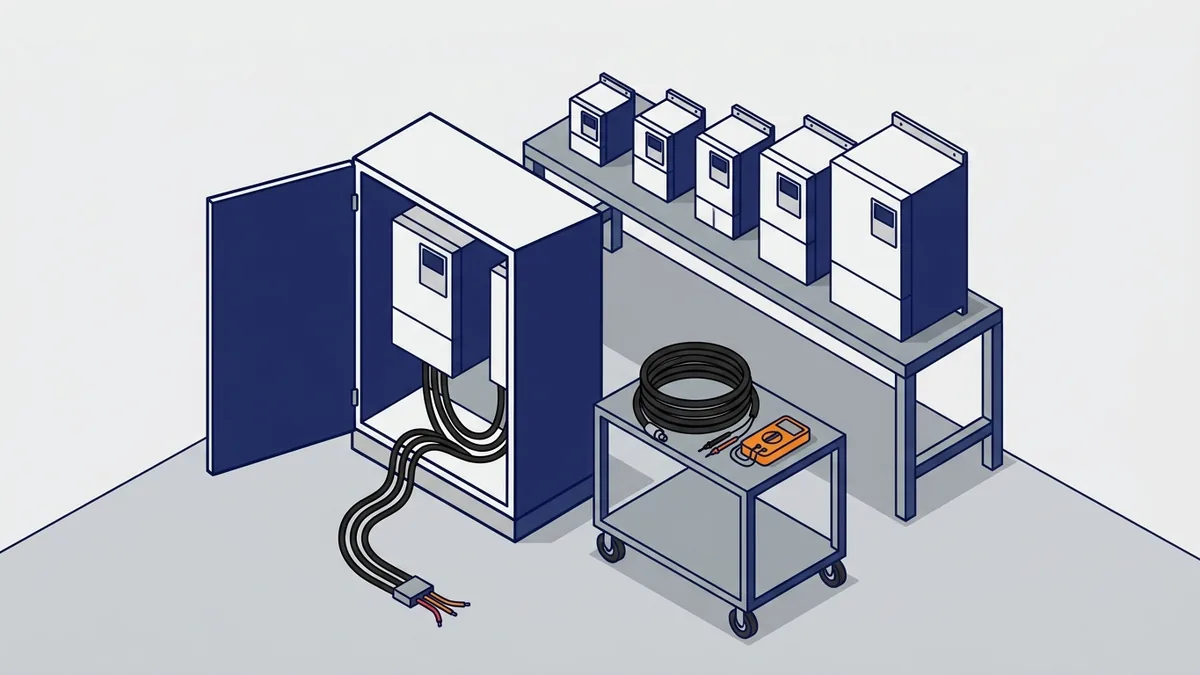
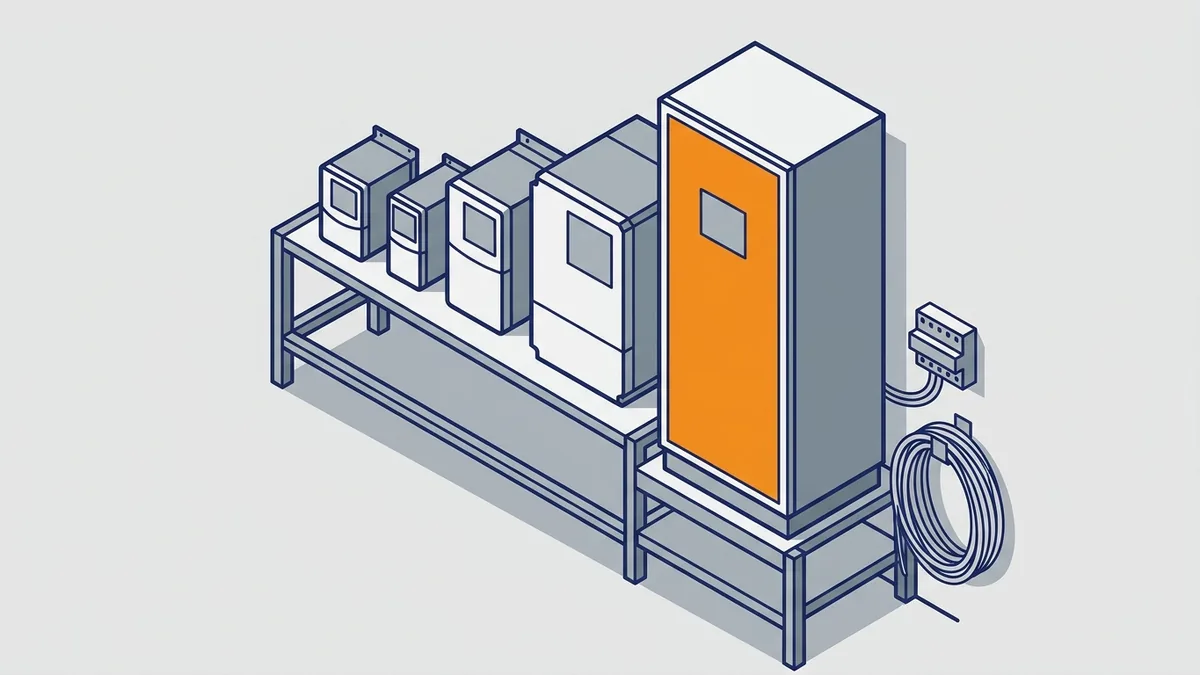
Frame size, written FR4 to FR14, rises with horsepower and voltage. The Eaton SPX9000 variable frequency drive uses small frames for light duty and large frames for heavy industrial loads. This article focuses on the large frames, but the small ones help you see the pattern.
What horsepower and voltage ratings does the SPX9000 come in?
Eaton’s 9000X manual gives these ranges for the small and medium frames:
- FR4: 230 V, 3/4 to 3 hp; 480 V, 1 to 5 hp
- FR5: 230 V, 5 to 7.5 hp; 480 V, 7.5 to 15 hp
- FR6: 480 V, 20 to 30 hp; 575 V, 2 to 25 hp
- FR7: 480 V, 40 to 60 hp; 575 V, 30 to 40 hp
- FR8: 480 V, 75 to 125 hp; 575 V, 50 to 75 hp
- FR9: 480 V, 150 to 200 hp; 575 V, 100 to 175 hp
Above that, FR10 to FR14 cover the large drives. The manual’s FR11 table, for example, lists 400, 500, 550 and 650 hp.
What do FR13 and FR14 mean?
These are the biggest frames, and they are multi-module builds. Eaton’s catalog says FR13 is built from an inverter module and a converter module. It also says FR14 is built from two FR13 modules. Because of this, one listed drive is really a small system, so plan space and input equipment for the whole build.
What is the difference between I_H and I_L ratings?
Eaton rates each large drive at two duty levels. First, I_H is the high-overload (heavy duty) current, and I_L is the low-overload (light duty) current. Then the horsepower in a catalog number usually matches the I_H rating. As a result, compare amps at the same duty level before you compare two drives.
For example, Eaton’s catalog rows show how this works:
- SPXH12A0-4A2N1 (FR14): 1200 hp at I_H with 1600 A, and 1500 hp at I_L with 1770 A.
- The SPXH13A0-5A2N1 (FR14) lists 1350 hp at I_H with 1300 A, and 1500 hp at I_L with 1500 A.
- In FR13, SPX800A0-4A2N1 lists 800 hp at I_H with 1030 A, and 900 hp at I_L with 1150 A.
- Also in FR13, SPX800A0-5A2N1 lists 800 hp with 820 A.
High-horsepower SPX9000 models we stock (200 to 2000 HP)
We carry open-chassis spx9000 drives from 200 to 2000 HP. Open chassis means the drive has no enclosure, so you supply the enclosure and the cooling. Also, the table lists the amps from our own listings. Eaton’s catalog rows cover only some of these models, so confirm the nameplate amps before you order.
| Catalog number | HP | Voltage class | Input | Output | Our listed amps |
|---|---|---|---|---|---|
| SPX250A0-4A2N1 | 250 | 480 V (-4) | 400-480 VAC | 480 VAC | 330 |
| SPX250A0-4A2N1U (12-pulse) | 250 | 480 V (-4) | 400-480 VAC | 480 VAC | 330 |
| SPXH10A0-4A2N1 | 1000 | 480 V (-4) | 400-480 VAC | 480 VAC | 1300 |
| SPXH12A0-4A2N1 | 1200 | 480 V (-4) | 400-480 VAC | 480 VAC | 1600 |
| SPXH16A0-4A2N1 | 1600 | 480 V (-4) | 400-480 VAC | 480 VAC | 1940 |
| SPXH19A0-4A2N1 | 1900 | 480 V (-4) | 400-480 VAC | 480 VAC | 2300 |
| SPX200A0-5A2N1 | 200 | 575 V (-5) | 540-600 VAC | 600 VAC | 208 |
| SPX250A0-5A2N1 | 250 | 575 V (-5) | 540-600 VAC | 600 VAC | 261 |
| SPXH10A0-5A2N1 | 1000 | 575 V (-5) | 540-600 VAC | 600 VAC | 1030 |
| SPXH13A0-5A2N1 | 1350 | 575 V (-5) | 540-600 VAC | 600 VAC | 1300 |
| SPXH15A0-5A2N1 | 1500 | 575 V (-5) | 540-600 VAC | 600 VAC | 1500 |
| SPXH20A0-5A2N1 | 2000 | 575 V (-5) | 540-600 VAC | 600 VAC | 1900 |
How do I read an SPX9000 catalog number?
First, read the series, SPX. Next comes the horsepower code, so H10 means 1000 hp and H12 means 1200 hp. Smaller sizes, for example, use plain numbers, such as 250 or 800.
Then the number ends in -4 or -5. Eaton’s SKU descriptions tie -4A2N1 to the 480 V class and -5A2N1 to the 575 V class. However, do not read more into the other letters than Eaton’s own descriptions say.
Eaton calls the -5 class 575 V, while our listings show 540-600 VAC in and 600 VAC out. In fact, both describe the same class. So match the drive to your plant supply, not just to the label.
Choosing the right SPX9000: voltage, amps and duty
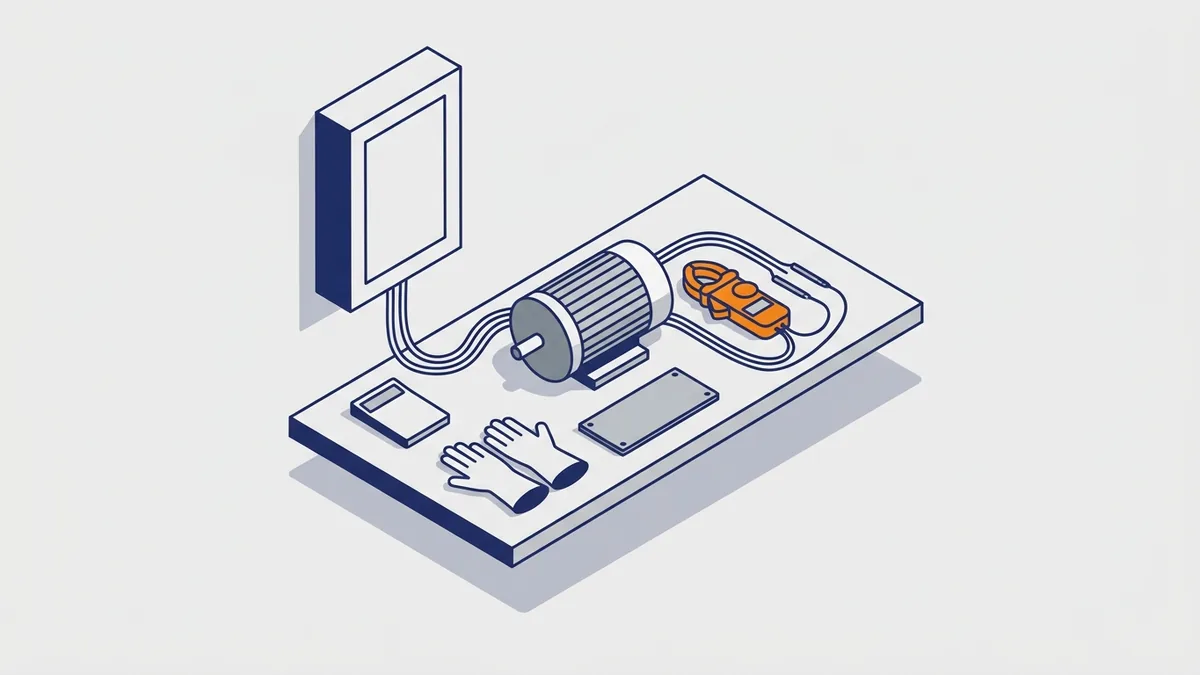
Start with your supply voltage, then size by current. Horsepower alone can mislead you, because two motors of the same hp can draw different amps. Follow these steps:
- First, confirm your supply. Choose a -4 model for 400-480 V in, or a -5 model for the 575/600 V class.
- Next, read the motor nameplate full-load amps (FLA).
- Then pick the duty level. Compare the FLA against the drive’s I_H amps for heavy duty or I_L amps for light duty.
- Also check the ambient temperature. Eaton’s rating tables assume a maximum environment of 40°C (104°F).
- Finally, confirm the input chokes and other parts that your catalog number needs.
Which model fits a 480 V versus a 575/600 V motor?
For a 480 V motor on a 400-480 V supply, use a -4 model with 480 V output. For a 575/600 V motor, use a -5 model with 600 V output. Then check amps. However, a 575 V drive of the same hp draws fewer amps than a 480 V one, so the current ratings are not interchangeable between classes.
Does the SPX9000 need derating for heat, altitude or switching frequency?
Yes, in many cases. The ratings assume a 40°C maximum ambient. Hotter air, high altitude and a higher switching frequency all cut the current the drive can deliver, because each one adds heat or removes cooling.
The exact percentages and overload limits for each frame are in Eaton’s manual, so we do not quote them here. For example, if your site sits high or runs hot, size up one step and check the manual’s derating tables first.
12-pulse, input chokes and brake choppers on large frames
Large frames need extra equipment around the drive. In fact, three items cause most surprises at order time.
What is the 12-pulse SPX9000 and when is it needed?
We list a 12-pulse 250 HP model, SPX250A0-4A2N1U. A 12-pulse front end is a way to reduce harmonics, which are distortion the drive puts back on your power line. It carries a different part number from the standard 250 HP model, so one catalog number does not cover both. However, we found no Eaton data on its harmonic performance. If your utility or plant standard sets harmonic limits, check Eaton’s documentation or ask us.
How do harmonic options affect input equipment?
Extra line reactors lower harmonics at a modest level. A 12-pulse drive usually needs a supply with two phase-shifted feeds, often from a transformer with two secondary windings. An active front end is another route, but it adds its own hardware. In every case, the options change your transformer, fusing and cable plan, so settle them before you order.
Do large SPX9000 drives include input chokes or a brake chopper?
Eaton’s catalog states that chokes are provided with all FR10-FR14 drives. It also says FR10-FR14 includes a 3% line reactor that is not integral to the chassis. So the chokes ship with the drive, but you mount them separately. Eaton’s catalog lists the count by catalog number:
- SPX H10 4 (FR13): 3 x CHK0520
- For the SPX H12 4 (FR14), 4 x CHK0520
- The SPX H16 4 (FR14) takes 6 x CHK0400
- SPX H10 5 (FR13): 2 x CHK0400
- For the SPX H13 5 (FR14), 4 x CHK0400
- The SPX H15 5 (FR14) takes 6 x CHK0400
First, confirm the choke set when you order. Next, for braking, Eaton says internal brake choppers are available up to frame size 9. However, Eaton’s SKU pages show large FR13 units with no brake chopper. As a result, if your load regenerates, such as a crane or an overhauling load, plan on external braking.
How do I size an external brake chopper and resistor?
Start with the load. Find the peak braking power, how long each braking event lasts, and how often it repeats. Then pick a resistor that handles that energy without overheating. Its ohm value must also stay above the chopper’s minimum, and the chopper must match the drive’s DC bus voltage. Because large frames are costly to get wrong, send us your load data and the drive nameplate before you buy.
SPX9000 vs SVX9000 and other options
The SPX adds closed-loop vector control, closed-loop frequency control and the 12 Mbit/s inter-drive bus. In contrast, the SVX9000 aims at open-loop dynamic performance. Therefore, if your application needs no encoder feedback, an SVX9000 may do the job. For more detail, we cover that comparison in our separate SVX9000 post.
What replaces a discontinued SPX9000?
We found no source that names an Eaton successor model, so we will not guess. Instead, ask Eaton or our team which drive is currently supported for your catalog number. Then check that the replacement matches your voltage class, amps, frame space and control needs. Also check whether your motor, chokes and control wiring still fit, because a new drive may need different parts.
When should I repair rather than replace an SPX9000?
Repair often makes sense when the drive is otherwise sound and the failure is a part, such as a fan or a board. It also helps when no direct replacement exists for your catalog number. However, replace when faults keep returning, or when you need a feature the old drive lacks. We do not quote repair costs or times here, so contact us with the nameplate details.
Installation and setup essentials for the SPX9000
This section lists the main checks only. For wiring, startup and parameters, follow Eaton’s manuals, not memory or a summary. In addition, large frames need the SPX FR10-FR14 manual, which Eaton’s catalog also names for mounting instructions.
What clearance, cooling and wire ratings does the SPX9000 need?
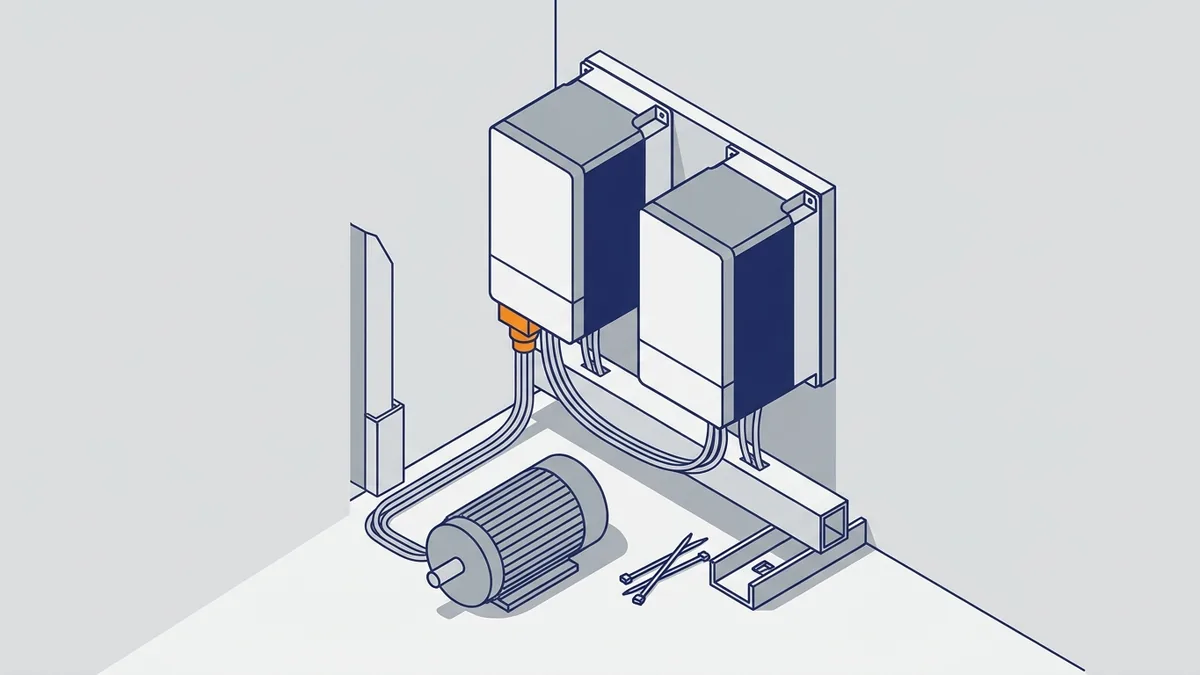
When you stack several units, leave clearance equal to C + D between them. Also direct the outlet air of the lower unit away from the inlet of the upper unit. In addition, use only copper wire rated at least 75°C. The manual lists wire and fuse sizes by hp and frame, so check it for your drive. It also holds the dimensions you need for enclosure design.
What is the short-circuit current rating?
Eaton’s 9000X manual gives a maximum symmetrical short-circuit current rating of 100 kA rms, per UL 508C. Then check that against the available fault current at your panel.
What fieldbus and I/O options are available?
The Eaton SPX9000 adjustable frequency drive has five plug-in slots for I/O expansion, and three of them are freely assignable. Next, Eaton lists optional fieldbus cards for CANopen, PROFIBUS-DP, Profinet, DeviceNet and LonWorks. It also offers PID control and PFC (power factor correction). Finally, the manual describes the Basic and Local/Remote applications with their default I/O.
How do I troubleshoot common trips on large frames?
Eaton’s manual lists the fault codes and their meanings, so use it to read the exact code first. Then check the usual causes for each type of trip:
- Overcurrent: look for a motor or cable short, a ground fault, a locked load, or an acceleration time that is too short.
- Overvoltage: check for a deceleration time that is too fast, a regenerating load without braking, or high line voltage.
- Undervoltage: check for a supply sag, a blown fuse, or a loose input connection.
- Overtemperature: check the cooling fans, clogged filters or heatsinks, blocked airflow and high ambient heat.
If a fault returns after these checks, stop resetting the drive. Call us with the code and the nameplate details.
Where to find SPX9000 documents and parts
Eaton’s website hosts the documents you need for your spx9000 drive.
Where can I download the SPX9000 manual and catalog?
First, get the Eaton 9000X user manual, MN04001004E, from Eaton’s site. It covers the rating tables and applies to both the SVX9000 and the SPX9000. It is not limited to FR4 to FR9, because it also holds SPX FR10-FR14 content. That includes 575 V SPX FR10-FR14 power-rating tables, FR13 dimensions, choke drawings and FR10-FR12 cable tables. Next, the SPX FR10-FR14 installation manual, MN04001001E, covers the large frames and is listed on Eaton’s SPX9000 product page (dated 30/04/2006). Each Eaton SKU page also links to catalog material. We host a copy of the 9000X manual and the product series catalog on our own site as well.
What replacement parts are common?
Eaton and distributor pages list these parts:
- PP01068: cooling fan, 80 mm, internal mount
- VB00487: 9000X driver board
- VB00537: 9000X shunt board
Then match any part to your frame and voltage class using the manual. If you are unsure, send us the nameplate and we will help.
SPX9000 cost, lead time and warranty
Price, timing and warranty are the questions buyers ask before they order. The next two sections answer them.
How much does an SPX9000 cost and how long does it take to get one?
We do not quote prices here, and the 2006 catalog list prices are out of date. Instead, large frames are quoted to order, so use our product pages or ask us for a quote. Also, we have no lead time to share. As a result, ask about current availability of your exact catalog number before you plan a project around it.
What warranty applies?
Eaton’s SKU pages state a 2-year warranty. Eaton’s page text says drive products carry 24 months from shipment, or 36 months with Eaton certified startup. However, that applies to new product sold by Eaton. So for a unit from a distributor or a repaired drive, confirm the warranty with the seller.
Common SPX9000 ordering mistakes and when to call for help
Most problems come from a few repeat errors. Watch for these:
- Ordering by hp only, without checking I_H against I_L amps.
- Mixing up the 480 V (-4) and 575/600 V (-5) classes.
- Forgetting the enclosure, cooling, choke mounting space or external braking on open-chassis large frames.
- Assuming one catalog number covers both a standard and a 12-pulse build.
What mistakes do buyers make when ordering a drive?
The list above covers the usual ones. In addition, buyers sometimes trust amps from a listing without reading the nameplate. Always confirm the nameplate amps, because the shop figures are not Eaton-verified for every model.
Call us when a drive shows repeated faults. Also call when the nameplate and catalog numbers do not match, or when a large frame needs an engineered replacement.
Frequently asked questions
What is the Eaton SPX9000?
It is a high-performance Eaton AC drive in the 9000X family. It offers V/Hz, open-loop sensorless vector and closed-loop vector control. In addition, Eaton lists a range from 0.75 kW at 400 V to 2 MW at 690 V.
What is the difference between SPX9000 and SVX9000?
Closed-loop (encoder feedback) vector control and closed-loop frequency control are SPX9000 only. However, the SVX9000 is aimed at open-loop dynamic performance.
How do I choose between the -4 and -5 SPX9000 models?
First, match the supply. The -4 models are the 480 V class, with 400-480 V in and 480 V out. The -5 models are the 575 V class, which we list as 540-600 V in and 600 V out. Then size to the motor nameplate amps.
What is the short-circuit rating of an SPX9000?
Eaton’s 9000X manual gives a maximum symmetrical short-circuit rating of 100 kA rms, per UL 508C.
Where do I get the SPX9000 manual?
Eaton hosts the 9000X user manual (MN04001004E), which also holds SPX FR10-FR14 content. It also hosts the SPX FR10-FR14 installation manual (MN04001001E) for the large frames. However, large frames need the FR10-FR14 manual.
Are the large SPX9000 drives still available?
Eaton has marked some SPX9000 catalog numbers as discontinued. So ask us for current availability of your exact catalog number, or for repair or replacement options.
The spx9000 is a capable drive, but the large frames reward careful checking of voltage class, nameplate amps, duty level and extras such as chokes and braking. Confirm each item against Eaton’s manuals before you order. If you want help matching a drive, getting a quote or arranging a repair, contact Precision Electric or browse our SPX9000 products.