kVA Converter Guide: Convert kVA to Amps, kW and Back
A kVA converter turns a nameplate rating into amps or kW, but it only gives a good answer when you enter the right inputs. This guide shows you which formula to use for each direction, and how to apply it to transformers, generators, UPS units and motors. You will also learn the common mistakes and when to stop calculating and call for help.
On this page
- What a kVA converter does and what you need before you use one
- kVA, kW, kvar and power factor in plain terms
- How to convert kVA to amps with a kVA converter
- Using a kVA converter on IEC, split-phase and high-leg systems
- Going from amps back to kVA
- How to convert kVA to kW with a kVA to kW converter
- How to convert kW to kVA with a kW to kVA calculator
- Finding amps from kW, and kW from amps
- Sizing transformers with kVA
- How do I find transformer full-load current from kVA?
- Why does the secondary of a transformer carry more current than the primary?
- How do I choose a transformer kVA size from a load in amps?
- What are the standard transformer kVA sizes?
- How do I size transformer overcurrent protection and conductors under NEC 450.3 and 240.21?
- What are transformer inrush current and available fault current?
- Using kVA ratings on generators
- Using kVA ratings on UPS units and drives
- Motors: kVA math vs NEC table full-load current
- Common kVA math mistakes
- Choosing a kVA converter or calculator and checking the result
- When to call an engineer or repair shop
- Frequently asked questions
What a kVA converter does and what you need before you use one
What does a kVA converter do?
A kVA converter changes apparent power (kVA) into another quantity, such as amps or kW, or turns those values back into kVA. However, each conversion needs different inputs. A kVA calculator that hides those inputs can give you a wrong answer without any warning.
So there is no single amps value for a given kVA. First, you must know the voltage and the number of phases.
What information do I need from the nameplate?
Before you open any kVA calculator, gather these four items from the nameplate:
- kVA or kW: the rating you start with.
- System voltage: use line-to-line voltage on three-phase systems.
- Number of phases: single-phase or three-phase.
- Power factor: needed only for conversions that involve kW.
The table below shows which inputs each job needs.
| Conversion | Voltage | Phase | Power factor |
|---|---|---|---|
| kVA to amps | Needed | Required | Not used |
| kVA to kW | Not used | Skip it | Needed |
| kW to kVA | Not used | Skip it | Needed |
| kW to amps | Needed | Required | Used |
Always confirm voltage, phase and power factor on the nameplate. After all, a kVA converter never replaces the nameplate.
kVA, kW, kvar and power factor in plain terms
What is the difference between kVA and kW?
First, kW is real power, the power that does the work. Meanwhile, kVA is apparent power, the total the source must supply. The gap between them is reactive power, measured in kvar.
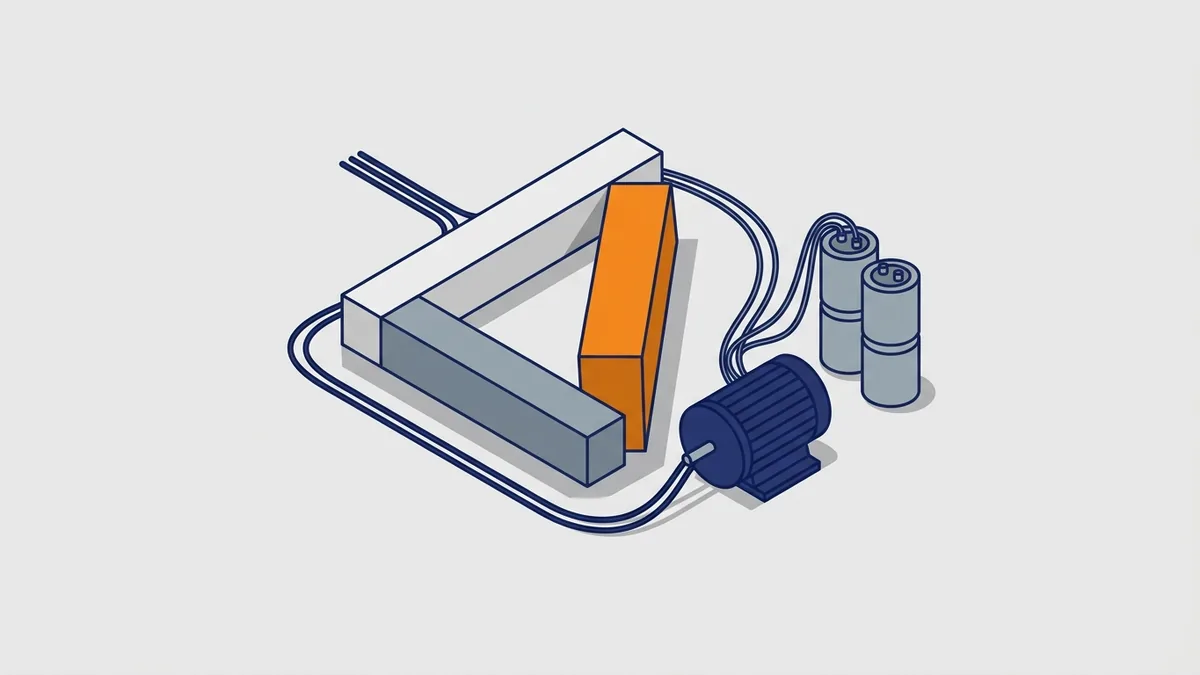
The three values form a power triangle: kVA² = kW² + kvar². For example, 100 kW at 0.8 power factor is 125 kVA and 75 kvar.
kVA equals kW only at a power factor of 1, as with a purely resistive load. Otherwise kVA is always larger. As a result, kVA is never lower than kW.
What is power factor and why does it matter for the math?
Power factor is the ratio of kW to kVA. For example, 85 kW on a 100 kVA supply gives a power factor of 0.85.
It matters because it links the two units. In fact, every kVA to kW converter and every kW to kVA calculator uses it. Roughly, 0.80 to 0.90 is moderate and 0.90 to 0.97 is good. Finally, anything under 0.60 is very low.
Why are transformers, generators and UPS units rated in kVA?
Winding heat depends on current, and current depends on kVA, whatever the load’s power factor. Also, the manufacturer does not know the power factor of the load you will connect. So the maker rates the equipment in kVA and leaves the kW answer to you.
For this reason, a kVA converter is part of daily work around this equipment.
How do I improve a low power factor?
Add capacitors, which supply the reactive power that motors and transformers would otherwise pull from the source. The size you need in kvar is: kvar = kW × (tan of the starting angle − tan of the target angle). For example, a 100 kW load at 0.80 needs about 42 kvar to reach 0.95. That is 100 × (0.750 − 0.329).
Low power factor also costs money. It raises current for the same kW, so it adds losses and voltage drop and calls for larger equipment. In addition, many utilities bill demand in kVA or add a charge below a set power factor. Check your rate schedule, because each utility sets its own limit.
However, do not install capacitors on a circuit with drives or other harmonic-rich loads without a study. They can resonate with the system and cause damage. In that case, ask an engineer.
How to convert kVA to amps with a kVA converter
Here is the short answer to “how do I convert kVA to amps?” First multiply kVA by 1000 to get VA. Then divide by the voltage, and by 1.732 as well on a three-phase system. You do not need power factor.
People search for this as a converter kva to amp tool or a kva to ampere converter. Either way, the math below is what runs behind the screen. In addition, you can do it by hand in under a minute.
What is the single-phase formula?
For single-phase, use this formula:
Amps = kVA × 1000 ÷ volts
For example, 5 kVA at 240 V gives 20.8 A. Likewise, 10 kVA at 240 V gives 41.7 A. As a shortcut, 240 V single-phase draws about 4.17 A per kVA.
What is the three-phase formula and what is 1.732?
For balanced three-phase, use this formula:
Amps = kVA × 1000 ÷ (1.732 × line-to-line volts)
The number 1.732 is the square root of 3. It comes from the 120-degree spacing between the three phases. However, use it only in the three-phase formula, never on single-phase.
Here are three worked examples:
- 75 kVA at 480 V is about 90.2 A.
- 100 kVA at 208 V is about 277.6 A.
- 5 kVA at 208 V is about 13.9 A per phase.
Next, notice that the same 100 kVA draws about 120.3 A at 480 V but about 277.6 A at 208 V. As a result, lower voltage means more current for the same kVA.
However, if you have three equal single-phase loads on line-to-neutral voltage, use a different version: current per phase = kVA × 1000 ÷ (3 × line-to-neutral volts).
How many amps is 1 kVA at 208, 240 and 480 V?
The table below uses the formulas above for 1 kVA. Multiply each value by your kVA rating.
| System | Amps per kVA |
|---|---|
| 120 V single-phase | 8.33 |
| 240 V single-phase | 4.17 |
| 208 V three-phase | 2.78 |
| 240 V three-phase | 2.41 |
| 480 V three-phase | 1.20 |
| 600 V three-phase | 0.96 |
Some people use rule-of-thumb multipliers, such as about 1.2 A per kVA at 480 V three-phase and about 2.8 at 208 V. However, these are shortcuts, not exact values. So use the formula or a table as the check.
Using a kVA converter on IEC, split-phase and high-leg systems
How do I convert kVA and amps at 380, 400 and 415 V?
Use the same three-phase formula with the line-to-line voltage of your system. For example, 100 kVA gives about 151.9 A at 380 V, 144.3 A at 400 V and 139.1 A at 415 V. Only the voltage changes.
How do I convert kVA and amps on a 120/240 V split-phase system?
Treat the two hot legs as one 240 V single-phase source. Amps = kVA × 1000 ÷ 240. For example, a balanced 10 kVA load draws about 41.7 A on each hot leg. The neutral carries only the unbalance between the two legs.
How do I convert kVA and amps for 208 V single-phase from a three-phase source?
A 208 V single-phase load connects between two phases of a 208Y/120 V system. Use the single-phase formula at 208 V. For example, 5 kVA draws about 24 A. However, that load sits on only two phases, so spread single-phase loads across all three to keep the source balanced.
How do I convert kVA and amps on a high-leg delta system?
A 120/240 V four-wire delta has 240 V between any two phases. Use 240 V in the three-phase formula for three-phase loads, and in the single-phase formula for loads across two phases. The high leg measures about 208 V to neutral, so never use it for 120 V loads. Also, the 120 V loads sit on a center-tapped winding, so check the transformer maker’s rating for that winding.
Going from amps back to kVA
To go the other way, multiply the voltage by the current. A kVA to amperage conversion run backward uses these formulas:

- Single-phase: kVA = amps × volts ÷ 1000.
- Three-phase: kVA = 1.732 × line-to-line volts × amps ÷ 1000.
For example, 300 A at 415 V three-phase is 215.6 kVA. Also, 900 A at 480 V three-phase is about 748 kVA, which matches a 750 kVA rating.
First, use measured line-to-line voltage and the current of a balanced load. However, if the phases carry different currents, the formula only gives a rough answer. In that case, calculate each phase on its own or ask an engineer.
How to convert kVA to kW with a kVA to kW converter
The conversion kva kw formula is simple: kW = kVA × power factor. For example, a 100 kVA generator rated at 0.8 power factor gives 80 kW. Likewise, 500 kVA at 0.85 gives 425 kW.
Also, kW can never be greater than kVA, because power factor is never above 1. So if your kVA to kW converter shows a bigger kW number, check your inputs.
This table shows 100 kVA at common power factors:
| Power factor | kW from 100 kVA |
|---|---|
| 0.80 | 80 |
| 0.85 | 85 |
| 0.90 | 90 |
| 0.95 | 95 |
| 1.00 | 100 |
How to convert kW to kVA with a kW to kVA calculator
The conversion of kilowatt to kva is the reverse: kVA = kW ÷ power factor. For example, 10 kW at 0.8 is 12.5 kVA. Then at 0.85 it is 11.76 kVA. And 3 kW at 0.8 is 3.75 kVA.
In short, a lower power factor needs more kVA for the same kW. In fact, a load at 0.80 power factor draws 25% more kVA than kW. At 0.8, 1 kW equals 1.25 kVA.
| Power factor | 10 kW in kVA | 40 kW in kVA |
|---|---|---|
| 0.80 | 12.5 | 50.0 |
| 0.85 | 11.76 | 47.06 |
| 0.90 | 11.11 | 44.44 |
| 0.95 | 10.53 | 42.11 |
| 1.00 | 10.00 | 40.00 |
To size a source, first add up the real power of all loads in kW. Then divide by the load power factor. A kW to kVA calculator does the same thing.
Finding amps from kW, and kW from amps
When you start from kW, you must include power factor. When you start from kVA, you do not. Alternatively, you can work in two steps: first kW to kVA by dividing by power factor, then kVA to amps.
For single-phase, the one-step formula is amps = kW × 1000 ÷ (volts × PF). For three-phase, put 1.732 in the bottom as well: amps = kW × 1000 ÷ (1.732 × volts × PF).
Here is a worked example going the other way. A 480 V three-phase load draws 40 A at 0.8 power factor. As a result, its running power is about 26.6 kW.
Sizing transformers with kVA
How do I find transformer full-load current from kVA?
Use the same kVA to amps formula on each winding. For three-phase, divide kVA × 1000 by 1.732 times the winding voltage. For single-phase, divide by the voltage alone.
Next, the table below shows three-phase full-load amps for a few common sizes. Values differ slightly between publishers because of rounding.
| kVA | 208 V | 240 V | 480 V | 600 V |
|---|---|---|---|---|
| 15 | 41.69 | 36.13 | 18.06 | 14.45 |
| 45 | 125.06 | 108.38 | 54.19 | 43.35 |
| 75 | 208.43 | 180.64 | 90.32 | 72.25 |
| 112.5 | 312.64 | 271.95 | 135.48 | 108.38 |
For larger sizes and more voltages, check the Elliott Electric Supply three-phase transformer full-load current chart. In addition, the Acme 3-phase distribution transformer spec sheet on AutomationDirect lists amps at 208, 240, 380, 440, 480 and 600 V. The Engineering ToolBox page on transformer kVA, volts and amps covers single-phase units.
Why does the secondary of a transformer carry more current than the primary?
A transformer passes about the same kVA from one side to the other. Because kVA is volts times amps, the low-voltage side must carry more current. For example, a 45 kVA transformer at 480 V primary and 208 V secondary carries 54.1 A on the primary and 124.9 A on the secondary.
So always use the winding’s own voltage. Using the primary voltage to find secondary current is a common error.
How do I choose a transformer kVA size from a load in amps?
First, turn the load amps into kVA with the amps to kVA formula. Then round up to the next standard size. For example, 175 A at 208 V three-phase is about 63 kVA, so the next standard size up is 75 kVA.
Likewise, 175 A at 240 V single-phase is about 42 kVA, so you would pick 50 kVA. However, never round down.
What are the standard transformer kVA sizes?
Round up to one of these common sizes. Makers may offer others, so confirm in the catalog.
| Type | Common standard kVA sizes |
|---|---|
| Single-phase | 1, 1.5, 2, 3, 5, 7.5, 10, 15, 25, 37.5, 50, 75, 100, 167, 250, 333, 500 |
| Three-phase | 3, 6, 9, 15, 30, 45, 75, 112.5, 150, 225, 300, 500, 750, 1000, 1500, 2000, 2500 |
How do I size transformer overcurrent protection and conductors under NEC 450.3 and 240.21?
Start with the rated current of each winding from the kVA formula. Then NEC 450.3(B) sets the maximum overcurrent device rating, as a percent of that current, for transformers of 1000 V or less. The limits depend on whether you protect only the primary or both sides.
- Primary protection only: 125% of rated primary current at 9 A or more, 167% from 2 A to under 9 A, and 300% under 2 A.
- Primary and secondary protection: the primary device up to 250%. The secondary device up to 125% at 9 A or more, or 167% under 9 A.
When the percentage does not match a standard device size, the code lets you go up to the next standard rating in the main cases. For example, a 75 kVA, 480 V three-phase primary carries about 90 A. Its 125% value is about 113 A, so a 125 A device is the next standard size.
For conductors, the device rating and the ampacity rules in 240.4 still apply. In addition, 240.21(C) allows limited secondary conductor taps without protection at the supply end. These rules set short length limits and a minimum ampacity tied to the primary device and the voltage ratio. Because the details vary by case and edition, confirm them in the current NFPA 70 and with the authority having jurisdiction.
What are transformer inrush current and available fault current?
Inrush is the brief surge when you energize a transformer. It is often many times full-load current, commonly cited as about 8 to 12 times for a fraction of a second. So the primary device must ride through it. Use the manufacturer’s inrush data for the final choice.
Available fault current is the most current the secondary can deliver in a short circuit. For a quick estimate, assume a strong source and divide full-load current by the impedance as a decimal: fault amps = full-load amps ÷ (%Z ÷ 100). For example, a 75 kVA, 208 V three-phase transformer has about 208 A of full-load current. With 2% impedance, that is about 10,400 A. Read the real %Z on the nameplate, because it changes the answer. A weaker source gives a lower value, so this is a conservative estimate.
Using kVA ratings on generators
What is the kW rating of a kVA generator?
Use kW = kVA × power factor. Three-phase generator sets are conventionally rated at 0.8 power factor, so a 100 kVA set is stamped 80 kW. Likewise, a 750 kVA set at 0.8 delivers 600 kW.
However, do not assume 0.8 for every set. Single-phase sets are sometimes rated at unity. For that reason, read the data plate for the actual rating.
In practice, two parts set the limits. The alternator limits kVA, because of current and heat. The engine limits kW, because of shaft power. As a result, a 500 kVA set gives at most 400 kW, even when the load is at unity power factor.
Can a 100 kVA generator run a 100 kW load?
No. At 0.8 power factor, the set delivers 80 kW, so a 100 kW load leaves a 20 kW shortfall. Meanwhile, a 200 kW load at 0.8 power factor needs at least 250 kVA.
If you size on kW alone, the alternator comes up short whenever the load power factor is below 0.8. Instead, use the kW to kVA calculator method: divide total kW by the load power factor.
You can also read amps from the rating. For example, 100 kVA at 480 V three-phase is about 120.3 A. At 208 V it is about 278 A.
How do I size a generator beyond kVA conversion?
Conversion alone is not enough for generator selection. These factors also change the size you need:
- Rating type: a standby rating suits emergency use with limited running hours. A prime rating covers unlimited hours at a variable load. A continuous rating covers a constant load. The same engine carries a lower number at each step up, so match the rating to the duty.
- Altitude and temperature: engines lose power in thin or hot air. Use the manufacturer’s derating data for your site.
- Load steps: a large load added at once makes voltage and frequency dip. Stage big loads or size the set for the largest step.
- VFD harmonics: drives and rectifiers add heat in the alternator, so it may need to be larger.
Finally, have the maker or an engineer confirm motor-starting and VFD (variable frequency drive) loads.
Using kVA ratings on UPS units and drives
How do I read amps from a UPS or drive kVA rating?
Use the same kVA to amps formula with the supply voltage and phase. For example, a 5000 VA UPS at 208 V three-phase works out to 13.8 A per phase: 5000 ÷ (208 × 1.732).

For UPS units, read both the VA (or kVA) rating and the watt rating on the datasheet. Also, do not guess the kW from a power factor you assume.
For drives and phase converters, the input kVA and amps on the nameplate set the supply and conductor sizing. Our separate phase converter and ABB drive posts cover product-specific sizing. However, this guide covers only the kVA math.
How do I size a UPS and its input breaker?
First, check that your load fits both limits. Add up the load in VA and in watts, and keep each under the UPS rating. A load can be within the VA rating but over the watt rating, or the reverse. Leave some room for growth.
Next, separate output current from input current. Output current comes from the output VA and voltage. For example, 10 kVA at 208 V single-phase is about 48 A. Input current is higher, because the UPS also loses some power as heat and recharges its batteries. The datasheet gives input current at full load with the battery charging.
Then size the input breaker and branch circuit from the manufacturer’s recommended values for that model. Do not size them from the output current. Finally, confirm the choice against the code and the installation manual.
Motors: kVA math vs NEC table full-load current
Can I use kVA conversion to size a motor branch circuit?
No. A kVA formula gives the current of a load at a given kW and power factor. However, it does not replace the NEC motor tables for circuit sizing.
NEC 430.6(A)(1) sends you to the tables, by motor type, horsepower and voltage. Table 430.248 covers single-phase motors, and Table 430.250 covers three-phase motors. Also, check the current NFPA 70 edition for the exact values before you use them.
What is the difference between NEC table FLC and nameplate FLA?
First, table full-load current (FLC) is the value from the NEC tables. Second, nameplate full-load amps (FLA) is the value printed on the motor. In practice, the two often differ.
- Table FLC is used for conductors, disconnects and short-circuit and ground-fault protection.
- Nameplate FLA is used for overload protection.
For example, a 10 hp, 460 V three-phase motor has a table FLC of 14 A. Conductors for a single continuous-duty motor must be at least 125% of that, or 17.5 A of ampacity.
Single-phase and three-phase motor currents differ sharply. For example, a 10 hp motor at 230 V is 50 A single-phase but 28 A three-phase. Also, low-speed (under 1,200 RPM), high-torque and multispeed motors use nameplate FLA instead of Table 430.250.
How do I convert motor horsepower to kW and kVA?
Horsepower is output power. First, multiply hp by 0.746 to get output kW. Then divide by efficiency to get input kW. Finally, divide by power factor to get kVA.
For example, a 50 hp motor at 92% efficiency and 0.85 power factor works out like this:
- Output: 50 × 0.746 = 37.3 kW.
- Input: 37.3 ÷ 0.92 = about 40.5 kW.
- Apparent power: 40.5 ÷ 0.85 = about 47.7 kVA.
Use the efficiency and power factor from the motor nameplate or datasheet at the actual load.
How do I size a generator or transformer for motor starting?
A motor draws much more kVA at start than when it runs. The NEMA code letter on the nameplate gives locked-rotor kVA per horsepower. For example, code F is 5.0 to 5.59 kVA per hp, and code G is 5.6 to 6.29. Multiply by hp: a 50 hp code G motor draws about 280 to 315 kVA at start.
Then compare that to the source. The source must hold voltage during the start, so a generator or transformer often needs to be much larger than the running kVA. The maker’s motor-starting data or sizing software shows the allowed voltage dip. In addition, a reduced-voltage starter or a VFD cuts the starting kVA, which can allow a smaller source.
Common kVA math mistakes
Most wrong answers from a kVA converter come from bad inputs, not bad math. Watch for these:
- Using the single-phase formula on a three-phase system, or 1.732 on a single-phase one.
- Using line-to-neutral voltage in the line-to-line formula, such as 277 V instead of 480 V.
- Treating kW and kVA as the same, then buying a source that matches the number on the nameplate.
- Assuming 0.8 power factor when the real load is lower, which needs a larger source.
- Mixing NEC table FLC with nameplate FLA.
- Rounding down when you pick a breaker or transformer size. Round up to the next standard size.
- Using the primary voltage to calculate secondary current.
Choosing a kVA converter or calculator and checking the result
What should a good kVA calculator ask for?
A good kVA converter asks for the phase, the voltage type (line-to-line or line-to-neutral), the kVA or kW, and the power factor. If a tool skips the phase or voltage question, it is guessing. In that case, pick another one.

Also, you can find every input on a nameplate: kVA, volts, phase, and power factor or kW. Depending on what you have, check the transformer nameplate, the generator data plate or the motor nameplate.
How do I check a kVA calculator result?
First, never trust one number from one tool. Instead, cross-check it in one of these ways:
- Compare it with a full-load amps table, such as the transformer charts named above.
- Read the load with a clamp meter and compare.
- Compare it with the current printed on the nameplate.
Finally, verify against the code and the manufacturer’s data before you order anything.
When to call an engineer or repair shop
Sometimes the best kVA converter is a second opinion. Stop calculating and get help in these cases:
- The nameplate current is far above or below your calculated current.
- Three-phase loads are heavily unbalanced, harmonic-rich (drives, rectifiers) or show low measured power factor.
- A transformer, generator or drive overheats or trips at loads below its kVA rating.
- The nameplate is missing or unreadable.
- A generator must carry motor starting or regenerative loads.
In the end, final conductor, protection and code decisions belong to a qualified person and the authority having jurisdiction.
Frequently asked questions
How do I convert kVA to amps?
For single-phase, amps = kVA × 1000 ÷ volts. For three-phase, amps = kVA × 1000 ÷ (1.732 × line-to-line volts). However, you need only voltage and phase, not power factor. For example, 75 kVA at 480 V three-phase is about 90.2 A.
How do I convert kVA to kW?
Multiply kVA by the power factor: kW = kVA × PF. For example, a 100 kVA generator rated at 0.8 power factor gives 80 kW.
How do I convert kW to kVA?
Divide kW by the power factor: kVA = kW ÷ PF. For example, 10 kW at 0.8 power factor is 12.5 kVA. At a power factor of 1, kW and kVA are equal.
Why is kVA higher than kW?
kVA includes both real power (kW) and reactive power (kvar). The lower the power factor, the bigger the gap. As a result, kVA is never below kW.
Do I need power factor to convert kVA to amps?
No. Current follows from kVA, voltage and phase alone. However, power factor matters when you start from kW.
Can I size a motor circuit from a kVA conversion?
No. NEC 430.6(A)(1) uses the table full-load current in Tables 430.248 and 430.250 for conductors and short-circuit protection. In contrast, nameplate current is used for overload protection.
A kVA converter is only as good as the voltage, phase and power factor you give it, so read the nameplate first and check the answer against a table or a meter. Then use it to size and compare, and confirm with the code and the manufacturer’s data. If you need help with a transformer, generator, UPS or drive, contact Precision Electric for a quote or repair, or browse our products.