








Motor Fan Guide: Cooling Fans, Fan Motors and Repair
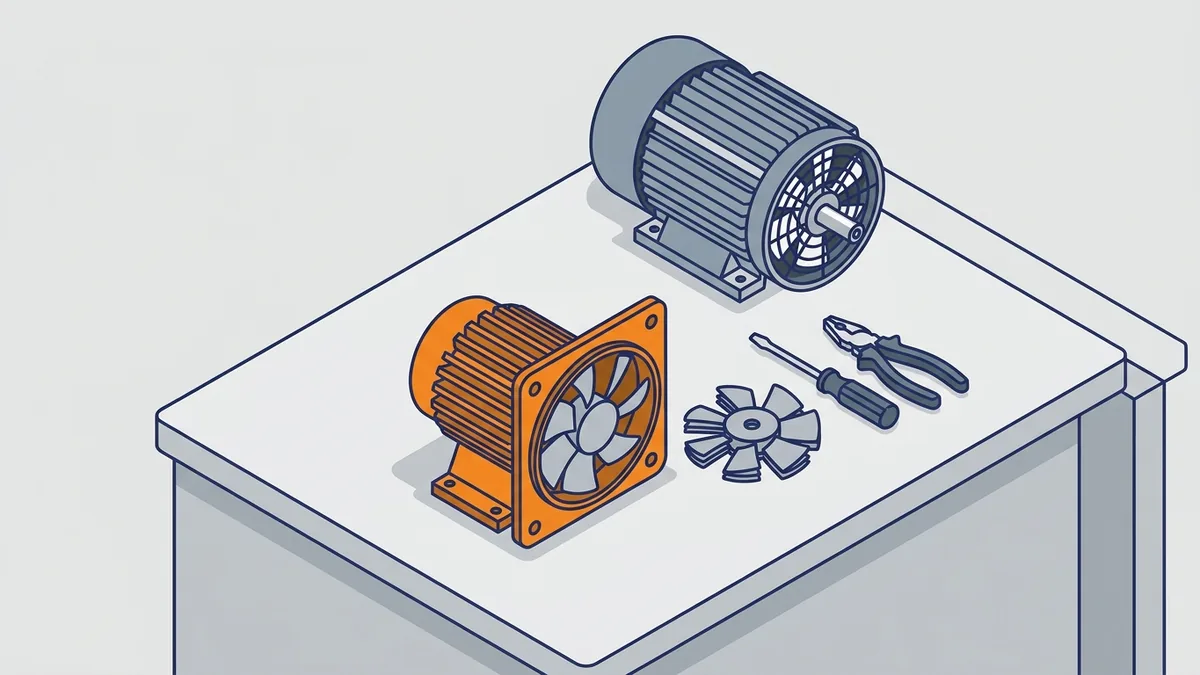
A motor fan can mean two things: the fan that cools an electric motor, or the motor that turns a fan or blower. Because the two get mixed up, people often test the wrong part or order the wrong replacement. In this guide, you will learn how each type works, how to test a fan motor safely, how to handle bearings, and how to choose between repair and replacement.
On this page
- What “motor fan” means: a motor’s cooling fan vs. a motor that drives a fan
- How the cooling fan on an electric motor works
- Types of motors that drive fans and blowers
- Signs a fan motor is failing
- How to test a fan motor
- Step 1: Spin test and visual check
- Step 2: Test the capacitor (PSC and capacitor-start fan motors)
- What capacitance tolerance is acceptable?
- Step 3: Test winding continuity, resistance and ground
- What do typical PSC resistance readings look like?
- Step 4: Check supply voltage and, for ECM and DC fans, the control side
- How to test a three-phase fan motor
- How to diagnose an ECM or DC fan in practice
- Fan motor bearings: failure causes, signs and prevention
- Repair or replace: which is the better call?
- How to choose a replacement fan motor
- What a replacement costs
- Common mistakes to avoid
- When to call a repair shop or a specialist
- Frequently asked questions
What “motor fan” means: a motor’s cooling fan vs. a motor that drives a fan
What is a motor fan?
A motor fan is either a fan that serves a motor or a motor that serves a fan. First, it can mean the cooling fan on the motor itself, such as the shaft fan on a TEFC motor or a separate forced-ventilation fan. Second, it can mean the motor that drives a fan blade or blower wheel. Examples include an HVAC blower, a condenser fan or a ceiling fan.
So, before you search for parts, work out which one you have. Use this quick split to jump to the right section:
- Motor cooling fan: The fan is part of the motor and keeps the motor’s own temperature down. Read the cooling sections and the IC code table.
- Motor-driven fan: The motor is the power source for a fan or blower. Read the sections on motor types, failure signs, testing and replacement.
For example, a plant motor that runs hot because its fan cover is clogged has a cooling problem. In contrast, a furnace blower that hums and will not turn has a drive-motor problem.
What is a fan and blower motor?
A fan and blower motor is any motor chosen to turn a fan blade or blower wheel. Small units use shaded-pole, PSC (permanent split capacitor) or ECM (electronically commutated) motors. Larger industrial fans and blowers usually run on three-phase induction motors. Many of these use a VFD (variable frequency drive, an electronic speed control). For general motor theory, see our Electric Motor Basics post, since this guide sticks to fan-specific points.
How the cooling fan on an electric motor works
Every motor turns part of its input power into heat. If that heat stays in the windings, the insulation ages faster and the motor fails early. So the electric motor cooling fan has one job: move enough air to carry heat away from the frame.
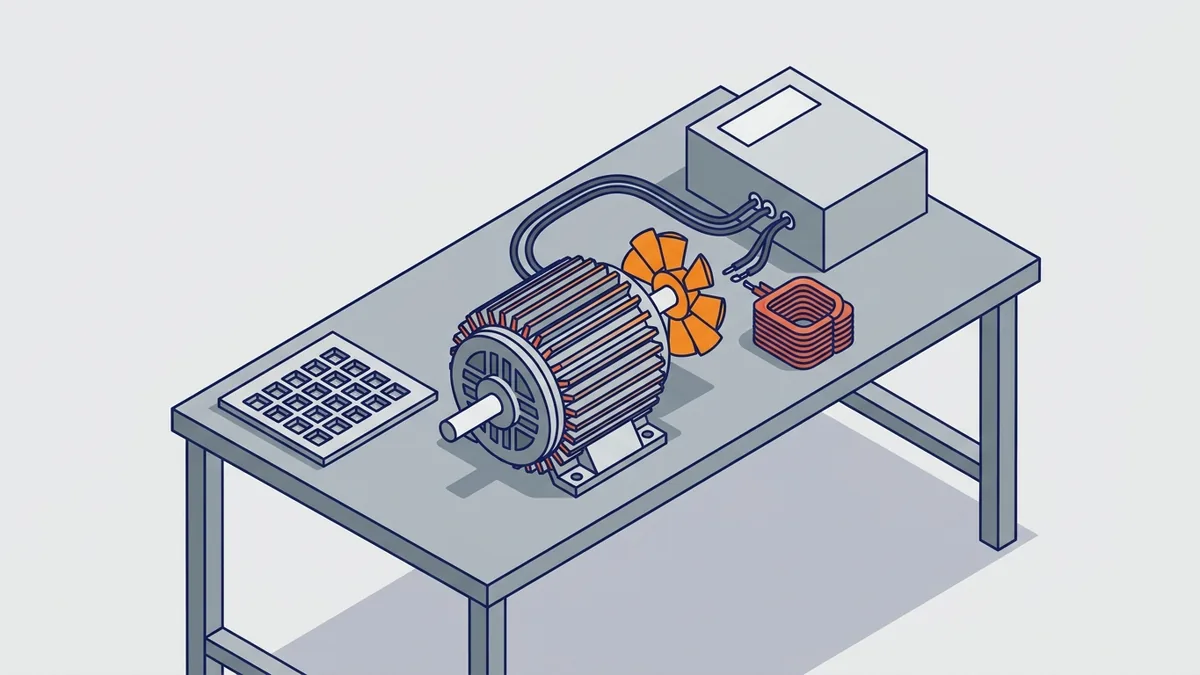
On a TEFC (totally enclosed, fan-cooled) motor, a fan sits on the shaft at the end away from the output shaft. A metal shroud covers it. As the shaft turns, the fan draws in outside air and blows it along the body through the cooling fins. Because the frame is sealed, that air never enters the motor.
However, the two ends do not cool equally. The air is coolest where it leaves the fan, so the drive end gets less cooling than the fan end. Also, a clogged motor fan cover or packed fins can overheat a motor as surely as an overload can.
Open motors vs. totally enclosed motors
Open motors work differently. In an open-type motor, such as cooling codes IC01 and IC06, cooling air passes through the inside of the motor. That cools well, but it needs a clean, dry area. In contrast, a TEFC motor fan moves air only over the outside, so dirt and moisture stay out of the windings.
Totally enclosed motors come in several cooling styles. This table sums up the common ones.
| Type | Full name | How it sheds heat |
|---|---|---|
| TEFC | Totally enclosed, fan-cooled | Shaft-mounted fan blows outside air over the finned frame |
| TENV | Totally enclosed, non-ventilated | No fan; the frame surface must be large enough to shed heat on its own |
| TEAO | Totally enclosed, air-over | No fan of its own; it sits in the airstream of the fan it drives |
| TEAA | Totally enclosed, air-to-air | Uses an air-to-air heat exchanger |
| TEPV | Totally enclosed, pipe-ventilated | Cooling air arrives through ducts or pipes |
| TEAW | Totally enclosed, air-to-water | Uses an air-to-water heat exchanger |
Also, think about the site. Sources describe TEFC motors as a good fit for dry areas or zones without direct washdown. Meanwhile, they describe TENV motors as the cleanest and easiest to maintain.
Motor cooling codes: IC410, IC411 and IC416
What do IC410, IC411 and IC416 mean on a motor? IC stands for International Cooling, and the IEC 60034-6 standard defines these codes. In short, the code tells you how the motor gets rid of heat. It also tells you whether that cooling depends on motor speed.
| Code | How it cools | Where it is typically used |
|---|---|---|
| IC410 | Surface cooling with no fan (natural convection) | TENV motors, washdown and clean areas |
| IC411 | Surface cooling with a shaft-mounted fan; airflow drops as speed drops | TEFC motors, the most common industrial induction motor, usually IP55 |
| IC416 | Surface cooling with a separate fan motor on its own mains supply; airflow does not depend on motor speed | VFD-driven motors that run at high torque and low speed |
So when a data sheet lists IC411, expect a shaft-mounted motor fan whose airflow follows speed. When it lists IC416, expect a separate fan motor with its own power supply. That difference matters most when a drive runs the motor slowly.
Cooling on VFD-driven motors
A shaft-mounted motor fan turns at motor speed. So when a VFD slows the motor, the fan slows too and moves less air. At light load, that is usually fine, because the motor also makes less heat. However, a motor that delivers high torque at low speed for long periods can overheat.
Does a motor on a VFD need a separate cooling fan? Not always. A motor that drives a centrifugal fan or blower usually does not, because the load torque falls fast as speed drops. In contrast, a load that needs high torque at low speed for long periods may need an IC416 forced-ventilation fan.
If you add one, wire that motor fan to the mains, not to the drive output. That way it runs at full speed whatever the drive does. Also, interlock it with the main motor so the main motor cannot run without its cooling air. For drive sizing, wiring and settings, see our VFD guides.
How to choose an IC416 auxiliary fan
No single speed or torque cutoff fits every motor. Each motor design cools differently, so the answer comes from the motor maker’s data. Ask for the torque-versus-speed curve for that motor on a VFD. It shows how much torque the motor can deliver for long periods at each speed.
Next, compare that curve with the torque your load needs at its lowest running speed. If the load sits above the curve for long periods, the shaft fan cannot cool the motor, so you need forced ventilation. If the load sits below the curve, the shaft fan is enough.
Then choose the fan from the motor maker, not by guesswork. Most makers sell an auxiliary blower kit matched to the motor frame. Confirm its supply voltage and phase, because it runs on its own mains supply. Also check that the airflow direction and the blower rotation match the motor.
Types of motors that drive fans and blowers
What types of electric fan motor are there? Most fall into four groups. Before you test or order a motor fan part, name the type, because each one fails, tests and replaces in its own way.
- Shaded-pole: A simple AC motor that runs straight off the supply. It has few parts and costs little, but it wastes a lot of power as heat. You find it in small fans and light-duty equipment.
- PSC (permanent split capacitor): An AC induction motor that needs a run capacitor. It runs on fixed speed taps that the installer picks. Many furnace blowers and condenser fans use it.
- ECM or brushless DC: A motor with permanent magnets and an electronic control module that switches the current. It can hold a target torque or airflow and run at many speeds.
- Three-phase induction: The workhorse for industrial fans and blowers. It often runs on a VFD; see our VFD posts for those details.
How to identify a fan motor type
Use this table to identify the motor fan in front of you. Then confirm with the nameplate.
| Motor type | Run capacitor? | Control module? | How speed is set | What to look for |
|---|---|---|---|---|
| Shaded-pole | No | No | Usually fixed | Small, simple motor; copper shading rings on the stator poles |
| PSC | Yes | No | Fixed speed taps | Capacitor wired to the motor; several colored speed leads |
| ECM / brushless DC | No | Yes | Programmed or variable | Electronics pack on the motor end; separate control plug |
| Three-phase induction | No | No (external starter or VFD) | VFD or fixed speed | Three line leads; three-phase voltage on the nameplate |
What is a DC motor ceiling fan?
A DC ceiling fan has a brushless DC motor and a small electronic driver. The driver sits in the canopy or the motor housing and converts the mains supply to DC. So the “DC” describes the motor only. Also, the fan connects to the same hot, neutral and ground wiring as any other ceiling fan.
How can I tell if a ceiling fan is AC or DC? First, check the manual or the label on the motor housing. Next, look for a direction switch on the housing, which usually means an AC fan with an induction motor. In addition, a slim, flat motor body is common on DC fans.
Vendors claim a DC fan uses about a third of the power of an AC fan and offers more speeds. Treat that as a retailer figure, not test data. Also, these ceiling-fan points do not carry over to an industrial motor fan on a three-phase supply.
Testing differs too. You cannot ohm-test a DC fan like an AC capacitor motor, because the driver sits between your meter and the windings. So if the supply is good and the fan is dead, suspect the driver and ask the fan maker about parts.
PSC vs. ECM blower motors
What is the difference between a PSC and an ECM blower motor? A PSC is an AC induction motor with a run capacitor and fixed speed taps. An ECM is a brushless DC motor with a control module that holds a target torque or airflow. As a result, the ECM adjusts to the system, while the PSC stays on the tap you wired.
The fastest way to tell them apart is the capacitor. If a run capacitor is wired to the blower, it is a PSC. If there is no run capacitor and the motor has an electronics pack, it is an ECM.
Vendors put ECM blower efficiency at up to about 90%, against 60 to 70% for a PSC. Again, those are vendor figures. For replacement, the key point is control. A PSC takes line voltage on a speed tap, while an ECM expects a low-voltage control signal.
Signs a fan motor is failing
What are the signs of a bad fan motor? A motor fan rarely fails without warning. Watch for these symptoms:
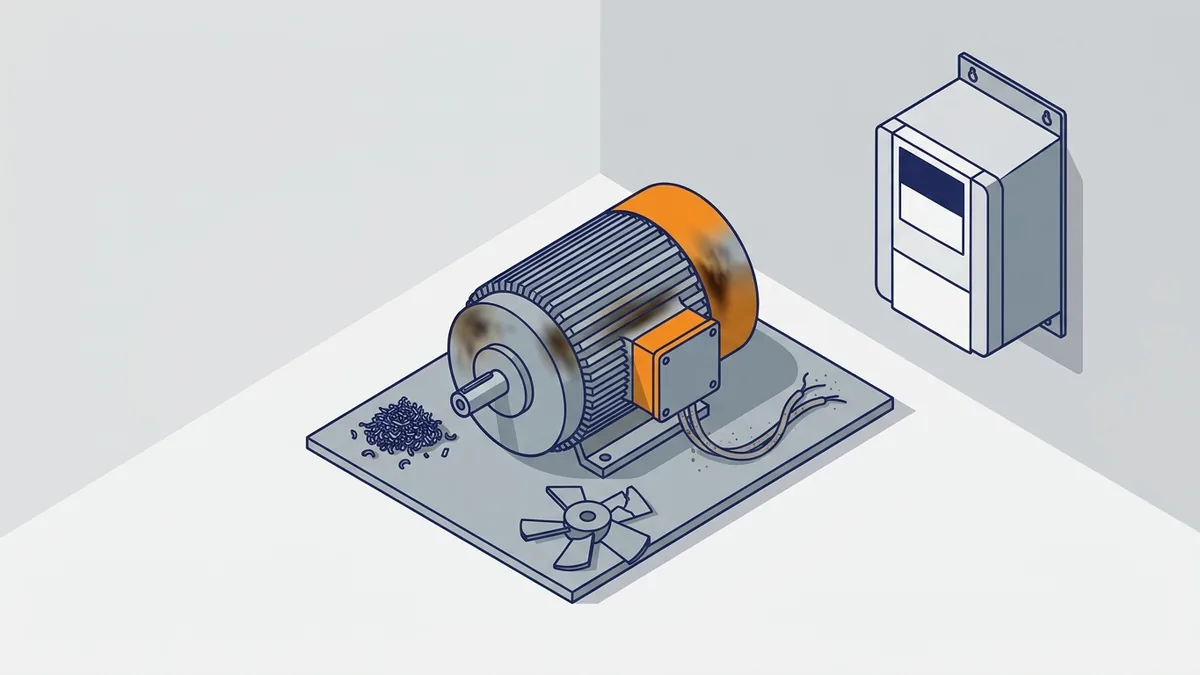
- The motor hums but will not spin.
- Starting takes a push on the blade or shaft.
- Heat, a hot smell or a thermal overload trip can show up.
- Grinding, squealing, rumbling or vibration may begin.
- A tripped breaker or blown fuse is another clue.
- Slow running, or stopping and starting, also counts.
However, a symptom does not prove the motor is bad. A weak capacitor, a seized bearing, an unbalanced blade or a blocked duct can all cause the same signs. So use the symptoms to choose your tests, then confirm with the steps below.
Symptoms by motor type
With a PSC motor, a hum with no rotation points to a failed capacitor or seized bearings. On an ECM, a dead or on-and-off motor with good supply voltage often points to the control module. For a three-phase motor fan, overheating, trips and noise usually point to bearings, cooling, load or supply. Also, a three-phase motor that hums and will not start may have lost one phase.
Blower motors also die early because of the system around them. High static pressure from undersized returns, tight grilles, crushed flex duct or dense filters makes the motor work harder. In addition, a weak capacitor makes a PSC motor start hard and run hot.
How to test a fan motor
Testing a motor fan safely starts before you pick up the meter. Work from the simplest check to the hardest, and follow these steps first:
- Turn off power at the breaker or disconnect.
- Lock out and tag out the circuit.
- Verify zero voltage across the motor’s line terminals with a CAT III rated meter in AC voltage mode.
- Discharge any capacitor before you handle it.
- Photograph the wiring and label each lead before you disconnect anything.
- Remove the fan blade or wheel if it blocks the shaft.
Next, match the tests to the motor fan type. Steps 1 to 3 suit shaded-pole and PSC motors. Step 4 covers supply voltage for all types and the control side for ECM and DC fans. Three-phase motors need different tests, which follow Step 4.
Step 1: Spin test and visual check
With the power locked out, spin the shaft by hand. A healthy motor fan turns freely and coasts smoothly. In contrast, a shaft that feels stiff, rough or locked points to seized bearings or a dragging rotor.
This test also separates a seized motor from a bad capacitor. If the motor hummed without starting but the shaft spins freely, suspect the capacitor. Likewise, if you saw it start after a push, the capacitor is almost certainly the culprit. Then look for burn marks, a bulging or leaking capacitor, melted insulation and damaged leads.
Step 2: Test the capacitor (PSC and capacitor-start fan motors)
How do I tell a bad capacitor from a bad fan motor? Test the capacitor on its own. Set your meter to capacitance (µF), discharge the capacitor and disconnect its wires. Then compare the reading with the µF rating on the label.
Always test out of circuit, because the motor windings in parallel give a false reading. Also, skip the “sweep test” done without a capacitance meter. It cannot show that a capacitor has drifted well below its rating. Yet that weak capacitor still makes the motor fan overheat and trip its thermal overload.
A dual run capacitor serves two motors, usually a compressor and a condenser fan. So test C to FAN and C to HERM separately. Each reading must match its own rating; the fan side has the lower value.
Finally, never “upgrade” the µF value. A larger capacitor may spin the fan faster, but it overheats the windings and can burn out the motor. Replace a bad one with the same µF rating and a voltage rating at least as high.
What capacitance tolerance is acceptable?
Start with the tolerance printed on the capacitor label. Run capacitors commonly list ±5% or ±6%. For example, a 10 µF capacitor rated ±6% should read between 9.4 and 10.6 µF.
A reading outside the range means replace the capacitor. A reading above the range, or a bulging case, also means replace it. A reading near the low limit is a replace-now result when the motor runs hot, starts hard or trips its overload.
Also, capacitors lose capacitance as they age and do not recover. So a low-edge reading only gets worse. Because the part costs far less than a motor, replace it rather than wait.
Step 3: Test winding continuity, resistance and ground
How do you test a fan motor’s windings with a multimeter? Set the meter to ohms and measure between the leads: common, run, start and each speed wire. Then compare each reading with the label or manufacturer data. Values vary by motor, so never guess a “normal” number.
- OL (open): The winding is broken or burnt through.
- Zero or near zero: The winding is shorted.
- Well below expected: Turns are shorting inside. For example, about half the expected value means internal shorting.
- Close to expected: The winding is likely sound.
On a simple capacitor motor, the two capacitor leads read the run and start windings in series. Meanwhile, the two power leads read the run winding alone. On a multi-speed motor, measure from common to each speed wire.
Next, check for a short to ground. Touch one probe to each lead in turn and the other to bare metal on the frame. Every reading should be OL; any other reading means the motor should not return to service.
What do typical PSC resistance readings look like?
Fractional-hp PSC windings have low resistance, usually a few ohms up to a few tens of ohms. Use that range only as a sanity check, and let the label or maker’s data decide. A reading far outside it, or OL, calls for a closer look.
Two patterns help more than any single number. On a three-lead motor (common, run, start), the largest reading should about equal the sum of the other two. On a multi-speed motor, resistance from common rises as speed falls, so the high-speed lead reads lowest and the low-speed lead reads highest.
Step 4: Check supply voltage and, for ECM and DC fans, the control side
If the motor fan passes its tests, confirm that power reaches it. Follow your site’s live-work rules and measure the supply voltage at the motor or contactor with your rated meter. Then compare it with the nameplate. Missing or low voltage points to the controls, contactor or wiring, not the motor.
Can I test an ECM or DC fan motor with a multimeter? Only partly. You can check supply voltage and the presence of the control signal. However, ohming the windings and testing a capacitor tell you nothing. An ECM has no run capacitor, and its module sits between your probes and the windings.
So if every check passes and the motor is still dead or intermittent, suspect the control module. At that point, stop testing. Replace a small sealed motor, or send a large or costly one to a repair shop.
How to test a three-phase fan motor
Three-phase motors need three extra checks. Lock out the circuit first, then disconnect the motor leads from the starter or VFD output and tag them. Also, never run a megger on a motor that is still wired to a drive.
- Phase-to-phase resistance: Measure T1 to T2, T2 to T3 and T1 to T3. The three readings should be nearly equal. Large motors read well under an ohm, so use a low-resistance ohmmeter. Unequal readings or OL point to a winding fault or a bad connection.
- Insulation resistance: Join the three leads together and test them to the frame with a megger (insulation tester). For motors rated up to 1000 V, a 500 V DC test is common, but follow the maker. Read the value at one minute. IEEE 43 is a common reference, and it lists 5 MΩ as the minimum for random-wound motors. A falling trend over time is also a warning. Discharge the winding when you finish.
- Current balance: With the motor running under load, clamp each phase and compare the readings with the nameplate full-load amps. The three phases should be close, and none should pass the nameplate value.
If the currents are uneven, find the cause. First, measure the voltage on each phase, because supply imbalance causes uneven current. Next, lock out and move the three supply leads one position around, so rotation stays the same, then run again. If the high reading stays on the same supply line, the problem is upstream. If it stays with the same motor lead, the motor is the cause.
How to diagnose an ECM or DC fan in practice
Pin layouts and signal types differ by maker, so use the wiring chart for your exact motor. I cannot give you expected voltages that hold for every model. Instead, follow this order:
- Turn off power, then wait the time the maker lists before you touch the plug. Stored charge can remain in the module.
- Check the supply at the power plug. Read line voltage across the line pins, compare it with the nameplate, and confirm the ground is solid.
- Check the control signal at the control plug, pin by pin, against the maker’s chart. The signal may be 24 VAC call signals or a low-voltage DC or PWM signal, depending on the model.
Now decide between the module and the motor. If supply and control are both good and the motor will not run, spin the shaft by hand. A permanent-magnet rotor feels notchy, which is normal. A locked shaft points to a bearing or rotor problem.
On models where the module unplugs from the motor, measure the three motor windings. They should read equal. If they do, the module is the likely fault. Otherwise, the motor is bad. On sealed models, use the maker’s test tool or a known-good module if one is available.
Fan motor bearings: failure causes, signs and prevention
Why do electric fan motor bearings fail, and how do I prevent it? Bearings are the main wear part in any motor fan. Most failures trace back to a few causes:
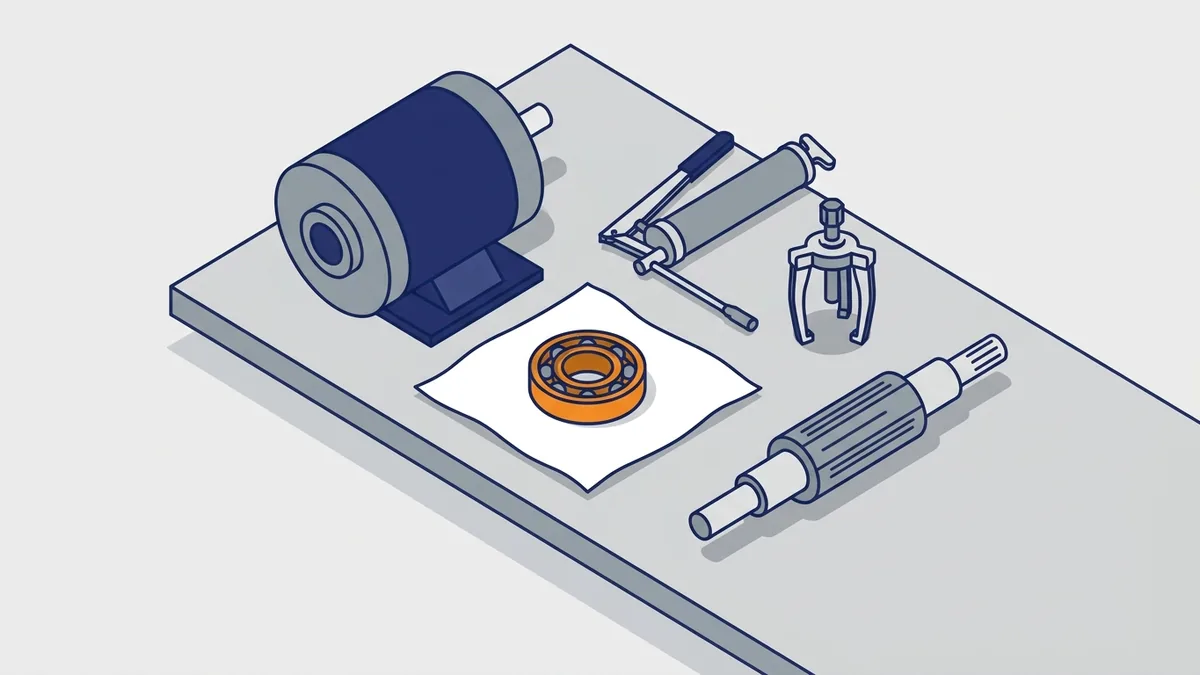
- Too little grease, which lets metal rub on metal.
- Too much grease, which raises running temperature and can overheat the bearing.
- The wrong grease, or two greases mixed that do not work together.
- Vibration from misalignment, shaft deflection, wear or poor mounting.
- Contamination from water, sand, dirt or chemicals, and moisture in humid or outdoor sites.
- High running temperature.
- Incorrect installation.
- Electrical damage from current passing through the bearing.
Signs of bearing trouble
Bearing trouble in a motor fan shows up as noise, heat and vibration. You may hear growling or squealing, feel a hot bearing housing or see vibration readings climb. Also, remember the cooling gradient on a TEFC motor. Because the drive end gets less cooling than the fan end, watch that bearing closely.
How to prevent bearing failure
- Use the grease type and amount the motor manufacturer calls for.
- Check compatibility before you add a different grease.
- Keep the motor clean and dry, and keep the fan cover and fins clear.
- Check alignment, belt tension and mounting bolts during service.
- Balance or replace a damaged blade or wheel so it does not shake the bearings.
- Follow the motor’s operating guide for lubrication and working temperature.
What grease, how much and how often?
The nameplate or manual comes first. Many motor makers call for a polyurea-based grease of medium consistency (NLGI 2) in ball bearings, but confirm for your motor. Sealed bearings, marked 2RS or ZZ, take no grease at all.
For the amount, use the grams or pump strokes in the manual. If it gives none, a common relubrication rule is grams = 0.005 × bearing outer diameter (mm) × bearing width (mm). Add small amounts, because too much grease overheats the bearing.
The interval depends on speed, bearing size, temperature and the environment. The manual lists hours or months. Heat, dirt and moisture shorten it, so a hot or dirty site needs more frequent service. I do not give a fixed number, because one interval cannot fit every motor.
When you grease, clean the fitting and open the drain plug. Add grease slowly, and follow the maker on whether the motor should run or stand still. Then run it briefly to push out the excess before you refit the plug.
How do you recognise incompatible greases? Look for these signs:
- The grease turns soft and runs out of the bearing.
- It hardens or looks dry and crusty.
- Oil separates from the grease.
- The bearing runs hotter or noisier after regreasing.
Mixing polyurea with some other thickeners, such as lithium-complex, is a known cause. If you do not know what is inside, purge the old grease or send the motor to a shop.
Bearing currents on VFD-driven motors
Can a VFD damage fan motor bearings? Yes, it can. Voltage builds on the motor shaft until it discharges through the bearing. Each discharge acts like a tiny spark-machining (EDM) event that pits the balls and raceways.
Over time, the pits form a washboard pattern called fluting, a sign of severe damage. Causes include VFD voltage pulse overshoot, magnetic asymmetry in the motor and supply imbalance. As a result, a motor fan on a drive can lose bearings again and again, even with perfect grease.
Confirming fluting is a repair-shop job, because someone must remove and inspect the bearing. Above all, do not just fit new bearings and restart; fix the cause first.
VFD-side fixes for bearing currents
Several fixes work, and they often work best together:
- Shaft grounding ring: It gives shaft voltage a safe path to the frame, so it does not discharge through the bearing.
- Insulated bearing: It blocks the current path. It usually goes at the non-drive end, often with a grounding ring at the drive end.
- Hybrid bearing: Ceramic balls in steel rings block the current.
- Output filter: A dv/dt filter, sine filter or common-mode choke softens the voltage pulses that cause the problem.
- Cable and grounding practice: Use VFD-rated symmetrical shielded cable, bond the shield 360 degrees at both ends, keep motor leads short, and bond the drive, motor and load solidly to ground.
How do you measure shaft voltage? A shop does it with an oscilloscope. A carbon-brush probe touches the rotating shaft, and a high-voltage differential probe reads shaft to frame while the motor runs on the drive. Spikes and sudden collapses in the trace show bearing discharges. A handheld multimeter cannot see these fast pulses, and only a qualified person should work near a rotating shaft.
Repair or replace: which is the better call?
Should I repair or replace a fan motor? Work through the cheapest likely motor fan fault first:
- Capacitor: On a PSC motor, test and replace it first. It is the cheapest part and a common fault.
- Bearings: If the shaft is rough or noisy but the windings test good, replace the bearings. This makes most sense on larger motors.
- Windings: If a winding is open, shorted or grounded, replace a small motor and rewind a large one.
Fractional PSC and ECM motors are usually replaced. Labor to rebuild them often costs more than a new motor. Also, on most residential ECM motors, the control module is not sold separately. So a module fault means a whole new motor assembly.
In contrast, shops normally repair larger industrial three-phase fan motors. They can rewind them, replace bearings and balance the rotor. Call a shop when the motor is large, has a special mount or shaft, or keeps failing the same way.
How to choose a replacement fan motor
How do I choose a replacement fan motor? Read the motor fan nameplate before you order, and match every line that matters:
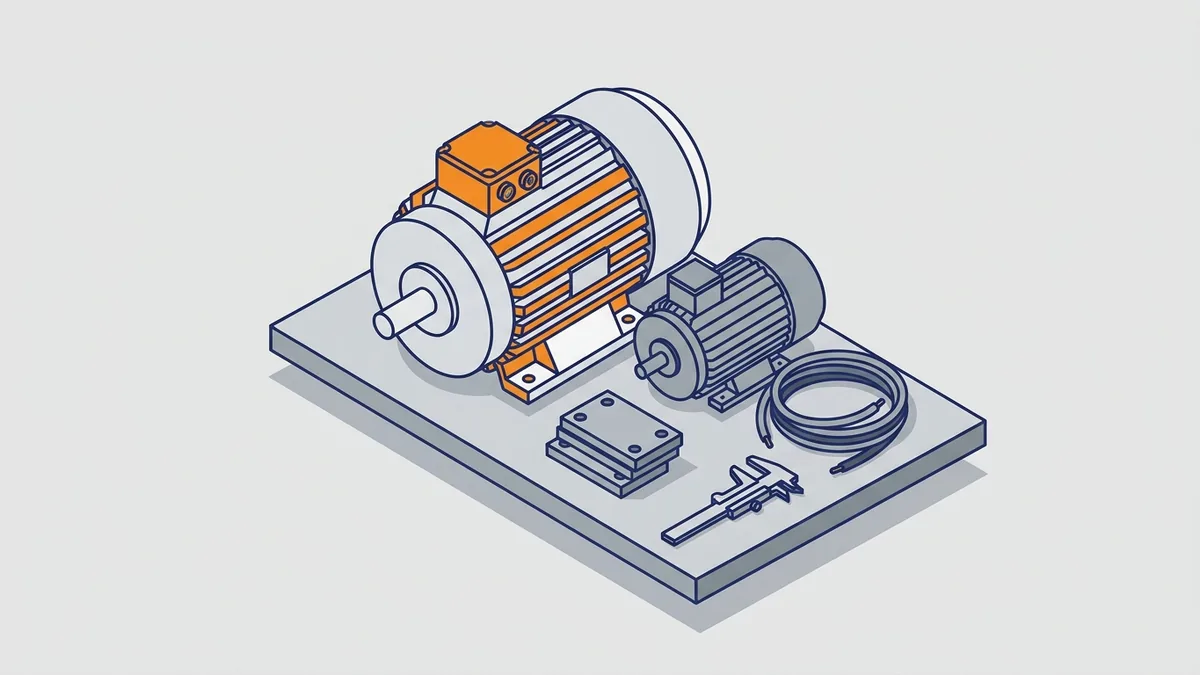
- Voltage, phase and frequency
- Power (hp or kW)
- RPM and number of speeds
- Rotation direction
- Frame size, mounting style and shaft size
- Enclosure and cooling type, such as open, TEFC or TEAO
- Duty rating
- Capacitor µF and voltage rating for PSC motors
For a PSC motor, match the original RPM and number of speeds. Also, always fit a new, correctly sized capacitor with the new motor, because an old capacitor can kill a new motor. Finally, send a clear photo of the nameplate to your supplier to remove most of the guesswork.
Beyond the nameplate: other fit checks
A matching nameplate list still leaves gaps. Check these points before you order:
- Frame, mount and shaft: Confirm the frame number, foot or flange mount, shaft diameter, shaft length and keyway. Compare them against the old motor, not just the hp.
- Bearing sizes: The drive-end and non-drive-end bearings can differ. Read them from the nameplate or data sheet, or from the bearings themselves.
- Rotation: A three-phase motor reverses when you swap any two leads. A single-phase PSC motor may be reversible by its lead diagram, or it may be fixed. A blade moves less air when it turns the wrong way, so confirm the direction against the maker’s definition.
- Thermal protector: An automatic-reset device restarts the motor when it cools. A manual-reset device waits for you to press it. Also check whether the protector is built into the winding or its leads connect to the control circuit.
- Washdown: Compare the IP rating and finish against the site. A wet area may need more than IP55, or a washdown-duty motor.
- Hazardous areas: The new motor must carry the same class, division or zone, and temperature code as the old one, or better. Never put a standard motor in its place.
Can I swap a PSC for an ECM?
ECM replacements must match the motor series and its programming. A variable-speed ECM is often programmed for one equipment model. So a generic ECM may not run the system correctly.
Can you swap a PSC for an ECM? You can, but it is not a drop-in swap. The frame, shaft, mounting and blower wheel must match. In addition, the control wiring differs, since the PSC uses line voltage on a speed tap and the ECM uses low-voltage control. Then someone must set up and check the airflow.
Codes can also drive the choice. On commercial equipment in California, Title 24 Part 6 fan power limits apply to replacement motors. Vendors read this as ruling out a PSC on a job that must comply, so confirm with the code or your inspector.
What a replacement costs
How much does a replacement fan motor cost? There is no single motor fan price, because cost depends on type, size and how hard the swap is. We do not quote prices here, but these points help you compare repair and replacement:
- A capacitor costs far less than a motor, so test it first.
- An ECM usually costs more than a PSC of similar size, and you often must buy the whole assembly.
- Retail HVAC prices online are not a guide to industrial motor prices.
- Industrial motor cost depends on frame, hp or kW, enclosure, speed and any special mounting or shaft.
- On a critical fan, downtime and labor often outweigh the part price.
For small fractional motors, replacing usually costs less than repair. For larger three-phase motors, repair is often the better value, especially with special frames. So for a firm number, send the nameplate details to your supplier or repair shop and ask for a quote on both options.
Common mistakes to avoid
What mistakes do people make when diagnosing or replacing a fan motor? These motor fan mistakes come up again and again:
- Replacing the motor when the capacitor failed. Test the capacitor first.
- Reusing the old capacitor. A weak capacitor can ruin the new motor.
- Using the wrong µF value. A larger capacitor overheats the windings.
- Testing a capacitor in circuit. The windings throw off the reading.
- Ohm-testing an ECM and condemning it. Winding and capacitor tests do not apply.
- Over-greasing or mixing greases. Both raise bearing temperature and shorten life.
- Running a VFD motor slow at high torque on a shaft fan. The fan cannot move enough air, so consider IC416 cooling.
- Ignoring the ductwork. Restrictive ducts, dirty filters and high static pressure overload blower motors, so the new motor fails the same way.
When to call a repair shop or a specialist
When should I send a fan motor to a repair shop? Call in a shop when a motor fan job goes beyond simple parts swaps. Common triggers include:
- Winding faults on a three-phase motor
- Fluted bearings or repeated bearing failures
- Overheating on a VFD that you cannot trace
- ECM module faults on commercial or costly motors
- Motors that need rewinding or balancing
- A missing or unreadable nameplate
Before you call, gather what the shop will ask for. Have a nameplate photo, the application, drive details if it runs on a VFD, and the failure symptoms. In addition, note how long the motor ran and whether it failed before.
Frequently asked questions
What is a DC motor ceiling fan?
It is a ceiling fan with a brushless DC motor. A small electronic driver in the canopy or motor housing converts the mains supply to DC, so it connects to ordinary ceiling-fan wiring. Vendors say it uses about a third of the power of an AC fan and offers more speeds.
How to test a fan motor
De-energize, lock out, verify zero voltage and discharge any capacitor, then spin the shaft by hand. Next, test the capacitor out of circuit against its label, check winding resistance between leads, and check each lead to the frame for OL. Finally, confirm supply voltage. A motor fan with an ECM or DC control module does not test the same way.
How does the cooling fan on an electric motor work?
On a TEFC motor (IC411), a fan on the shaft, usually opposite the output shaft, blows outside air over the finned frame. It removes heat without letting air into the motor. Because airflow falls with speed, a VFD motor running slow at high torque may need an IC416 forced-ventilation fan.
What causes electric fan motor bearings to fail?
The main causes are too little or too much grease, the wrong or mixed grease, and vibration or misalignment. Contamination, moisture, heat and poor installation also shorten bearing life. On VFD-driven motors, electrical discharge through the bearing can cause fluting.
How do I choose a replacement fan motor?
Match the nameplate: voltage, phase, speed and number of speeds, power, frame, shaft, mounting, rotation and enclosure. For a PSC motor, fit a new, correctly sized capacitor too. ECM motors must match the series and programming, so PSC to ECM is not a drop-in swap.
Whichever motor fan you have, start by naming its job and its motor type. Then test from the cheapest part up, protect the bearings and match the nameplate exactly when you replace it. If you need help diagnosing a fan motor, a repair quote or a matched replacement, contact Precision Electric and send us your nameplate details.