Eaton BAB Breakers: Catalog Numbers, Ratings and Panel Fit
If you need to replace or add a bolt-on branch breaker, Eaton BAB breakers are probably on your list. However, the catalog numbers, suffixes and voltage limits can confuse even experienced techs. This guide explains what the BAB is, how to read its number, where it fits and what to check before you order.
On this page
- What Eaton BAB breakers are
- Where Eaton BAB breakers fit: panelboards and voltage limits
- Reading a BAB catalog number
- Eaton BAB breaker models and ratings
- What amp ratings do BAB breakers come in?
- What is the interrupting rating of a BAB breaker?
- Does the rating change by voltage or with series rating?
- Is the BAB HACR rated, and what does that mean?
- How do BAB trip curves and ambient temperature work?
- Do BAB breakers come with shunt trip or remote operation?
- How do you wire and size the control supply for shunt-trip and remote versions?
- Other special versions
- BAB versus the alternatives
- How to choose and order the right BAB replacement
- Installing, testing and common mistakes
- Where to find datasheets, catalogs and panelboard guides
- Frequently asked questions
What Eaton BAB breakers are
What is an Eaton BAB breaker?
An Eaton Quicklag BAB breaker is a bolt-on thermal-magnetic miniature circuit breaker. It comes in 1-, 2- or 3-pole designs. Also, Eaton lists it to UL 489, and all products from 15 to 100 A are HACR rated.

Thermal-magnetic means the breaker trips two ways. First, a heat element handles slow overloads, and a magnet handles fast short circuits. Eaton also lists the BAB for switching duty on 120 VAC fluorescent lighting.
Is BAB a Cutler-Hammer or Westinghouse breaker?
Today BAB is an Eaton product. However, Eaton owns the Cutler-Hammer name, so you will see the Cutler-Hammer BAB breaker on older panels, labels and part numbers. Older Westinghouse panels may also carry it. So always confirm against the panel label.
What does bolt-on mean compared with plug-on?
A bolt-on breaker is fastened to the panelboard bus with a screw. In contrast, a plug-on breaker, like a residential BR or CH, clips onto the bus stabs. As a result, the bolt-on style holds tighter in commercial and industrial panels.
What the category covers
Eaton groups its bolt-on types as BAB, QBHW, HBAX and HBAW. Because of that, this article focuses on the BAB, and later sections compare it with the others.
Where Eaton BAB breakers fit: panelboards and voltage limits
Which panelboards use BAB breakers?
Eaton’s Pow-R-Line panelboards, such as PRL1a and PRL2a, use BAB as a bolt-on branch breaker. For example, Eaton’s panelboard guides list the BAB as the 15 to 100 A, 10 kA breaker for 240 V in the PRL1a. Resellers also say older Westinghouse and Cutler-Hammer bolt-on panels accept it. That is a secondary source, so check the panel label first.
The Eaton panelboard guide also shows a BAB-H as a chassis-mounted main option in the 50 to 100 A range.
What voltage can a BAB breaker be used on?
First, BAB is a 240 V maximum breaker. Eaton’s panelboard summary notes that single-pole breakers are rated 120 Vac maximum. However, many 1-pole SKU pages show 120/240 V. So read the label and the data sheet for the exact number you plan to use.
Can a BAB breaker be used on 480Y/277 V?
No. Eaton’s panelboard summary uses GHB breakers for 480Y/277 V circuits in the PRL2a. Also, a reseller says the same about the BAB1060, and that matches Eaton’s panelboard data. In short, never put a 240 V breaker on a 277 V circuit.
Can a BAB breaker be used on DC circuits?
Treat the BAB as an AC breaker. Its voltage ratings in this article are all AC. DC is harder to interrupt than AC, so use a BAB on DC only if its label and Eaton’s data sheet list a DC rating. Otherwise, pick a breaker made and rated for DC.
Note that a “24/48 Vdc” shunt trip, such as the one on the BAB1020S, describes the control coil. It does not give the breaker a DC rating for the load circuit.
Wire range
Eaton’s panelboard guide lists the wire range for BAB and QBHW 15 to 70 A units as #14 to #4. However, check the SKU page for the larger sizes.
Lug torque and conductor ratings
Torque and conductor ratings differ by frame and amp size, so do not guess. Look for the torque value and the conductor marking on the breaker or in its instruction sheet. Then tighten the lug with a calibrated torque tool.
Also check the wire temperature rating and the copper or aluminum marking before you land a conductor. If the label does not allow your conductor, pick a different breaker or conductor.
Reading a BAB catalog number
How do I read a BAB catalog number?
The pattern is BAB, then the number of poles, then the amps. For example, BAB1020 is a 1-pole, 20 A breaker. Likewise, BAB2020 is a 2-pole, 20 A breaker. Finally, BAB3030H is a 3-pole, 30 A breaker with a suffix.

What do the H, S, L1, I, RP and F variants mean?
Each letter changes the breaker, so do not order by amps alone. This list comes from Eaton’s SKU pages.
- H: the 240 V-only version of the 2- and 3-pole breakers, such as BAB2040H and BAB3030H.
- S: shunt trip. BAB1020S has a 24/48 Vdc shunt, and BAB2080S has a 120 VAC shunt.
- L1: low-magnetic with a 120 to 240 V shunt trip, as in BAB1020L1.
- I: BAB2020I, which has a T196 trip and suits panels up to 240 V 3-phase, 4-wire.
- RP and RSP: remotely operated breakers, such as BABRP2020 and BABRSP1030.
- F: the fire alarm breaker, such as BABF1015.
A shunt trip is a small coil that trips the breaker from a remote signal. In addition, two SKU pages can describe similar breakers differently. So treat the eaton.com SKU page as the final word.
Eaton BAB breaker models and ratings
What amp ratings do BAB breakers come in?
Branch ratings run from 15 to 100 A. For example, Eaton’s PRL1a summary lists the 1-pole at 15 to 70 A and the 2-pole at 15 to 100 A. Next, the table below shows examples from Eaton’s SKU pages.
| Catalog number | Poles | Amps | Voltage | Interrupting rating | Notes |
|---|---|---|---|---|---|
| BAB1020 | 1 | 20 | 120/240 V | 10 kAIC | Listed for HID lighting |
| BAB2090 | 2 | 90 | 120/240 V | 10 kAIC | HACR rated |
| BAB2020I | 2 | 20 | 120/240 V | 10 kAIC | T196 trip; 3-phase, 4-wire panels |
| BAB3015H | 3 | 15 | 240 V | 10 kAIC | 240 V only |
| BAB3030H | 3 | 30 | 240 V | 10 kAIC | HACR rated |
| BAB3060H | 3 | 60 | 240 V | 10 kAIC | 3-phase, 4-wire panels |
What is the interrupting rating of a BAB breaker?
The standard US BAB catalog numbers we checked on Eaton’s site list 10 kAIC. Interrupting rating is the most fault current a breaker can safely stop. However, Eaton’s data conflicts for some 3-pole H numbers, such as BAB3100H and BAB3040H. Their descriptions read 6 kAIC, but the spec fields and panelboard guides show 10 kAIC on 240 V. So confirm the exact SKU with Eaton before you rely on either number.
Does the rating change by voltage or with series rating?
Yes, voltage matters. The 10 kAIC figure applies at the voltage on the SKU page, such as 120/240 V or 240 V. A breaker never carries that rating at a higher voltage.
A series rating is a different thing. It lets a breaker be used above its own rating when a listed upstream current-limiting device protects it. Only a published series-rated combination allows this, and it applies to the whole tested pair. So do not assume a BAB gets a higher rating until you find that combination in Eaton’s tables.
Is the BAB HACR rated, and what does that mean?
Yes. Eaton says all 15 to 100 A products are HACR rated. HACR stands for heating, air conditioning and refrigeration. In other words, it means the breaker can protect those motor loads in equipment listed for HACR use.
How do BAB trip curves and ambient temperature work?
A thermal-magnetic breaker has two zones on its trip curve. At moderate overloads, the heat element trips it after a delay. The higher the current, the shorter the delay. At very high current, the magnet trips it with no delay.
Heat also matters. These breakers are calibrated at a set ambient temperature, commonly 40 °C. In a hotter enclosure, the thermal element trips sooner, so the breaker may nuisance trip below its rating. In a colder space, it trips later. Use the derating chart on Eaton’s data sheet for exact numbers.
Low-magnetic, as on the L1 version, means the instant-trip point is set lower. As a result, the breaker reacts faster to a short circuit or a high fault. Check the curve for the SKU before you count on it.
Do BAB breakers come with shunt trip or remote operation?
Yes. Eaton’s panelboard summary says BAB, QBHW, GHQ and GHB breakers in PRL1a and PRL2a come with a shunt trip, for example BAB1020S. In addition, Eaton’s catalog describes the BABRP and BABRSP as remotely operated breakers for lighting control or energy management. The BABRSP1030 adds a status switch.
How do you wire and size the control supply for shunt-trip and remote versions?
First, match the control supply to the coil voltage on the SKU. For example, BAB1020S uses 24/48 Vdc, BAB2080S uses 120 VAC, and BAB1020L1 takes 120 to 240 V. A supply at the wrong voltage can burn the coil or fail to trip the breaker.
Next, size the supply and control wiring for the coil’s rated current, which the data sheet lists. Then wire the trip signal as the instruction sheet shows. For the BABRP and BABRSP, follow the wiring diagram for the open, close and status connections. Finally, test the trip with the panel safe before you put it in service.
Other special versions
BABF1015 is a fire alarm breaker, rated 10 kAIC at 120/240 V and NFPA 72 compliant. However, the SKU pages we reviewed show non-interchangeable trips, so you cannot swap the trip unit in the field.
BAB versus the alternatives
What is the difference between BAB and QBHW?
Both are bolt-on breakers for Pow-R-Line panels. A reseller says they share dimensions and mounting, but that is a secondary source. However, the main difference is rating. Eaton lists QBHW at 22 kAIC, against 10 kAIC for the BAB. So choose by the fault current available at the panel.

What is the difference between BAB and GHB?
Voltage is the big gap. For example, the BAB stops at 240 V. Eaton’s summary shows the 3-pole, 15 to 100 A GHB as the 480Y/277 V, 14 kAIC breaker in the PRL2a.
Can I use a BR or CH breaker in place of a BAB?
No. BR breakers are 1 inch per pole, and CH breakers are 3/4 inch. Each plugs into its own residential load center. In contrast, BAB bolts on in panelboards that call for bolt-on breakers, so these types are not equivalent.
Other bolt-on types
Eaton also names HBAX and HBAW in the same family. However, we did not review their specs, so check the catalog before comparing. If a circuit needs arc-fault or ground-fault protection, look at Eaton’s QBAF and QBGF bolt-on types instead.
How to choose and order the right BAB replacement
How do I pick the right replacement BAB breaker?
Start with the old breaker and the panel. Then work through this list.
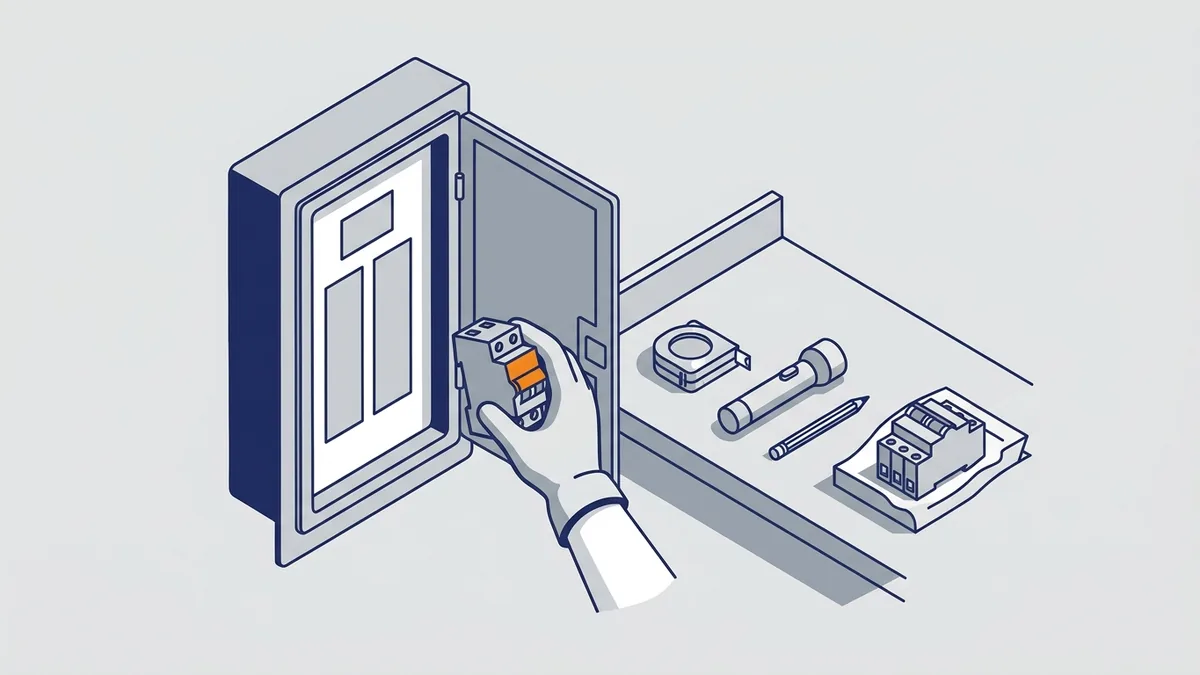
- Match poles, amps, voltage, interrupting rating and suffix from the old label.
- Note any shunt trip voltage.
- Confirm the panelboard type, such as PRL1a, PRL2a or an older Westinghouse or Cutler-Hammer panel.
- Check the panel’s voltage and short-circuit rating. Never exceed them.
- Confirm the system is 240 V or less. For a 3-phase, 4-wire panel, pick the right H or I version.
- Check the terminal and wire range against your conductors.
How do I check a BAB breaker is genuine?
Eaton’s SKU pages carry a serial-number check line, such as “Serial number is invalid” or “known suspect.” Use it to check any breaker you did not buy from an authorized source, because counterfeits are a real risk in a safety device.
What warranty does a BAB breaker have?
The SKU pages we reviewed show a 1-year warranty. However, confirm the terms for your exact catalog number.
Is the BAB still current?
We could not confirm current production status, so ask before you plan a large order. Eaton’s SKU pages and catalog are the best place to check.
Installing, testing and common mistakes
Safety first
Turn the panel off and lock it out before you open it. Then follow Eaton’s installation instructions and local code. Also, use qualified personnel for all panel work.
How do you install a bolt-on breaker, step by step?
Follow Eaton’s instruction sheet for your panel. In general, the steps run like this.
- De-energize the panel, lock it out and test that it is dead.
- Make sure the breaker is off and matches the panel, poles and rating.
- Set the breaker on the bus so the line end meets the bus connection and the load lug faces the wiring side.
- Fasten the line-side bolt to the torque on the label or instruction sheet.
- Land the load conductor in the lug and tighten it to the marked torque.
- Check that the breaker sits square and that the trim or cover fits.
After that, close the panel and restore power. Then switch the breaker on and check the load. Finally, look for heat, loose lugs or tripping, and test any shunt trip before you leave.
What are common mistakes when replacing a BAB breaker?
- Using a 240 V-only BAB on a 277 V circuit.
- Ignoring the kAIC rating.
- Assuming a residential BR or CH breaker will fit.
- Ordering by amps only and missing the suffix.
- Installing a shunt-trip version without a control supply.
When should I call an electrician or replace the panel?
Stop and get help if you see repeated nuisance trips, heat discoloration at the lugs, or a breaker that will not reset. Also call a qualified electrician if available fault current is above the panel’s rating. In that case, a new breaker will not solve the problem.
Drives need their own sizing
If you also run drives, size the fuse or breaker from the drive manual. However, Eaton’s sources we reviewed do not say a BAB suits a VFD branch circuit.
Where to find datasheets, catalogs and panelboard guides
Where do I find the BAB datasheet and catalog?
Start with the Eaton BAB bolt-on miniature circuit breakers category page on eaton.com. Also, each catalog number has its own SKU page, such as BAB1020, BAB2020 or BAB3030H, with a datasheet and spec sheet. Then open Eaton’s Miniature Circuit Breakers and Supplementary Protectors catalog, Volume 4, Tab 1 (CA08100005E).

For panel fit, use these Eaton documents:
- The Pow-R-Stock Plus quick selector reference guide.
- The Panelboards Consulting Application Guide (Pow-R-Line, Tab 22).
- The Panelboards and Lighting Controls Product Guide.
Frequently asked questions
What is an Eaton BAB breaker?
It is a bolt-on thermal-magnetic miniature circuit breaker from Eaton’s Quicklag industrial line, in 1-, 2- or 3-pole designs. In addition, it is UL 489 listed, and Eaton says all 15 to 100 A products are HACR rated.
What is the interrupting rating of a BAB breaker?
The standard US BAB catalog numbers we checked list 10 kAIC. Some 3-pole H numbers, such as BAB3100H, show 6 kAIC in their descriptions but 10 kAIC in the spec fields, so confirm the exact SKU with Eaton. Eaton’s QBHW series is the 22 kAIC option for Pow-R-Line panels.
Which panels take BAB breakers?
Eaton’s Pow-R-Line panelboards, such as PRL1a and PRL2a, use BAB as a bolt-on branch breaker. Resellers say older Westinghouse and Cutler-Hammer bolt-on panels also accept it. However, confirm against the panel label.
Can a BAB breaker be used on 277/480 V?
No. BAB is a 240 V maximum breaker. Instead, Eaton’s panelboard summary uses GHB breakers for 480Y/277 V circuits in the PRL2a.
What does the H, S or L1 suffix mean on a BAB number?
On Eaton’s SKU pages, H appears on the 240 V-only 2- and 3-pole versions, such as BAB3030H. Next, S marks shunt-trip versions like BAB1020S. Finally, L1 marks a low-magnetic version with a shunt trip, BAB1020L1. Check each SKU page.
Is a BAB breaker the same as a BR or CH breaker?
No. BR (1 inch per pole) and CH (3/4 inch) are plug-on residential types for their own load centers. In contrast, BAB bolts on in commercial and industrial panelboards.
Eaton BAB breakers are easy to order correctly once you read the poles, amps and suffix, then match them to the panel’s voltage and fault rating. Finally, always confirm the exact SKU on Eaton’s page before you buy. If you need help with a breaker, a drive or a repair, contact Precision Electric.