








Eaton Soft Start Guide: S811+, S801+, Ampgard and VFD Options
Picking the right Eaton soft start option for a three-phase motor can be confusing. Eaton sells several soft starter lines, a medium-voltage starter, and drives that also ramp a motor up gently. This guide maps each line, its ratings and catalog numbers, and shows you when a VFD is the better pick.
On this page
- What Eaton soft start covers: the product lines at a glance
- Eaton S811+ soft starter
- Eaton S801+ soft starter
- S811+ vs S801+: which one to order
- Ratings, frame sizes and how to read an Eaton soft starter catalog number
- How do I read an S811+ or S801+ catalog number?
- What amp ratings and frame sizes do S811+ and S801+ units come in?
- What motor hp or kW can each catalog number handle?
- What are the starts-per-hour limits, and how do temperature and altitude affect ratings?
- What voltage and control power does an Eaton S811+ need?
- How do you size the 24 Vdc supply?
- Which options can you order?
- How do you wire and set up inside-the-delta?
- What accessories (24 Vdc supply, lug kits, DIM/CIM, communication modules) do you need with an S811+ or S801+?
- Short-circuit ratings, protection and standards
- Where each Eaton soft start model fits (applications)
- Medium-voltage soft start: Ampgard RVSS
- Soft start with an Eaton VFD: DG1, H-MAX and SPX9000
- Eaton soft starter vs VFD: how to choose
- How to size and order an Eaton soft starter
- Common mistakes and when to call for repair or replacement help
- Frequently asked questions
- What is an Eaton soft starter?
- What is the difference between the Eaton S811+ and S801+?
- What current and voltage range do Eaton S811+/S801+ soft starters cover?
- Does an Eaton S811+ need a separate power supply or lug kits?
- Should I use an Eaton soft starter or an Eaton VFD?
- Does Eaton make a medium-voltage soft starter?
What Eaton soft start covers: the product lines at a glance
What is an Eaton soft starter and what does it do?
An Eaton soft starter is an electronic reduced-voltage starter for three-phase motors. At start, it lowers the voltage applied to the motor, then ramps it up. As a result, current and torque rise smoothly instead of jumping to full value. That means less shock on belts, gears and couplings, and a smaller current spike on your supply.
However, a soft starter only works during starting and stopping. It does not control running speed, and it does not save energy once the motor is up to speed. For the theory behind voltage ramps, see our Soft Start Explained post.
Which Eaton soft start lines are available?
Eaton soft start comes in four main routes. First, pick the route that matches your voltage class. Then pick the level of control you need.
- S811+: the full-feature low-voltage soft starter, with a display, communications and programmable inputs and outputs.
- S801+: the core low-voltage soft starter, set with dials and DIP switches.
- Ampgard RVSS: a medium-voltage reduced voltage solid-state soft starter for 2.4 to 13.8 kV motors.
- Eaton VFDs: the DG1, H-MAX and SPX9000 drives ramp a motor up gently and also control its speed.
| Eaton line | Voltage class | Size range | Interface | Best fit |
|---|---|---|---|---|
| S811+ | Low voltage, 200-600 V (UK page lists up to 690 V) | 11 A or 37 A up to 1000 A, depending on the catalog | Digital Interface Module with display and keypad | Networked control, pumps, detailed diagnostics |
| S801+ | Low voltage, 200-600 V | Shares the S811+/S801+ family range; confirm by catalog number | Control Interface Module with dials and DIP switches | Simple ramp-and-protect starting |
| Ampgard RVSS | Medium voltage, 2.4-13.8 kV | Ampgard control up to 8,000 hp | Built to order in a switchgear-style lineup | Large medium-voltage motors |
| DG1, H-MAX, SPX9000 VFDs | Low voltage, 240-600 V in our stock | 10 HP to 1000 HP in our stock | Drive keypad | Speed control plus soft starting |
Current ranges differ between Eaton’s regional catalogs, as the S811+ section explains. So always confirm the exact catalog number before you order.
What about other Eaton soft starters, like the S611 and DS7, and combination starters?
Eaton also makes other soft starter families, such as the S611 and the DS7, which is aimed at smaller motors. In addition, Eaton offers combination enclosed starters, which pair a starter with disconnect and protection in one enclosure. This article focuses on the S811+ and S801+ because they are the main panel-mount low-voltage lines. For the other families, check the ratings in Eaton’s soft starter catalog before you compare.
Can an Eaton soft starter replace a wye-delta or across-the-line starter?
Yes, in many cases. Eaton describes the S811+/S801+ line as the smallest, most compact soft starter on the market. For example, it can fit in place of older soft starters, wye-delta starters, or across-the-line NEMA and IEC starters. As a result, retrofits in a motor control center (MCC) or an existing enclosure get easier.
In addition, Eaton says its enclosed soft starter units are up to 78 percent smaller. Before you swap, check the motor leads, the branch protection and the control wiring. Also decide whether the starter will run inline or inside the delta, because the setting must match the wiring.
Eaton S811+ soft starter
What is the Eaton S811+ soft starter and what features does it have?
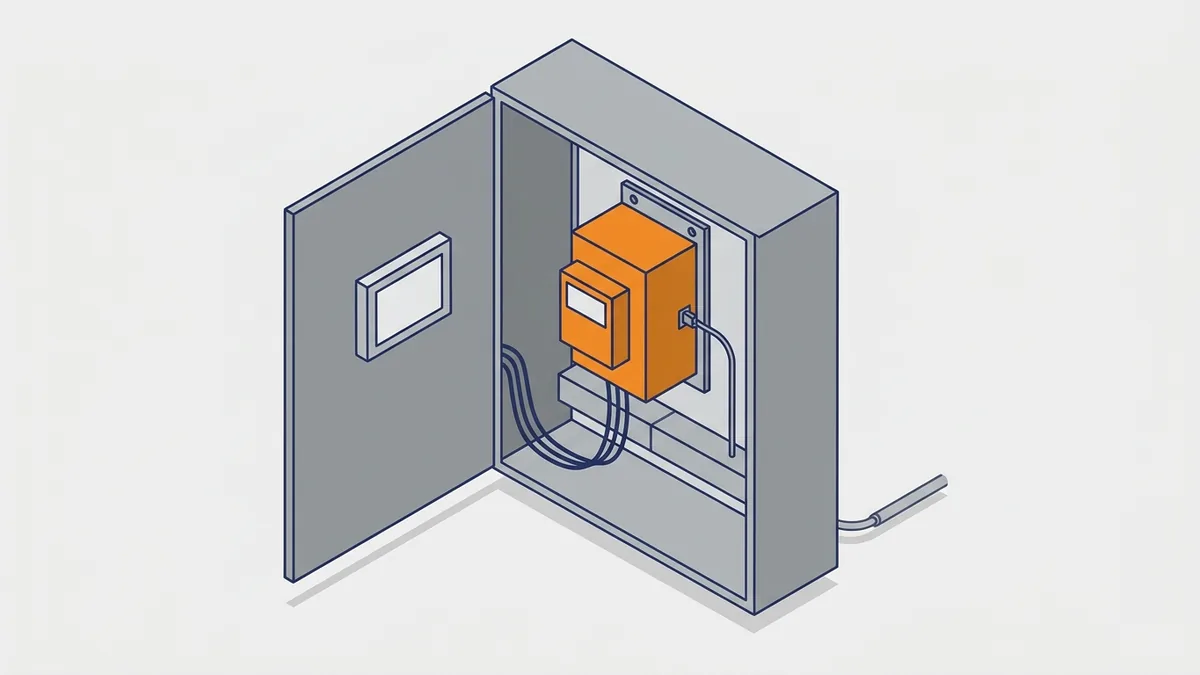
The S811+ is the full-feature Eaton soft start model for low-voltage motors. Eaton calls it an electronic, self-contained soft starter that you mount in a panel or enclosure. Next, it uses a Digital Interface Module (DIM), which is a display and keypad for setup and diagnostics. Also, a communications port links it to Modbus or to an Eaton HMI, the operator panel on a machine.
On older drawings and parts lists, you may see it called a Cutler-Hammer soft starter. Its key built-in features include:
- Run bypass contactor: a built-in contactor that carries the motor current once the ramp ends.
- Overload protection: electronic motor overload, set from the motor nameplate.
- Communications: Modbus RTU on the SKU pages, plus support for Eaton C441 communication modules.
- Programmable I/O: analog and digital inputs, programmable relay outputs and configurable terminals.
- Soft stop and pump control option: a slow, controlled stop that removes water hammer in pipe systems.
- Kick start: a short boost at start that helps break loose high-inertia loads.
- Wiring choice: inline (the default) or inside the delta.
S811+ current and voltage range
The S811+/S801+ brochure from Eaton lists the family from 11 A to 1000 A. However, the UK (Moeller) S811+ page lists five sizes from 37 A to 1000 A, with mains voltages from 200 V to 690 V. Meanwhile, the US SKU pages list 200 to 600 V. Because regional catalogs differ, rely on the exact catalog number and its specification sheet.
Also, Eaton describes the product as working from fractional horsepower up to motors that draw 1000 A steady-state. It built the starter for three-phase motors in a delta (3-lead) setup. For wiring diagrams, fault codes and parameter setup, see our Eaton S811+ soft starter guide. In contrast, this article sticks to choosing and ordering the right unit.
Eaton S801+ soft starter
What is the Eaton S801+ soft starter?
The S801+ is the core Eaton soft start model. It shares the same compact family design as the S811+. However, you set it up with dials and DIP switches on a Control Interface Module (CIM) instead of a keypad. Even so, it still ramps the motor up, pulls in its built-in bypass, and protects the motor with its built-in overload.
What does the S801+ leave out?
The S801+ drops the extras that make the S811+ a networked controller. Compared with the S811+, it leaves out:
- External communications (the S801+ does not support C441 communication modules)
- Analog and digital inputs
- Programmable relay outputs
- Configurable terminals
- The pump control algorithm for soft stopping
So this Eaton soft start model suits a plain ramp-and-protect job. In particular, it works well where nobody needs to read data from the starter.
S801+ catalog numbers and ratings
Here are example S801+ catalog numbers from the SKU pages on Eaton’s site:
| Catalog number | Frame | Rated current |
|---|---|---|
| S801+N37N3S | N | 37 A |
| S801+R10N3S | R | 105 A |
| S801+R13N3S | R | 135 A |
| S801+T18N3S | T | 180 A |
| S801+T24N3S | T | 240 A |
| S801+T30N3S | T | 304 A |
| S801+V42N3S | V | 420 A |
| S801+V50N3S | V | 500 A |
The S801+T30N3S page lists 90 kW at 230 V, 160 kW at 380-400 V and 185 kW at 440 V. Likewise, the S801+V42N3S lists 150 kW, 257 kW and 300 kW at those voltages. In addition, the catalog note says V-frame units need lug kits and a 24 Vdc supply.
For warranty, the S801+N37N3S page lists one year from installation or 18 months from shipment, whichever comes first. Also, that term falls under Eaton Selling Policy 25-000.
S811+ vs S801+: which one to order
What is the difference between the S811+ and S801+?
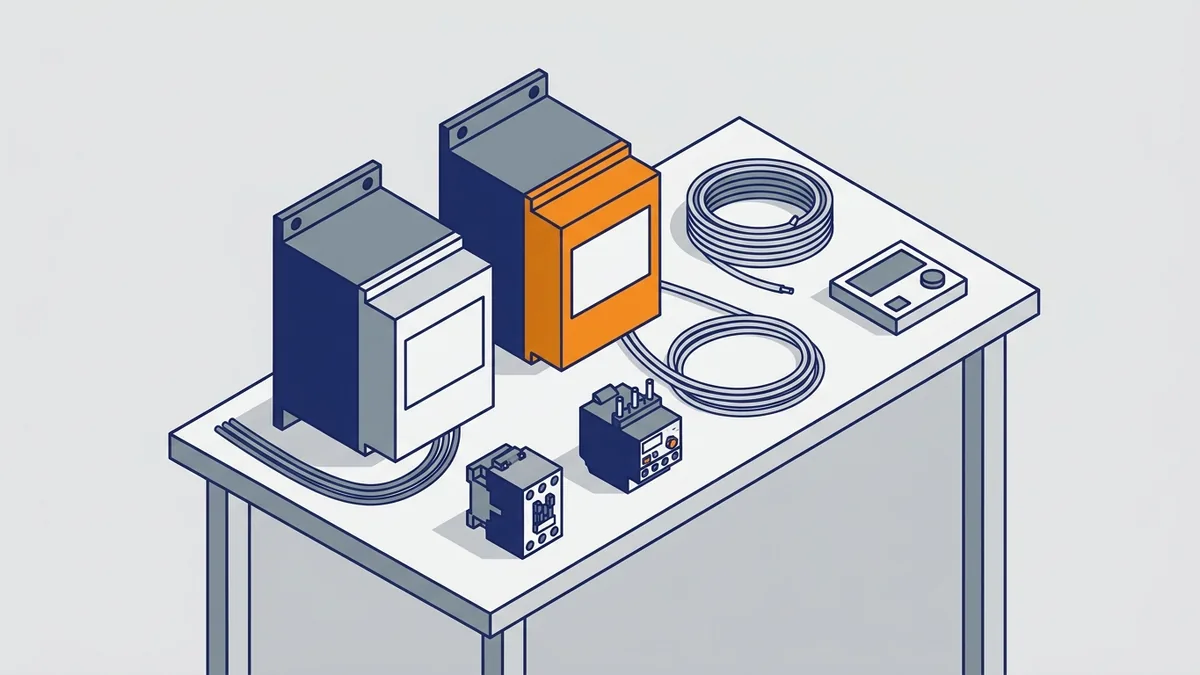
Both Eaton soft start models share the same compact frame family, bypass contactor and overload. The difference lies in control and connectivity:
| Feature | S811+ | S801+ |
|---|---|---|
| Interface | Digital Interface Module (DIM) with display and keypad | Control Interface Module (CIM) with dials and DIP switches |
| External communications | Yes, Modbus port and C441 modules | No C441 module support |
| Analog and digital inputs | Yes | No |
| Programmable relays | Yes | No |
| Pump control option | Yes | No |
| Terminals | Configurable | Not configurable |
| Bypass contactor and overload | Built in | Built in |
A quick rule of thumb
- Choose the S801+ when you need a plain ramp up, ramp down and motor protection, with no network.
- Choose the S811+ when you need a fieldbus or HMI link, programmable I/O, pump soft stop or detailed diagnostics on a display.
One warning: the SKU pages list some overlapping fields for the two lines. For example, some S801+ pages show Modbus RTU or mixed CIM and DIM entries, and dimensions differ between pages. So check the specification sheet for your exact catalog number before you order.
Ratings, frame sizes and how to read an Eaton soft starter catalog number
How do I read an S811+ or S801+ catalog number?
Every Eaton soft start catalog number in this family follows the same pattern. Take S811+T30N3S as an example:
- S811+ or S801+ names the product line.
- The frame letter (N, R, T, U or V) gives the physical size, from smallest to largest.
- The two digits are a short code for rated amps. For example, T30 is 304 A, R10 is 105 A and V10 is 1000 A.
- The suffix shows the version. N3S appears on the standard catalog numbers, while P3S marks the premium 600 V rated version with level/edge sense.
If you see another suffix, such as V3S, do not guess. Instead, read the voltage class on the specification sheet for that exact catalog number, because the 200-600 V and 690 V IEC versions are not interchangeable.
What amp ratings and frame sizes do S811+ and S801+ units come in?
The table below combines frame and current pairs from the S811+ manuals and SKU pages. Also, the overload column shows the adjustable trip range where the manual lists it.
| Frame code | Rated current | Overload range |
|---|---|---|
| N37 | 37 A | See spec sheet |
| N66 | 66 A | See spec sheet |
| R10 | 105 A | See spec sheet |
| R13 | 135 A | See spec sheet |
| T18 | 180 A | 56-180 A |
| T24 | 240 A | 75-240 A |
| T30 | 304 A | 95-304 A |
| U36 | 360 A | 112-360 A |
| V36 | 360 A | See spec sheet |
| V42 | 420 A | See spec sheet |
| V50 | 500 A | 156-500 A |
| V65 | 650 A | See spec sheet |
| V72 | 720 A | See spec sheet |
| V85 | 850 A | See spec sheet |
| V10 | 1000 A | 320-1000 A |
Not every rating appears in both lines, so check the catalog for your model. Also, the brochure’s range starts at 11 A, so check the catalog for ratings below 37 A.
What motor hp or kW can each catalog number handle?
Eaton rates these starters by amps first, and the hp or kW depends on voltage and duty. For that reason, this article does not list a hp figure for every row. Instead, match the motor full-load amps to the frame’s current rating. For hp motors in the US, use the full-load amps from NEC Table 430.250 or the nameplate. Then confirm the hp and kW for your voltage on the specification sheet or in the user manual.
The same frame can carry less motor at severe duty than at standard duty. Severe duty means longer ramps, higher current limits or more starts per hour. So pick the rating that matches your real duty, not the best-case figure.
What are the starts-per-hour limits, and how do temperature and altitude affect ratings?
Starts per hour depend on ramp time, current limit and ambient temperature, because each start heats the SCRs. Eaton’s own limits are in the user manual and the specification sheet for your catalog number. The SKU pages list an operating range of -30 to 50 °C. For example, the Platt listing later in this article quotes a 15-second ramp, a 300% current limit, 4 starts per hour and 40 °C.
If your panel runs hot, starts often or sits at high altitude, expect to size up a frame. We do not give derating percentages here. Use the derating data in Eaton’s manual for your unit.
What voltage and control power does an Eaton S811+ need?
The S811+R10N3S SKU page lists a 200-600 V operating voltage at 47-63 Hz. It also lists 24 V control power and an operating range of -30 to 50 °C. Next, that 105 A unit weighs 10.5 lb, while the 304 A S811+T30N3S weighs 45 lb. In addition, the T30 takes wire from #4 AWG to 500 kcmil.
Most important, the catalog notes say all units require a 24 Vdc power supply. The starter needs this supply for its control circuits. So plan a 24 Vdc source in the panel from day one.
How do you size the 24 Vdc supply?
Eaton lists the control current draw in the user manual and on the specification sheet, so we do not quote a number here. First, add the starter’s draw to anything else on the same supply, such as relays or a communication module. Then pick a regulated 24 Vdc supply with some margin above that total. Also, apply 24 Vdc before line voltage.
Which options can you order?
The S811+R10P3S SKU page lists these options for the family:
- Inline or inside-the-delta wiring (inline is the default)
- Level/edge sense, a choice in how the start input reads its signal
- Pump control and extended ramp
- Premium 600 V rating, shown by the P3S suffix
How do you wire and set up inside-the-delta?
Inside-the-delta needs a six-lead motor, with both ends of each winding brought out. In this setup, the soft starter sits in series with each winding, not in the incoming line. The motor must be connected in delta for your supply voltage. Because the starter sees only the winding current, about 58% of the line current, a smaller frame can start a larger motor.
It also changes the wiring and the settings. You run six conductors from the motor to the starter. Then you set the starter to inside-the-delta and enter the motor data as the manual directs. If the wiring and the setting do not match, the starter will protect and ramp the motor incorrectly. So follow the wiring diagram and setup steps in the S811+ user manual for your frame.
What accessories (24 Vdc supply, lug kits, DIM/CIM, communication modules) do you need with an S811+ or S801+?
Some parts of an Eaton soft start order do not come in the box. First, every unit needs a separate 24 Vdc power supply. Next, S811+ T, U and V frame units need lug kits, and Eaton notes the same for S801+ V frames. Finally, if you want a network link on the S811+, add the right communication module.
The right lug kit, DIM, CIM and module catalog numbers depend on the frame. Eaton lists them on the SKU page and in the user manual for each catalog number. So read those before you order, and give us the starter’s full catalog number if you want us to match the parts.
Short-circuit ratings, protection and standards
What short-circuit ratings and standards apply to the S811+?
The short-circuit current rating (SCCR) is the fault current a device can withstand when you protect it with the right fuse or breaker. For example, the S811+ user manual lists these ratings at 600 V:
| Frame | SCCR with listed fuses or breakers | SCCR with enclosed control and fuses |
|---|---|---|
| N | 10 kA | 100 kA |
| R | 10 kA | 100 kA |
| T | 18 kA | 100 kA |
| U | 30 kA | 100 kA |
| V | 42 kA | 100 kA |
For standards, the SKU pages list UL Listed, IEC/EN 60947-4-2 and CSA elevator duty. Likewise, the brochure lists EN 60947-4-2 and C-Tick. However, if your site needs a specific mark, check the specification sheet.
How is overload protection set on the S811+ and S801+?
The built-in overload on an Eaton soft start unit lets you program the trip current from 32% to 100% of the unit’s rated current. To set it, you enter or dial in the motor nameplate full-load amps (FLA). For example, a T30 unit covers motors from 95 A to 304 A FLA. Because of this wide range, one frame fits several motor sizes.
Size the branch protection to the manual and the NEC
The SCCR of an Eaton soft start unit only holds when you use the fuses or breakers that Eaton lists. So size the branch circuit protection from the fuse and breaker tables in the user manual. Also follow the NEC (National Electrical Code) and your local code for conductors and disconnects.
Which fuse or breaker protects each frame?
The exact fuse classes, breaker types and sizes for each frame at 240, 480 and 600 V are in the S811+ user manual (MN03900001E). We do not copy them here, because a wrong size voids the SCCR. Find your frame and voltage in the manual’s tables, then pick a listed fuse or breaker that also meets the NEC for your motor.
Where each Eaton soft start model fits (applications)
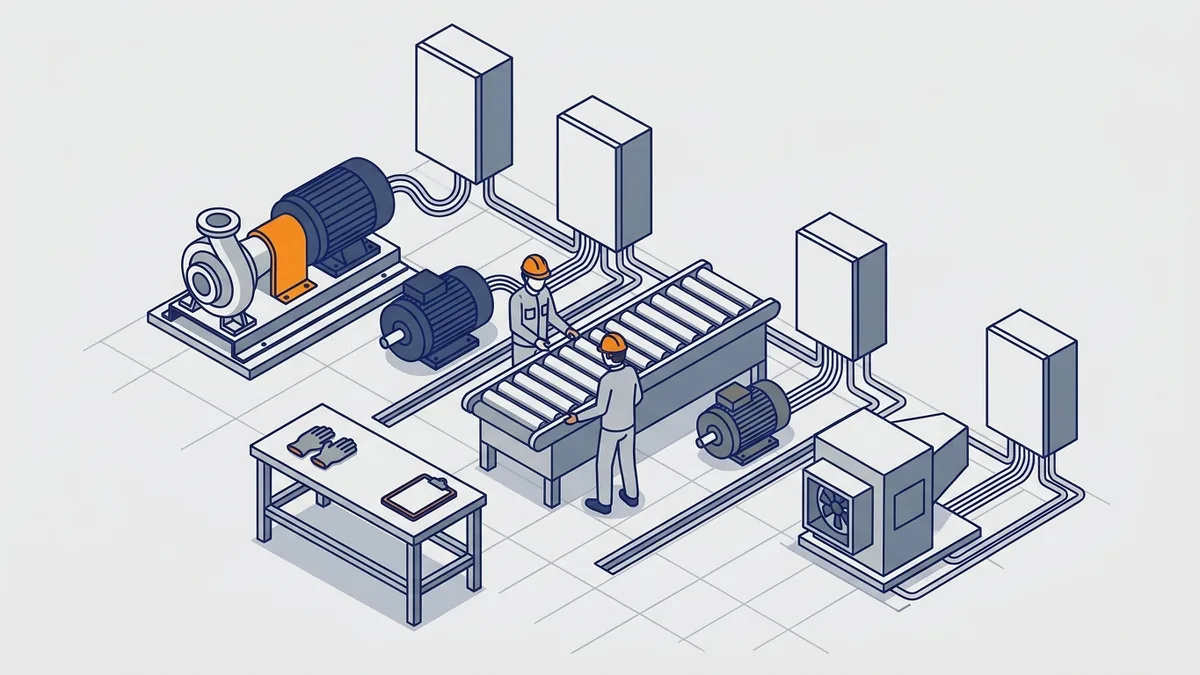
Is an Eaton motor soft starter suitable for pumps, conveyors and fans?
Yes. An Eaton soft start unit suits most fixed-speed loads that need a gentle start. However, the best fit depends on the load type and the features you need, as the sections below show.
Pumps and water systems
Pumps gain the most from a soft stop. For example, when a pump stops suddenly, the water column can surge back and slam check valves shut. In contrast, the S811+ pump control option stops the pump gently, which removes the water hammer that can damage pipes, valves and pumps. For well-pump detail, see our Soft Start for Well Pump post.
Conveyors, fans, compressors and high-inertia loads
Conveyors start smoother, which cuts belt slip and spilled product. Likewise, fans and compressors benefit from a current limit, which reduces the voltage dip on your supply. For heavy, high-inertia loads, the kick start function gives a short boost to get the load turning. For compressor loads in cooling systems, see our Soft Start for Air Conditioner post.
MCC and enclosure retrofits
Space often decides the choice in an older MCC. Because the Eaton soft start family is so compact, it can fit where a wye-delta or across-the-line starter once sat. As a result, you may be able to upgrade without a new enclosure.
Elevator duty
The family carries CSA elevator duty certification. So it is an option for elevator motor starting where your project calls for that mark. However, confirm the listing on the specification sheet for your catalog number.
Medium-voltage soft start: Ampgard RVSS
Does Eaton make a medium-voltage soft starter?
Yes. For 2.4 to 13.8 kV motors, the Eaton soft start route is the Ampgard reduced voltage solid-state soft starter, or RVSS. Ampgard control covers motors up to 8,000 hp. Also, the RVSS is designed to prevent mechanical shock, current spikes and voltage drops during start. In addition, it has a pre-start check and UL 347 medium-duty ratings.
Ampgard starter types and drive lineups
The Ampgard page for 2.5, 5.0 and 7.2 kV lists four starter types:
- FVNR: full-voltage non-reversing, a direct across-the-line start
- RVR: reduced voltage reactor start
- RVAT: reduced voltage autotransformer start
- RVSS: reduced voltage solid-state soft start
The RVSS also integrates into SC9000 medium-voltage drive and switchgear lineups. Eaton lists the SC9000 up to 12,000 hp, with a soft-mag pre-charge that eliminates drive inrush current. In addition, the SC9000 EP page lists 300 to 12,000 hp, 2400-13,800 V input and UL 347A certification.
Application cautions for medium-voltage soft starting
An older Bid Manager help file from October 2012 lists some cautions for Ampgard soft starts. For that reason, treat these as legacy guidance and confirm them with Eaton for your job:
- Avoid excessive capacitance on the load side.
- Remove surge capacitors from the motor terminal box.
- Report load cables longer than 800 ft to the factory.
- Plan special controls for power factor correction capacitors.
How to order an Ampgard RVSS
Ampgard is not an online catalog item. Instead, Eaton builds each RVSS to order in a switchgear-style lineup. So plan for an engineered quote with motor data, system voltage and site details.
Soft start with an Eaton VFD: DG1, H-MAX and SPX9000
Can an Eaton VFD (DG1, H-MAX, SPX9000) be used for soft starting?
Yes. A variable frequency drive (VFD) ramps both frequency and voltage, so the motor starts gently from zero speed. Unlike a soft starter, the drive then controls speed for as long as the motor runs. So a VFD is another Eaton soft start route, with speed control added.
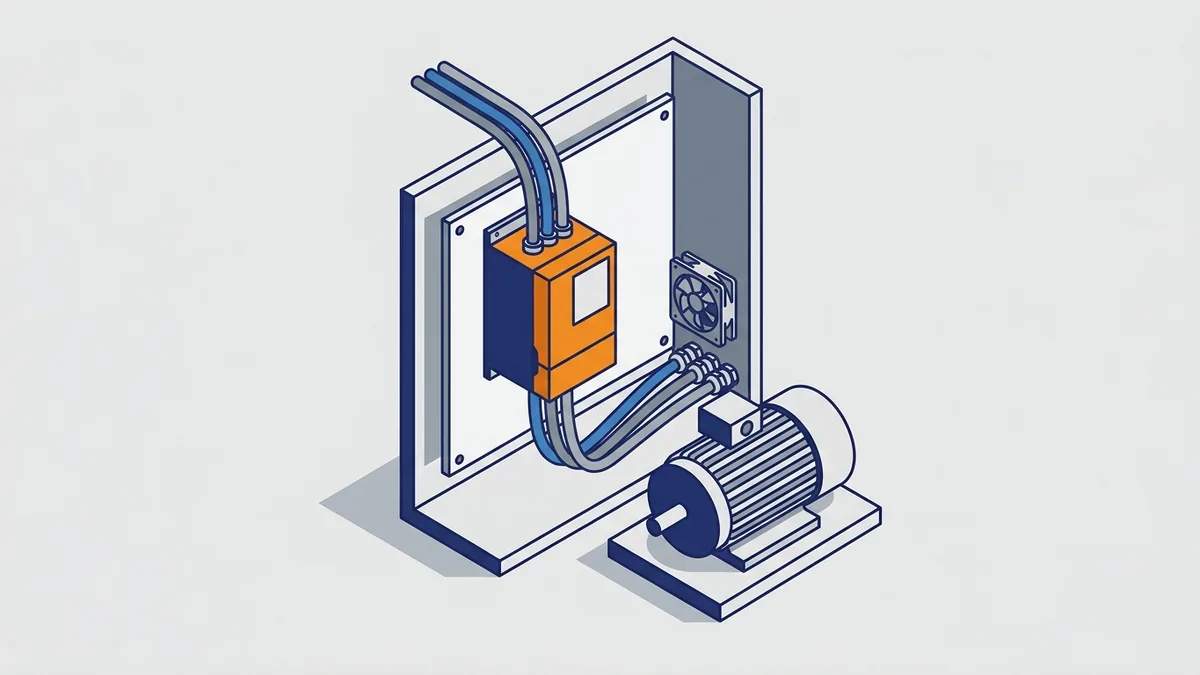
You set the start and stop ramps in the drive’s parameters. For exact acceleration, current-limit and torque settings, use the manual for your drive model.
Eaton drives Precision Electric stocks
| Series | Model | Enclosure | HP | Voltage | Rated amps |
|---|---|---|---|---|---|
| DG1 | DG1-32031FB-C21C / DG1-32031FB-C54C | NEMA 1 / NEMA 12 | 10 | 240 V | 31 A |
| DG1 | DG1-34016FB-C21C / DG1-34016FB-C54C | NEMA 1 / NEMA 12 | 10 | 480 V | 16 A |
| DG1 | DG1-34140FN-C21C / DG1-34140FN-C54C | NEMA 1 / NEMA 12 | 100 | 480 V | 140 A |
| H-MAX | HMX32AG26121-N / HMX32AG26122-N | NEMA 1 / NEMA 12 | 100 | 240 V | 261 A |
| H-MAX | HMX34AG14021-N / HMX34AG14022-N | NEMA 1 / NEMA 12 | 100 | 480 V | 140 A |
| SPX9000 | SPXH10A0-4A2N1 | Open chassis | 1000 | 480 V | 1300 A |
| SPX9000 | SPXH10A0-5A2N1 | Open chassis | 1000 | 600 V | 1030 A |
Which Eaton drive fits which job?
- DG1: general industrial drives for conveyors, pumps, mixers and similar machines.
- H-MAX: HVAC drives for fans, air handlers and building pumps.
- SPX9000: large-horsepower drives, such as the 1000 HP, 1300 A model at 480 V.
For DG1 fault codes and setup, see our Eaton VFD Drives post.
Eaton soft starter vs VFD: how to choose
Eaton soft starter or VFD: which should I choose?
Eaton’s guide, Choosing between a soft starter and a VFD to fit your application, gives clear advice. First, a soft starter is often the more economical choice when you need control only at startup. On the other hand, a VFD suits jobs that need speed control, energy savings or lower peak demand. Use this quick list to lean one way or the other:
- Lean to an Eaton soft start unit for fixed-speed motors, high-inertia loads and tight panels.
- Also lean to a soft starter for large motors where size and cost matter most.
- Lean to a VFD for variable-torque pumps and fans that can run slower part of the time.
- Also lean to a VFD when the process needs speed control.
How much does an Eaton soft starter cost compared with a VFD?
The guide says a VFD can initially cost two to three times more than a soft starter. It also says soft starters are smaller and less expensive than VFDs in larger horsepower jobs. However, a VFD can save energy when the load runs at reduced speed, so weigh running costs too. For a quote on a specific unit, contact Precision Electric.
The bypass contactor and heat
A soft starter uses SCRs, which are solid-state switches, to lower the voltage during the ramp. Then, once the motor reaches full speed, the bypass contactor pulls in and carries the current. According to the guide, this reduces heating. As a result, the starter stays cooler than a drive that switches power the whole time. For the generic comparison, see our Electronic Soft Start VS Variable Frequency Drive post.
How to size and order an Eaton soft starter
How do I size a soft starter for my motor?
Follow these steps before you pick an Eaton soft start catalog number:
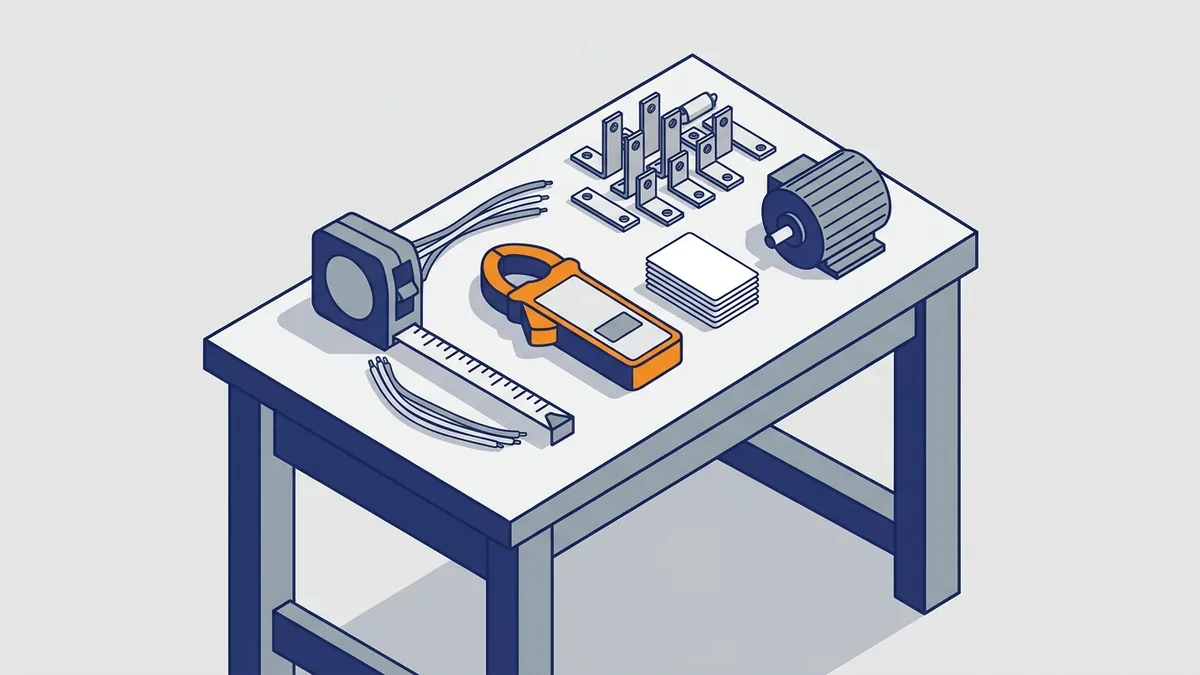
- Read the motor nameplate for full-load amps (FLA) and voltage.
- Define the duty: ramp time, starts per hour and the current limit you need.
- Pick a frame whose overload range covers the motor FLA.
- Confirm the line voltage falls inside the unit’s rating on the specification sheet.
- Choose the mounting: open panel mount or an enclosed unit.
- Plan the 24 Vdc control power supply.
- Decide on communications: S811+ for a network, S801+ for none.
- Add options such as pump control, extended ramp or inside-the-delta wiring.
Example: reading a distributor rating
Ratings depend on duty, so look at the conditions behind them. For example, a Platt distributor listing for the S811+T18N3S gives 180 A with a 15-second ramp and 4 starts per hour. It also lists a 300% current limit at 40 °C. On that basis, it shows 50 HP at 200 V, 60 HP at 230 V and 125 HP at 460 V.
These figures come from a distributor, not from Eaton. Also, they change with ramp time, starts per hour and ambient temperature. So size from the motor FLA and Eaton’s own documents, not from a horsepower figure alone. Finally, the same listing notes the unit needs the Cutler-Hammer power supply and two lug kits.
Accessories to order with the starter
- 24 Vdc power supply (all units)
- Lug kits (S811+ T, U and V frames; S801+ V frames)
- DIM for the S811+ or CIM for the S801+, if your catalog number does not include it
- Communication module for an S811+ network link
Where do I find the Eaton manual, catalog and spec sheets?
Start on Eaton’s website. These documents answer almost every ordering question:
- The S811+/S801+ soft starters catalog page on eaton.com, for the line overview and links to each catalog number
- The S811+ soft starter user manual (MN03900001E), for wiring, setup, fuse tables and SCCR
- The brochure for the S811+/S801+ soft starters (PA03902004E), for features and certifications
- The SKU page and specification sheet for your exact catalog number, such as the S811+R10N3S or S801+V42N3S product pages
- The soft starter catalog (CA04020001Z), linked from the S801+ SKU pages
- The guide called Choosing between a soft starter and a VFD to fit your application, for the starter vs drive decision
- The UK (Moeller) S811+ page, for IEC ratings up to 690 V
- The Ampgard medium-voltage motor control page and the medium-voltage control assemblies portfolio, for RVSS and SC9000 details
Common mistakes and when to call for repair or replacement help
What mistakes do people make when applying an Eaton reduced voltage soft starter?
Watch for these common Eaton soft start mistakes:
- Forgetting the 24 Vdc supply. The starter needs it, and the manual says to apply 24 Vdc before line voltage.
- Skipping lug kits on T, U and V frames, which stalls the install.
- Setting the wrong FLA, which causes nuisance trips or leaves the motor unprotected.
- Using a soft starter where you need speed control. Pick a VFD instead.
- Ignoring SCCR and fuse class. The rating holds only with the listed fuses or breakers.
- Running above the ambient limit. The SKU pages list -30 to 50 °C, so watch hot enclosures.
- Switching between inline and inside-the-delta wiring without changing the settings to match.
What do S811+ faults and trips mean, and how do you clear them?
Most soft starter trips fall into a few groups. These include motor overload, phase loss or imbalance, overtemperature, a shorted SCR, and a bypass or control power problem. The display on the S811+ shows which fault tripped, and the user manual lists each code with its cause.
To clear a fault, first find and fix the cause. For example, check the 24 Vdc supply, the incoming phases, the motor load and the panel temperature. Then reset the starter the way the manual describes. If the fault returns right away, do not keep resetting it, because repeated restarts can damage the unit.
When should I send a soft starter for repair or replace it?
Call for help when a fault keeps coming back after you fix the obvious causes. Also act when the unit shows no display or no response, even with 24 Vdc present. In addition, shorted SCRs or a failed bypass contactor are clear signs that the unit needs bench repair or replacement.
Precision Electric repairs and sources Eaton drives, controls and parts. So we can quote a repair or help you find a matching replacement. Before you call, check fault code meanings in our Eaton S811+ soft starter guide.
Frequently asked questions
What is an Eaton soft starter?
It is an electronic reduced-voltage starter that limits the voltage to a three-phase motor during start. As a result, current and torque ramp up smoothly. The main low-voltage lines, the S811+ and S801+, include a built-in bypass contactor and overload protection. For medium voltage, Eaton offers the Ampgard RVSS.
What is the difference between the Eaton S811+ and S801+?
Both use the same compact family design. However, the S811+ adds a Digital Interface Module, external communications, analog and digital inputs, programmable relays and a pump control option. In contrast, the S801+ uses a Control Interface Module with dials and DIP switches and focuses on core soft starting.
What current and voltage range do Eaton S811+/S801+ soft starters cover?
The brochure lists 11 A to 1000 A. Meanwhile, the US SKU pages list 200-600 V at 47-63 Hz with 24 Vdc control power. However, the UK page lists 37 A to 1000 A and up to 690 V, so check the exact catalog number and its specification sheet.
Does an Eaton S811+ need a separate power supply or lug kits?
Yes. The catalog notes say all units require a 24 Vdc power supply. In addition, S811+ T, U and V frames require lug kits, so order them with the starter.
Should I use an Eaton soft starter or an Eaton VFD?
Eaton says a soft starter is often the more economical choice when you only need control during startup. Also, it is smaller and cheaper at larger horsepower. However, choose a VFD when you need speed control or energy savings, and expect it to cost two to three times more up front.
Does Eaton make a medium-voltage soft starter?
Yes. The Ampgard line includes a reduced voltage solid-state soft starter (RVSS) for 2.4 to 13.8 kV motor control. Because Eaton builds it to order in a switchgear-style lineup, you request it through an engineered quote.
The right Eaton soft start choice comes down to voltage class, control needs and whether the motor ever needs to change speed. Use the S801+ for simple ramp-and-protect jobs, the S811+ for networked or pump duty, Ampgard RVSS for medium voltage, and a VFD when speed matters. Whatever you pick, confirm the exact catalog number and its accessories before you order.
Contact Precision Electric for help sizing an Eaton soft start unit, a quote on an Eaton drive, or repair of a failed starter.