








1 Phase Motor Guide: Types, Nameplate, Sizing and Repair
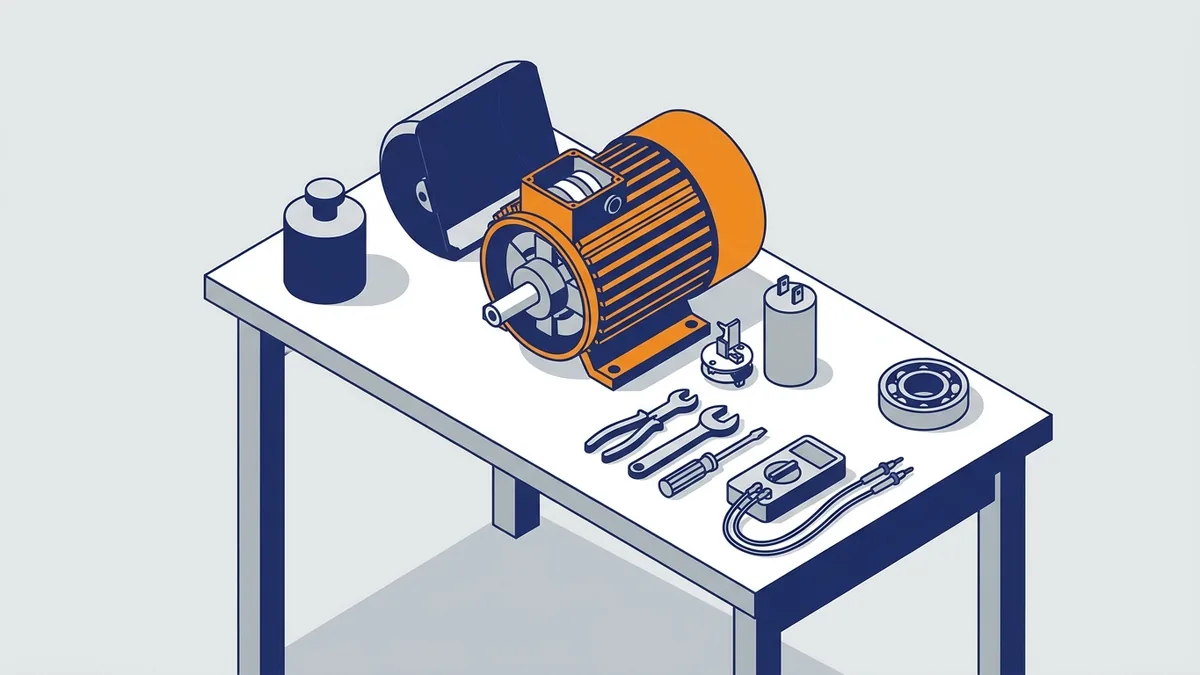
A 1 phase motor runs from ordinary single-phase power, so it is the usual choice for shops, farms and light-commercial buildings without three-phase service. This guide shows you how these motors work, how the types differ, and how to read a nameplate. It also covers sizing a 5 HP circuit, controlling speed, troubleshooting, repair or replacement, and buying.
On this page
- What Is a 1 Phase Motor?
- How a Single-Phase Induction Motor Works and Why It Needs a Start Circuit
- Types of Single-Phase AC Motors
- Single-Phase vs Three-Phase Motors: Which Do You Need?
- Reading a Single-Phase Motor Nameplate
- 1 Phase 5 HP Motors in Detail
- Voltage and Wiring a Single-Phase Motor
- Sizing the Circuit, Starter and Overload for a 5 HP Single-Phase Motor
- Why does the NEC table current differ from the nameplate current?
- What wire size, breaker and starter does a 5 HP single-phase motor need?
- What are the locked-rotor current and starting inrush, and how do they affect breaker, generator and transformer sizing?
- How do I set the overload relay from the nameplate?
- What disconnect, grounding conductor, terminal rating and voltage drop apply?
- Starting, Speed Control and VFDs on Single-Phase Motors
- Troubleshooting a Single-Phase Motor That Hums, Won’t Start or Trips
- Repair, Rewind or Replace?
- Buying or Specifying a Replacement 1 Phase Motor
- Frequently asked questions
What Is a 1 Phase Motor?
A 1 phase motor is an AC motor that runs from one alternating-current waveform. On 230 V, that power comes through two line conductors. On 115 V, it comes through a line and a neutral. Most people also call it a single phase motor, a single-phase AC motor, a 1ph motor or a single phase induction motor.
What does “phase motor” mean?
A bare “phase motor” search can mean single-phase or three-phase. The word only tells you how many power waveforms the motor needs. This article covers the single-phase kind. For example, if you see “ac motor 1 phase” in a catalog, it means the same thing as the terms above.
What is an AC motor 1 phase used for?
You find a 1 phase electric motor wherever the building has single-phase service. Common jobs include:
- Air compressors in shops and garages
- Water and transfer pumps
- Fans and blowers
- Conveyors and light machinery
- Farm equipment, such as augers and ventilation
Why do single-phase motors stop at about 5 to 10 HP?
The NEC single-phase motor table, Table 430.248, ends at 10 hp. In practice, stock motors top out around 5 HP. Above that, the current gets so high that three-phase power is usually the better fit.
How a Single-Phase Induction Motor Works and Why It Needs a Start Circuit
A single winding on single-phase power makes a pulsing magnetic field, not a rotating one. As a result, the rotor sits still and hums. The motor has no starting torque on its own.
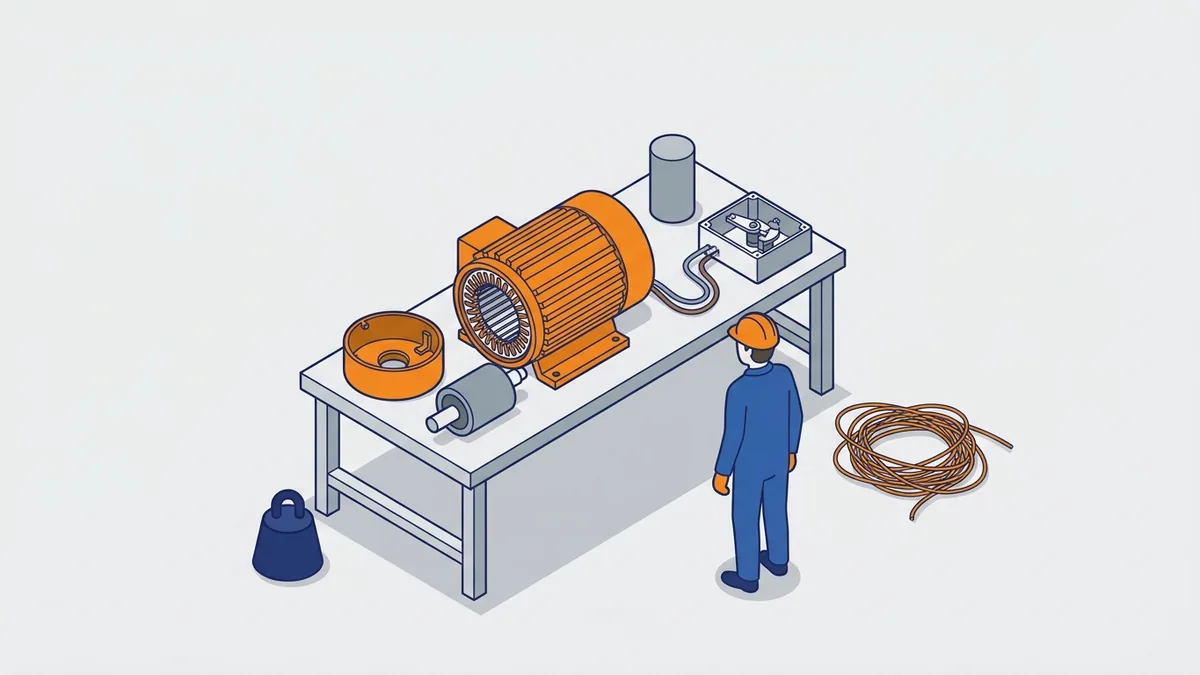
To fix this, the motor adds a second winding called the start winding. It is usually wired in series with a capacitor. Because the capacitor shifts the current timing, the two windings together make a field that turns.
How does a single-phase motor start and run?
The start sequence is the same on most larger designs:
- Power reaches the motor, and both the main and start windings energize.
- The rotor accelerates.
- At about 75% of rated speed, a centrifugal switch opens. This is a spinning switch with small weights that move outward as the shaft speeds up.
- The start circuit drops out, and the main winding runs the motor alone.
For a 1,725 rpm motor, that cutout happens near 1,300 rpm. However, some PSC motors skip the switch and keep the capacitor in the circuit the whole time.
Types of Single-Phase AC Motors
The four basic single-phase induction types differ by how they start. Each has its own torque, cost and best use. The table gives a quick comparison.
| Type | Starting torque | Start switch | Typical use |
|---|---|---|---|
| Split-phase | Moderate | Yes | Small, easy loads |
| Capacitor-start | High | Yes | Compressors, pumps, hard-to-start loads |
| PSC | Low | No | Fans and blowers |
| CSCR | High | Yes | Larger general-purpose motors |
Split-Phase and Capacitor-Start (CSIR)
A split-phase motor gets its phase shift from a resistance difference between the two windings. It has no start capacitor. Then a switching device disconnects the start winding once the motor reaches about 75% of rated speed.
A capacitor-start motor is a split-phase motor with a capacitor in series with the start winding. According to one electrotechnology text, it gives more than double the starting torque of a split-phase motor, with one-third less starting current. However, it costs more because of the switch and the capacitor.
To tell them apart, look for a large start capacitor on the motor body plus a centrifugal switch. That combination means capacitor-start.
Permanent Split Capacitor (PSC)
A PSC motor keeps its capacitor in the circuit and has no starting switch. The capacitor is sized for running, so starting torque is low, perhaps about 75% of rated torque. Because of that, PSC motors suit fans, blowers and other loads that start easily.
A single run capacitor is the clue that you have a PSC. In addition, this is the type most often named as compatible with single-phase drives.
Capacitor-Start/Capacitor-Run (CSCR)
A CSCR motor combines a start capacitor with a run capacitor. It is the usual design for larger general-purpose motors, including 5 HP. It is also the most efficient of the single-phase types. For example, one 5 HP listing describes its CSCR design as made for reduced amperage.
Shaded-Pole and Others
Shaded-pole motors are very small, often around 0.05 HP. They have low torque and low efficiency, so they run small fans. You can spot one by the copper shading coil. However, universal, repulsion-start, reluctance-start and ECM (brushless) types also exist, but they fall outside this industrial guide.
What is the difference between split-phase, capacitor-start, PSC and CSCR motors?
In short, split-phase has moderate torque and no capacitor. Capacitor-start adds a start capacitor for high torque. PSC keeps one capacitor in the circuit for low torque and simple design. Finally, CSCR uses both a start and a run capacitor, so it combines strong starting with better running efficiency.
Single-Phase vs Three-Phase Motors: Which Do You Need?
If your building has three-phase power, a three-phase motor is usually simpler. It has no start winding, no centrifugal switch and no capacitors. Those parts are the common failure points on a single phase motor.
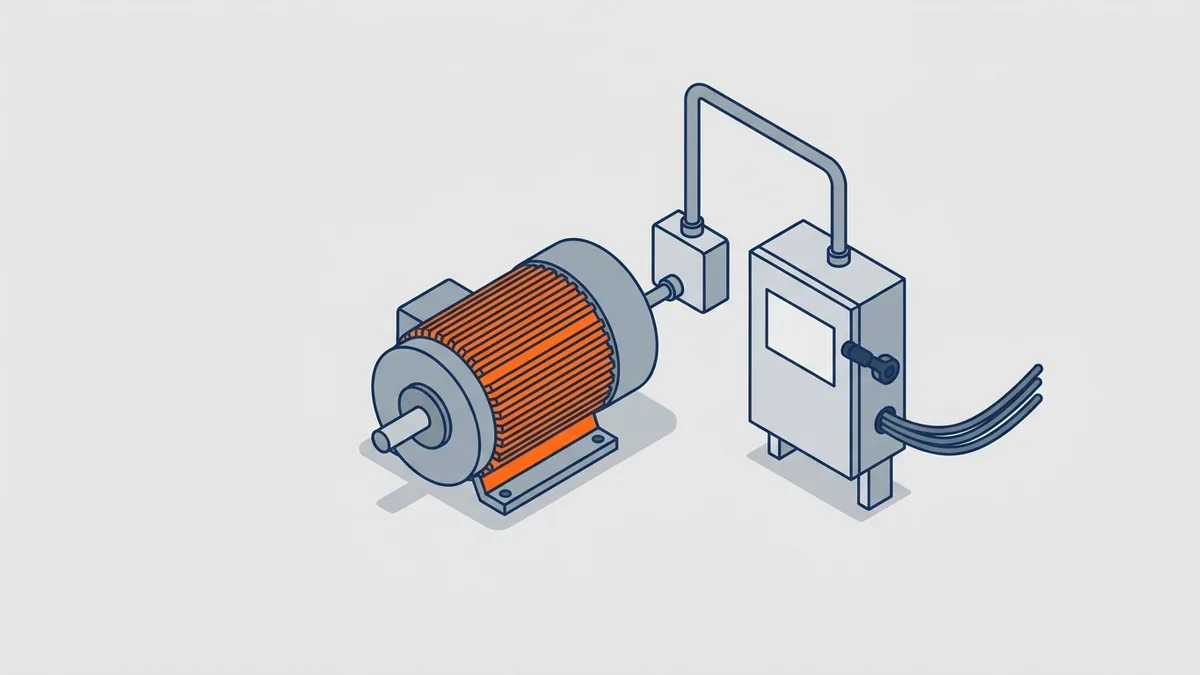
Current draw also differs. At 5 HP and 230 V, the NEC table shows this:
| 5 HP at 230 V | Table full-load current |
|---|---|
| Single-phase | 28 A |
| Three-phase | 15.2 A |
Should I choose a single-phase or three-phase motor?
First, start with the power you have. If the site has only single-phase service, you have two choices. You can buy a true 1 phase motor, or you can run a three-phase motor from a variable frequency drive (VFD). Our existing posts on running 3-phase motors on single-phase power and on VFDs cover that second route in detail, so this guide does not repeat them.
For a simple compressor or pump with a fixed speed, the single-phase motor is often the easier path. However, for variable speed, the drive route may win.
Reading a Single-Phase Motor Nameplate
The nameplate tells you almost everything you need to order a match. Read it before you call a supplier. Here are the items to note.
- Horsepower and rpm: 3,450 rpm is a two-pole motor, and 1,725 or 1,750 rpm is a four-pole motor. The slower one is the more common general-purpose choice.
- Voltage: 115 V, 230 V, 115/230 V or 208-230 V. Check whether 208 V and 200 V are allowed.
- FLA: full-load amps, the actual current at rated load.
- Frame: for example 184T, 213T or 56.
- Enclosure: ODP (open drip-proof) or TEFC (totally enclosed, fan-cooled).
- Service factor: a figure such as 1.15 shows the overload the motor can carry.
- NEMA design letter and insulation class: for example Design L and Class F.
- Duty, rotation and thermal protection: some motors have none.
How do I read a single-phase motor nameplate?
Go through the list top to bottom, then match each value on the replacement. Frame letters matter because the frame sets shaft height and mounting dimensions. For a T frame such as 184T, the first two digits divided by four give the shaft height in inches. Before you order, check the full dimensions in a frame table.
Also note the capacitor ratings. The nameplate or the capacitor label gives microfarads (µF) and voltage. As a result, those numbers are your reference when a capacitor fails.
How do I choose between ODP and TEFC, and what do ambient, duty and hazardous-location ratings mean?
An ODP motor lets air pass through the frame, so it runs cooler. Use it indoors where the air is clean and dry. A TEFC motor is sealed, and a fan on the shaft cools the outside. As a result, it suits dust, dirt, moisture and washdown areas.
Next, check three more ratings against the site:
- Ambient: the nameplate shows the room temperature the motor is built for. Standard motors are usually rated for 40°C. A hotter room needs a different motor or a lower load.
- Duty: continuous duty can run all day. Intermittent duty is built for short runs and can overheat if you run it longer.
- Hazardous location: if flammable gas or dust may be present, the motor must be marked for that class and division. A standard ODP or TEFC motor does not qualify.
What do automatic and manual reset thermal protection mean?
Thermal protection is a small sensor inside the motor that opens when the windings get too hot. With automatic reset, the motor restarts on its own after it cools. With manual reset, someone must press a button first.
Because an automatic restart can surprise a person, choose manual reset where that could cause injury. Examples include saws, augers and conveyors. In addition, remember that some motors have no built-in protection at all.
1 Phase 5 HP Motors in Detail
A 1 phase 5hp motor is the largest size most suppliers stock. It is a big single-phase machine, about 3.7 kW. Because it draws a lot of current, you need to plan the circuit with care. In addition, searches for a 5 hp motor 1 phase usually come from people replacing a compressor or shop motor.
Typical 5 HP single-phase specifications
The source listings fall into two families:
- General-purpose CSCR or capacitor-start motors at 1,725 to 1,755 rpm, in 184T or 213T frames. They come in ODP or TEFC, at 208-230 V, with a 1.15 service factor.
- Compressor-duty motors at 3,450 rpm in a 56 frame, at 230 V, with a 7/8″ shaft in the example.
Many units are 230 V only or 208-230 V. For example, one 184T listing works at 208 V but not at 200 V, so read the datasheet.
How many amps does a 5 hp motor 1 phase draw at 230 V?
It depends on which number you mean. The NEC table value is 28 A at 230 V. However, nameplates on the example motors run lower, at about 22 to 25 A. One 184T listing shows 23.0 A, and one 213T listing shows 24.5-22.0 A.
These numbers do different jobs. The table value sizes the wires and branch-circuit protection. In contrast, the nameplate value sets the overload device.
| Voltage | NEC table FLA, 5 HP single-phase |
|---|---|
| 115 V | 56.0 A |
| 200 V | 32.2 A |
| 208 V | 30.8 A |
| 230 V | 28.0 A |
Frames, mounting and C-face options
The 184T and 213T are foot-mounted frames, and the 56 frame is common on compressors. Also, some listings state that the motor accepts a C-face kit, which lets you bolt it to a pump or gearbox. NEMA MG 1 is the standard for single-phase motor frame dimensions, such as frames 42-56H. In addition, the Hydraulic Institute hosts a NEMA frame dimension reference tool.
Voltage and Wiring a Single-Phase Motor
Dual-voltage motors, rated 115/230 V, get their voltage from jumpers in the conduit box. The nameplate diagram shows which leads to join for each voltage. Because a 5 HP motor draws 56 A at 115 V, 230 V is the practical choice.
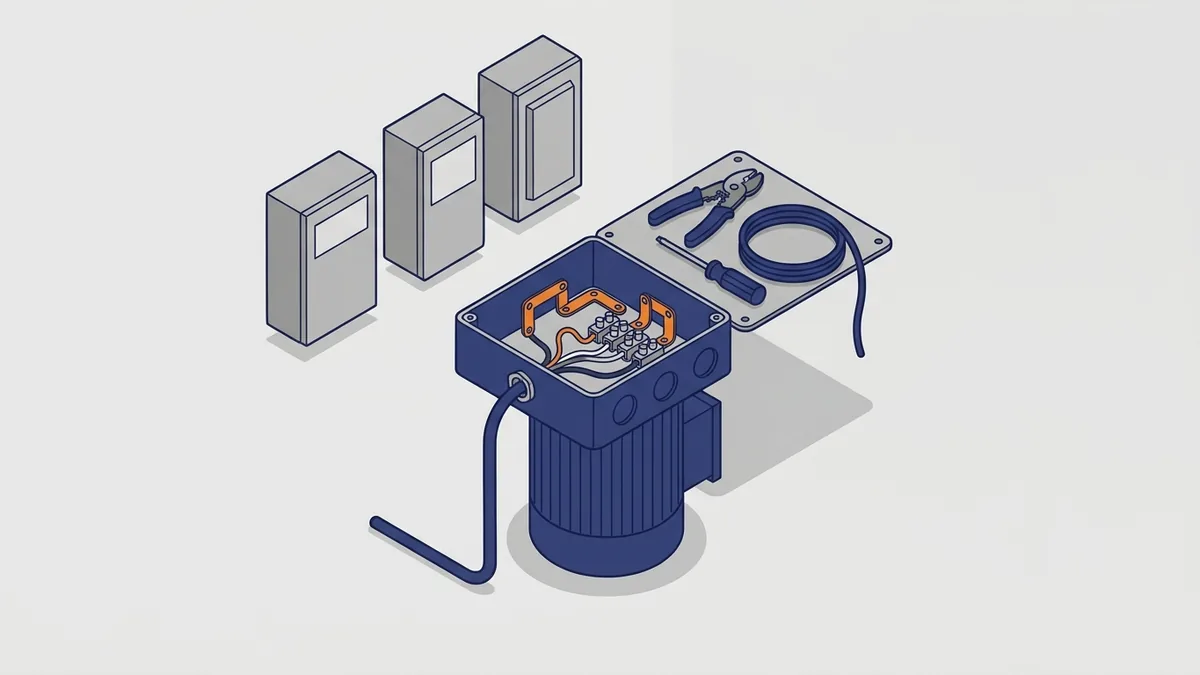
Always follow the wiring diagram on the motor or inside the conduit box. Lead markings come from NEMA MG 1, but they vary by design. For that reason, do not wire from a generic chart, because we could not verify those against the standard.
How do I wire a dual-voltage single-phase motor and reverse its rotation?
To set the voltage, make the jumper connections shown for your supply on the nameplate. Next, to reverse rotation, swap the start-winding leads as the nameplate shows. Do not guess which leads to swap. In fact, some motors cannot be reversed in the field, so check the diagram first.
Safety first: lock out and tag out the power before you open the conduit box. Then discharge the capacitors before you touch them. A single-phase motor can hold a lethal charge after power is off.
Sizing the Circuit, Starter and Overload for a 5 HP Single-Phase Motor
This section shows the NEC method and a worked example. It is not a final answer for your site. Always confirm against the NEC edition your area has adopted, local rules and the nameplate.
Why does the NEC table current differ from the nameplate current?
NEC 430.6(A)(1) tells you to size conductors and branch-circuit protection from the table full-load current, not the nameplate. The table uses standard values for every motor of that size. In contrast, nameplate current is the real figure for that one motor, so the overload device uses it. Also, one 2023 NEC check reports that the 430.248 values did not change across the 2017, 2020 and 2023 editions.
What wire size, breaker and starter does a 5 HP single-phase motor need?
Here is one worked example from the sources, for 5 HP at 230 V:
- Table current is 28 A.
- Multiply by 125% for conductors: 28 A × 1.25 = 35 A.
- That leads to 10 AWG copper, which is rated 35 A at 75°C. Section 240.4(G) lets Article 430 govern motor-circuit protection, so the 30 A limit in 240.4(D) does not apply.
- An inverse-time breaker larger than the conductor rating is allowed, up to 70 A under 430.52.
- Set the overload device from the motor nameplate current, not the table value.
However, web sources disagree. One page suggests 10 AWG copper with a 70 A breaker, and another says 8 AWG with a 40 A breaker. The 10 AWG answer fits the code sections above. Still, verify every number against your code book before you buy wire or a breaker.
For the starter, one 5 HP 230 V single-phase starter listing shows a NEMA 1 enclosure, motor FLA of 28 and an overload setting of 27-32. Likewise, a Square D 8911DPSG32V09 definite-purpose magnetic starter is rated for single-phase motors up to 5 HP at 240 V. Finally, compare the starter rating with your own motor.
Also think about voltage drop and starting inrush. On long runs, these are common reasons to use larger conductors or to see a weak start.
What are the locked-rotor current and starting inrush, and how do they affect breaker, generator and transformer sizing?
Locked-rotor current is the surge a motor draws in the first moments, before the rotor turns. It is several times the full-load current. The nameplate often lists it as LRA (locked-rotor amps) or shows a code letter. For the real figure on your motor, use the nameplate or the maker’s data sheet.
This surge explains why the NEC lets an inverse-time breaker be much larger than the wire rating. For 5 HP at 230 V, 28 A × 250% = 70 A. The breaker must ride through the start but still trip on a fault.
For a generator or transformer, size for the start, not just the run. Starting kVA is LRA × volts ÷ 1,000. For example, a motor with an LRA of 100 A at 230 V needs about 23 kVA during the start. As a result, a generator rated close to the running load may stall or sag. Ask the generator or transformer maker how much motor starting load it can carry.
How do I set the overload relay from the nameplate?
Use the nameplate current, not the table value. NEC 430.32(A)(1) sets the trip limit at 125% of nameplate amps for a motor with a service factor of 1.15 or more. It also applies to a motor marked with a temperature rise of 40°C or less. Other motors get 115%.
For example, take a 5 HP motor with a nameplate of 23.0 A and a 1.15 service factor:
- 23.0 A × 1.25 = 28.75 A, so set the relay at or below about 28.75 A.
- If the motor trips during a normal start, 430.32(C) allows a higher setting, up to 140% for this motor type.
- That top limit is 23.0 A × 1.40 = 32.2 A.
Some motors have built-in thermal protection. It can add to the overload relay, but check the code and the motor maker before you rely on it alone.
What disconnect, grounding conductor, terminal rating and voltage drop apply?
The disconnect must be rated at least 115% of the table current under 430.110. For 5 HP at 230 V, that is 28 A × 1.15 = 32.2 A. Pick a motor-rated switch above that number.
The equipment grounding conductor comes from NEC Table 250.122, based on the breaker size. A 70 A breaker calls for 8 AWG copper.
Next, check the terminal temperature rating. The 10 AWG answer above uses the 75°C column. If the equipment terminals are only rated 60°C, 10 AWG carries just 30 A. In that case, move up to 8 AWG, which carries 40 A at 60°C.
For voltage drop on a copper circuit, use VD = 2 × 12.9 × amps × one-way feet ÷ circular mils. Here is an example at 28 A and 150 ft one way:
- 10 AWG (10,380 circular mils): 2 × 12.9 × 28 × 150 ÷ 10,380 = 10.4 V, or about 4.5% of 230 V.
- 8 AWG (16,510 circular mils): the drop is 6.6 V, or about 2.9%.
The NEC suggests keeping a branch circuit near 3%. So on this long run, 8 AWG is the better pick.
Starting, Speed Control and VFDs on Single-Phase Motors
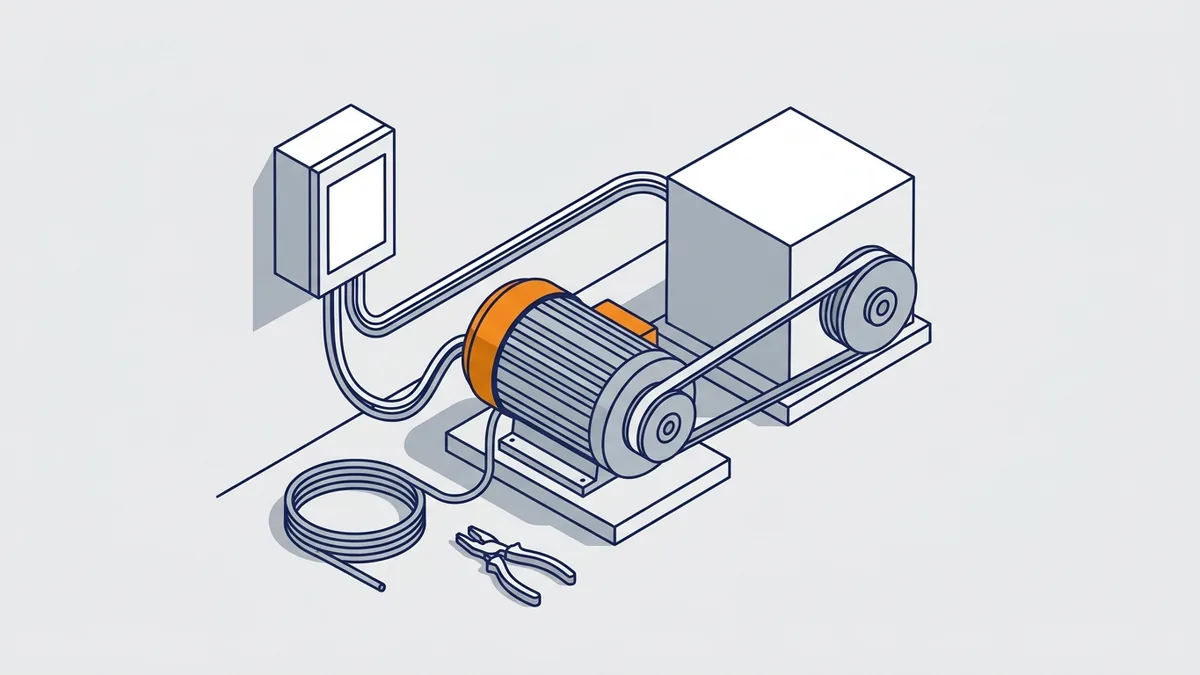
Most capacitor-start motors start direct-on-line. That means you connect them to full voltage through a starter or switch. It is the normal, simple method.
Can I run a single-phase motor on a VFD?
Generally no, not any motor. One vendor guide says only PSC motors suit true variable-frequency control. It also lists split-phase, capacitor-start and CSCR motors with centrifugal switches as incompatible. Shaded-pole motors might work in theory.
That guide is a vendor knowledge-base article, not a drive manufacturer document, so treat it as a secondary source. It says a drive built for single-phase motor output is needed for PSC speed control, and it names the Invertek Optidrive as an example. For safety, check with the drive manufacturer before you connect anything.
Our existing posts on VFD wiring and the SMV drive go deeper, so we do not repeat them here. However, if you need variable speed on a 5 HP load, a three-phase motor with a drive is the other path.
Troubleshooting a Single-Phase Motor That Hums, Won’t Start or Trips
Start with the symptom, then work through the checks in a fixed order. First lock out the power, then discharge the capacitors, and only then open the motor. The table maps common symptoms to likely causes.
| Symptom | Likely cause |
|---|---|
| Hums, will not start | Failed start capacitor or switch not closing |
| Silent, no hum | Supply or switch problem |
| Starts, then dies or trips | Switch not opening, bearing drag or low voltage |
| Runs hot | Stuck-closed switch, overload or voltage problem |
| Wrong rotation | Start-winding leads set wrong |
| Trips breaker on start | Seized load or bearing, shorted winding or undersized circuit |
Why does my single-phase motor hum but not start?
The usual cause is an open start circuit. That means a failed start capacitor or a centrifugal switch that is not closing. Also check for a seized bearing or load, and for supply voltage problems. In addition, bearing drag can stop a motor from reaching the cutout speed, which is typically 70 to 80% of synchronous speed.
Use this test order:
- Check supply voltage and wiring.
- Check the bearings and try to turn the load by hand.
- Test the start capacitor.
- Inspect the centrifugal switch.
- Test the windings.
Capacitors: Testing and Replacing Them
Start capacitors are intermittent duty, and run capacitors are continuous duty. However, a start capacitor that fails again and again often points to a stuck switch. In that case, fixing only the capacitor wastes time.
To test one, first discharge it through a 10 to 20 kΩ, 5 W resistor. A capacitor that reads more than 10% below its rated microfarads is considered dead. If it tests fine, move the switch weights by hand to check they move freely.
When you replace it, match the nameplate microfarad (MFD) value. Use the same voltage rating or higher. Do not rely on generic sizing charts, because they conflict. For example, for 5 HP, one vendor gives 250-300 µF for a start capacitor, one table shows 200 µF start and 40 µF run for CSCR, and a capacitor seller’s chart shows 480-580 µF start and 35-50 µF run. In the end, the nameplate always wins.
How do I pick a capacitor or potential relay when the label is missing?
First, look for the motor’s model and serial number on the nameplate. The motor maker can give you the correct capacitor values and relay part from that number. This is safer than guessing from a chart.
If the old capacitor is still readable, use its microfarad and voltage ratings. Also keep the type the same. A start capacitor is built for short duty, so never use it as a run capacitor.
Tolerances differ by type. Run capacitors are usually held to a tight range, often about ±6%. Start capacitors are rated as a range, and the top end is often about 20% above the marked value. So always check the full range on the label.
A potential relay opens the start circuit by sensing voltage across the start winding. It must match the motor’s design, so a wrong relay can leave the start capacitor in the circuit. Get that part by model number, not by size.
Centrifugal Switch and Start-Winding Failures
The centrifugal switch connects the start circuit at rest and opens it at about 75% of rated speed. If it stays open, the motor will not start. However, if it stays closed, the start capacitor and winding stay energized and overheat.
A failed start winding is often the result of a switch that did not open. As a result, inspect the switch whenever you deal with a start winding failure. Also note that some newer motors use a solid-state start switch instead. One forum report says it looks like a start capacitor but has four leads, so treat that as anecdotal and check the motor’s manual.
What winding and insulation tests show a shorted, open or grounded winding?
Lock out the power and discharge the capacitors first. Then disconnect the motor leads from the supply and from each other. Use the wiring diagram to find the main and start windings.
- Winding resistance: measure each winding with an ohmmeter. An open winding reads infinite. A shorted winding reads well below the maker’s value. The start winding normally reads higher than the main on a split-phase or capacitor-start motor.
- Ground check: measure from each lead to the bare motor frame. Any reading other than open suggests a grounded winding.
- Insulation resistance: use a megohmmeter (a meter that applies a test voltage). For a 230 V motor, 500 V is a common test voltage. A reading near or below 1 MΩ means the insulation is weak.
Winding resistance on a 5 HP motor is very low, often under a few ohms. So a standard meter may not show a short between turns. Compare your readings with the motor maker’s data, or send the motor to a shop for a proper test.
Repair, Rewind or Replace?
Some faults are cheap and quick to fix. For example, typical repairable items include capacitors, the centrifugal switch, bearings, cleaning and a new start switch.
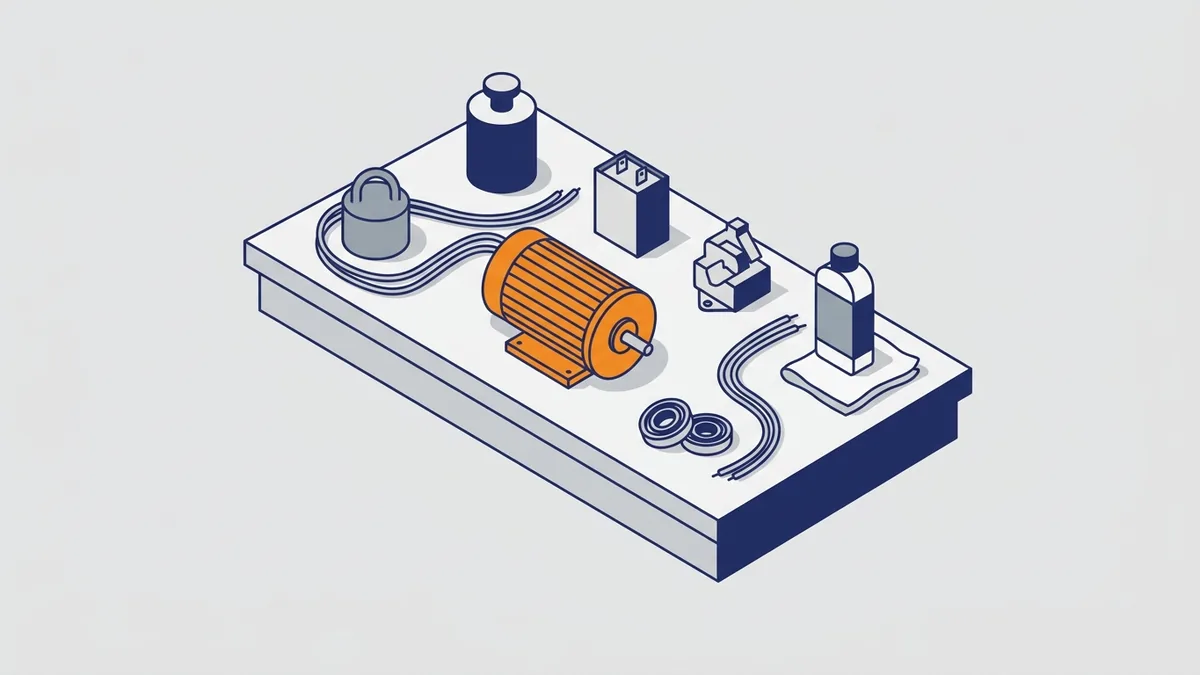
Call a motor shop when you find any of these:
- Open or shorted windings
- A seized bearing
- A damaged shaft or end bell
- Repeated capacitor failures
When should I repair, rewind or replace a single-phase motor?
Use this checklist to decide:
- Age: an old motor with several faults may not be worth saving.
- Nameplate: if it is unreadable, matching a replacement gets harder.
- Frame and mounting: a direct match saves rework.
- Downtime: if the line stops while you wait, a stocked replacement may win.
We do not list repair prices here. Instead, ask for a quote so you get shop pricing for your motor.
How do repair, replacement and three-phase conversion compare on cost and efficiency?
We do not state prices, because they vary by frame, enclosure and availability. Instead, compare the options by what each one involves:
| Option | What to weigh |
|---|---|
| Repair | Lowest cost for a minor fault. Works best when the windings are good. |
| Rewind | Makes sense for a large or hard-to-find motor. Ask the shop how it keeps efficiency. |
| Replace | Gives a new motor and a fresh start. Check the frame, rpm and design before you order. |
| Convert to three-phase | Needs a three-phase motor plus a VFD or phase converter. The motor draws less current, but you add equipment and wiring. |
On efficiency, three-phase motors are generally more efficient than single-phase motors of the same size. However, a drive or phase converter adds its own cost and losses. Federal efficiency rules and NEMA Premium labels apply mainly to three-phase general-purpose motors. Rules for single-phase motors are narrower and depend on size, so ask us which standard covers your motor. Then send the nameplate for a quote on each route.
Buying or Specifying a Replacement 1 Phase Motor
A wrong match costs time, so gather the data before you order. For a 1 phase motor, collect these items from the old nameplate:
- HP, rpm, voltage and frequency
- Frame and mounting type (foot or C-face)
- Shaft size
- Enclosure (ODP or TEFC)
- Duty and service factor
- Rotation
- Thermal protection
- Capacitor design (capacitor-start, PSC or CSCR)
What do I need to know to buy a replacement 1 phase motor?
First, match the list above. Then check protection. Some listings state no thermal protection and no overload protection, so plan for external protection, such as a starter with an overload relay.
What does a 5 HP single-phase motor cost?
We found no reliable price data, so we do not state a number. Price depends on frame, enclosure, design and availability. To get a real figure, send us the nameplate details and ask for a quote.
Where do I find NEMA standards and manufacturer manuals for single-phase motors?
Get the standards from NEMA. NEMA MG 1 Part 12 covers tests and performance for single-phase motors. For frame dimensions, use the NEMA MG 1 frame dimension tables on the Hydraulic Institute’s site. Finally, for wiring diagrams, capacitor data and manuals, go to the motor maker’s website and search by model number from the nameplate.
Frequently asked questions
What is a 1 phase motor?
It is an AC motor that runs from single-phase power. Because single-phase power produces no rotating field, most larger ones use a start winding with a capacitor and a centrifugal switch to get started. Then they run on the main winding.
How many amps does a 1 phase 5 HP motor draw?
NEC Table 430.248 lists 28 A at 230 V and 56 A at 115 V. These table values size conductors and branch-circuit protection. However, actual nameplate current is often lower, about 22 to 25 A in listings, and the overload device is set from the nameplate.
Can I put a VFD on any single-phase motor?
Generally no. One vendor guide says only PSC motors suit true variable-frequency control. It lists split-phase, capacitor-start and CSCR motors with centrifugal switches as incompatible. For that reason, check with the drive manufacturer before connecting.
Why does my single-phase motor hum but not start?
The usual cause is an open start circuit: a failed start capacitor or a centrifugal switch that is not closing. Also check for a seized bearing or load, and for supply voltage problems.
What is the difference between capacitor-start and PSC motors?
A capacitor-start motor uses a larger start capacitor switched out by a centrifugal switch, so it has high starting torque. A PSC motor leaves its capacitor connected and has no start switch. As a result, its starting torque is lower, so it suits fans and blowers.
Do I size the wire and breaker from the motor nameplate?
No. NEC 430.6(A)(1) requires conductors and branch-circuit protection to be sized from the table full-load current. Overload protection, however, uses the nameplate current.
A 1 phase motor is simple once you know its start circuit, its nameplate and the NEC sizing method. First check the nameplate, then confirm the code numbers for your site, and lock out and discharge before any repair. If you need help with a repair, a quote or a replacement 1 phase motor, contact Precision Electric.