








Eaton DC1 Drive: Models, Ratings, Catalog Numbers and Sizing
If you have an Eaton DC1 on a machine, or a DC1 part number to quote, you need to confirm the rating and decode the number. This guide covers what the Eaton DC1 is, its models and ratings, how to read a catalog number, how to size and start it, and when to step up to another drive. So use it to check the details before you order or install.
On this page
- What the Eaton DC1 is
- Eaton DC1 drive: key specifications
- Eaton DC1 models and ratings
- How to read an Eaton DC1 catalog number
- Eaton DC1-349D5NB-A20CE1 specs and what it fits
- IP20 vs IP66 Eaton DC1: choosing the enclosure
- Selecting and derating an Eaton DC1
- Installing and wiring an Eaton DC1
- Starting up an Eaton DC1: 14 basic parameters
- Eaton DC1 vs DA1 vs DG1: which drive fits
- When you need more than an Eaton DC1: DG1, H-MAX and SPX9000 options we stock
- Eaton DC1 documents, software and accessories
- Common Eaton DC1 mistakes and when to repair or replace
- Frequently asked questions
What the Eaton DC1 is
What is the Eaton DC1?
The Eaton DC1 is the compact drive in Eaton’s PowerXL range. First, Eaton developed it for simple applications and for serial production in machine building. You may also see it called the Eaton PowerXL DC1 or the Cutler-Hammer DC1, and it is a variable frequency drive (VFD), a device that controls motor speed by changing the power frequency.
Eaton’s own lineup sorts its drives by job. For example, the brochure classes the DC1, DB1, DE1 and DA1 as OEM drives, the DG1 as a universal drive, and the DA1 as a high-performance drive.
Where does it fit best?
An Eaton DC1 drive fits fans, pumps and conveyors. It also suits small machines where you need dependable speed control without extra features. Because it commissions with only 14 basic parameters, a technician can set it up fast.
Other headline traits:
- Small size, with IP20 and IP66 versions.
- 50 °C ambient without derating for IP20 models.
- Extra parameters that let it run IE4 and IE5 motors.
Eaton DC1 drive: key specifications
Which core numbers matter?
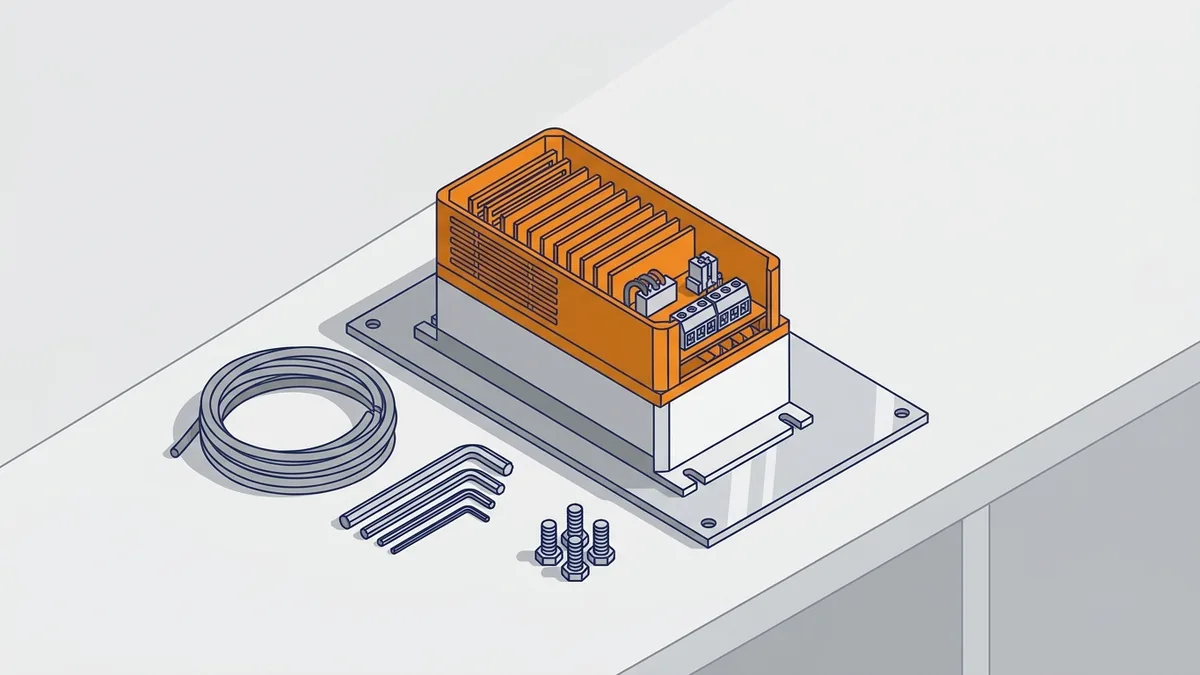
First, Eaton’s catalog sheet (PA040003EN) lists the core numbers. As a quick summary, the table below sums them up.
| Item | Eaton DC1 value |
|---|---|
| Input voltage | 110–115 V, 200–240 V and 380–480 V, each ±10 % |
| Input frequency | 50–60 Hz |
| Output frequency | 0–500 Hz, 0.1 Hz resolution |
| Overload | 150 % for 60 s, 175 % for 2 s (constant torque) |
| Control | V/Hz with voltage boost, sensorless vector |
| Onboard I/O | 4 inputs, 1 output, 1 relay output |
| Communication | Modbus RTU and CANopen built in; SmartWire-DT optional |
What other features are built in?
First, the Eaton DC1 VFD has a built-in PI controller, which holds a pressure or flow setpoint. It also has fire mode and works with permanent magnet, BLDC and synchronous reluctance motors. In addition, it can run a single-phase motor from the DC1-S2 versions, which the manual covers.
Eaton lists CE, UL, cUL, c-Tick, RoHS, Gost-R and UkrSEPRO certifications. Also, an optional EMC filter and brake transistor are available on selected models.
Eaton DC1 models and ratings
Which voltages and horsepower ratings are offered?
First, Eaton’s global listing gives 0.37 to 22 kW. In the North American training deck, that becomes 1/2 to 5 HP at 1~230 V and 3~230 V, and 1 to 30 HP at 3~480 V. So the 480 V three-phase range tops out at 30 HP. For anything larger, you need a different series.
Next, the table shows example models from Eaton’s SKU pages.
| Input / output | HP | Amps | Frame | Example catalog number |
|---|---|---|---|---|
| 115 V single-phase in, 240 V three-phase out | 0.5 | 2.3 | FS1 | DC1-1D2D3NN-A20CE1 |
| 115 V single-phase in, 240 V three-phase out | 1 | 4.3 | FS1 | DC1-1D4D3NN-A20CE1 |
| 240 V single-phase, IP66 with disconnect | 3 | 11 | FS2 | DC1-12011FB-A6SN |
| 240 V three-phase, IP20 | 5 | 18 | FS3 | DC1-32018FB-A20CE1 |
| 480 V in, 460 V out, IP20 | 2 | 4.1 | FS1 | DC1-344D1NN-A20CE1 |
| 480 V in, 460 V out, IP20 | 5 | 9.5 | See spec sheet | DC1-349D5NB-A20CE1 |
| 480 V in, 460 V out, IP20 | 20 | 30 | FS4 | DC1-34030NB-A20CE1 |
| 400 V class, IP66 | 25 at 460/480 V | 39 | FS4 | DC1-34039FB-A6SOE1 |
| 400 V class, IP66 | 30 at 460/480 V | 46 | FS4 | DC1-34046FB-A66OE1 |
What frame sizes are available?
First, the training deck shows FS1 to FS4 for IP20, covering 1 to 30 HP. Then, for IP66, it shows FS1 to FS3, covering 1 to 10 HP. However, Eaton’s European catalog also lists IP66 models in FS4, such as the 39 A and 46 A drives above. Because of this, check the exact model before you plan a panel or machine layout.
How to read an Eaton DC1 catalog number
How do I read a DC1 catalog number?
Eaton’s installation manual gives a part-number key. First, take DC1-349D5NB-A20CE1 as the example. Then read it from left to right:
- DC1 is the series.
- 3 means three-phase mains and a three-phase motor. A 1 here means single-phase input.
- 4 is the 400 V class, 380–480 V ±10 %.
- 9D5 is the 9.5 A output current. In the same way, 2D2 means 2.2 A.
- NB covers the filter and brake options (see below).
- A is the LED display, and 20 is IP20/NEMA 0.
- C and E1 split the suffix. C means additional PCB protection (a coated board). E1 means extended functionality (enhancement), version 1.
What does the NB and A20CE1 mean in DC1-349D5NB-A20CE1?
Eaton’s descriptions of FB models say “Radio interference suppression filter, Brake chopper.” So F marks an RFI filter and B marks a brake chopper. However, do not assume what the N means. Instead, confirm the NB letters on Eaton’s spec sheet for the exact SKU before you order.
Also, the A20CE1 part is the display, enclosure, board protection and enhancement suffix. For instance, enclosure codes are simple: -A20 is IP20/NEMA 0, -A66 is IP66/NEMA 4X, and -A6S is IP66 with a disconnect.
Why do some part numbers look different?
However, US and EU numbers differ for the same drive. For example, Eaton catalog number 199449 carries the model code DC1-34046FB-A66OE1. As a result, match on the model code and the nameplate, not on one number alone.
Eaton DC1-349D5NB-A20CE1 specs and what it fits
What is the Eaton DC1-349D5NB-A20CE1?
First, Eaton describes the Eaton DC1-349D5NB-A20CE1 as a DC1 series drive. It is IP20, with 480 V input and 460 V output, rated 5 HP at 9.5 A, with enhanced firmware. In addition, a third-party catalog lists it at 4 kW, with dynamic and flux braking, sensorless vector control and panel mounting. Likewise, a UK retailer shows the IEC rating as 400 V, 9.5 A and 4 kW.
For size and weight, use Eaton’s spec sheet, because sources disagree on those figures. So do not rely on a reseller listing.
Where does the eaton dc1 349d5nb a20ce1 fit?
For example, typical jobs for the eaton dc1 349d5nb a20ce1 are conveyors, pumps, fans and packaging machines with 5 HP motors. It also suits panel retrofits. However, check the motor’s full-load amps (FLA) against 9.5 A, not horsepower alone. Then apply the derating rules in the sizing section below.
What warranty comes with this model?
First, Eaton’s page gives one year from installation or 18 months from shipment, whichever comes first. In addition, it gives 5 years on the capacitor cells.
However, price varies a lot between new and used units. So before you buy, verify the condition, the firmware and the nameplate.
IP20 vs IP66 Eaton DC1: choosing the enclosure
What is the difference between IP20 and IP66 Eaton DC1 drives?
First, an IP20 drive goes inside a panel. Eaton lists IP20 models for 50 °C ambient without derating.
In contrast, an IP66/NEMA 4X drive mounts on the machine, so you can skip the panel. The -A66 versions are sealed, and the -A6S versions add a disconnect and local controls. Also, IP66 models are listed in FS1 to FS3, with FS4 in Eaton’s European catalog.
However, do not assume IP66 shares the IP20 ambient limit. Instead, confirm the temperature rating for your suffix in the manual.
Selecting and derating an Eaton DC1
How do I size and derate an Eaton DC1?
First, size the Eaton DC1 on output current at your real conditions, not on horsepower. Three things reduce the current you can use: altitude, switching frequency and ambient temperature. For example, on an IP66 spec page, Eaton gives a 4000 m maximum and 1 % derating per 100 m above 1000 m.

Then the installation manual works an example with a 9.5 A drive. The derating factors are 35 %, 10 % and 12.5%:
9.5 A × 0.65 × 0.9 × 0.875 = 4.86 A
However, that is lower than a motor that needs 5 A. In the manual’s case at 2,000 m altitude, the default 8 kHz switching frequency, instead of a higher one, fixes the problem. If it does not, move up one drive size.
How often can I switch it on at the mains?
Eaton limits mains switch-on to once every 30 seconds. As a result, do not use the line contactor for routine start and stop. Instead, use the control inputs.
Installing and wiring an Eaton DC1
How do I wire the control terminals?
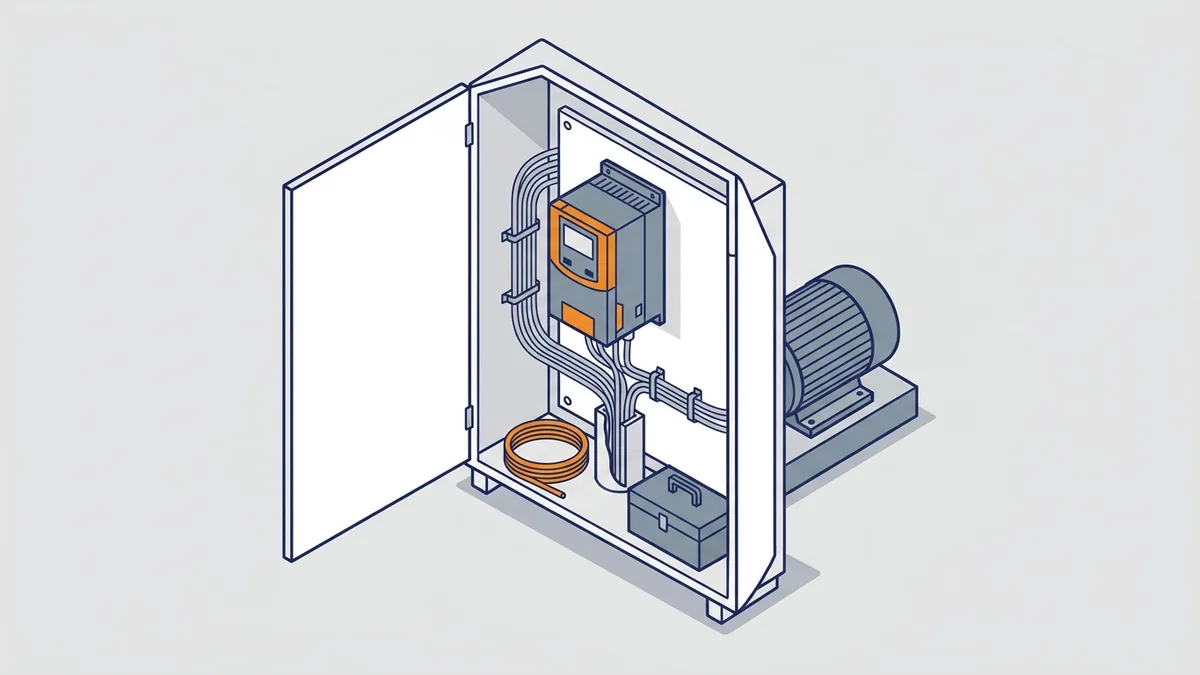
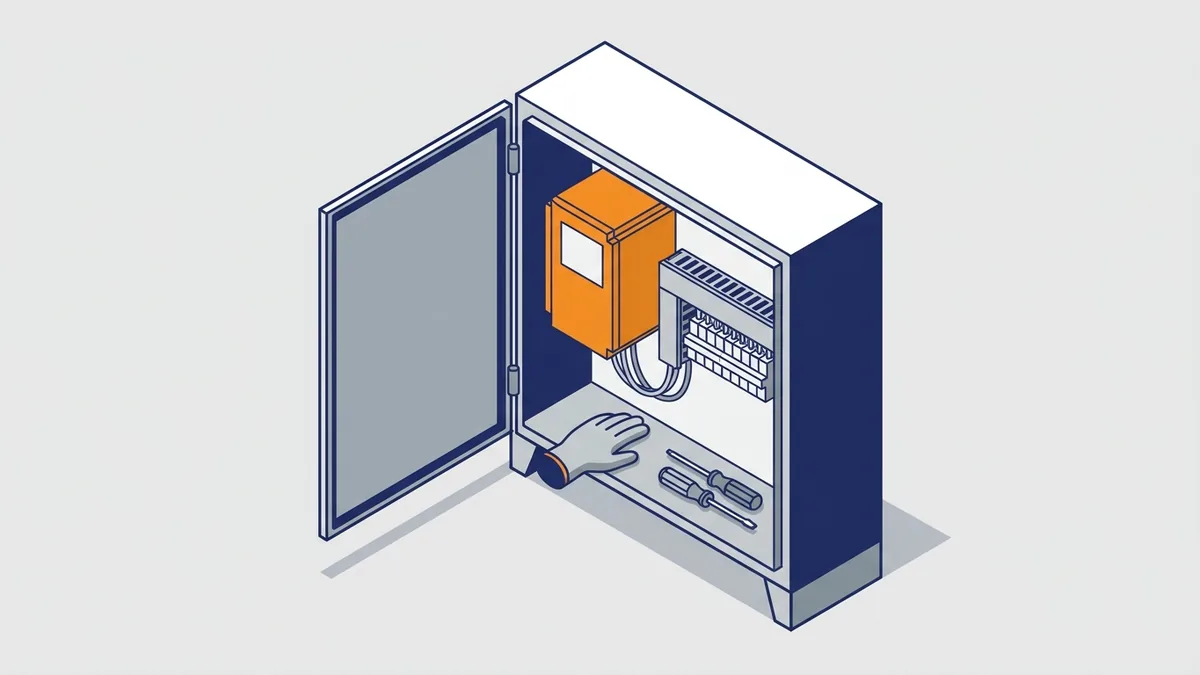
First, mount IP20 drives in a panel and IP66 drives on the machine. Then follow the clearances in the installation manual. Also, the control terminals are detachable, which makes wiring easier.
Next, the drive has four control inputs, on terminals 2, 3, 4 and 6. Before you apply mains power, make sure the enable contacts (FWD/REV) are open. Eaton’s manual warns about this, so check it first.
Also, if you have a spare that sat in storage, read the installation manual’s section on charging the DC-link capacitors. Do that before you power it up.
Starting up an Eaton DC1: 14 basic parameters
How do I start up and program an Eaton DC1?
The parameters sit in three groups: P0-00, P-01 to P-14, and P15 to P-55. As supplied, only the basic group is visible. So start there.

- Enter the motor data and ramp times first.
- Next, set the control mode.
- Set P-12 to 2 if you need two directions (FWD/REV) from the keypad.
- Finally, run the drive and watch the display.
When the drive runs at its nominal current under overload, the display decimal points flash. Then, if the overload lasts, the drive trips. Also, the parameter manual (MN04020004Z_EN) has application examples.
What is the extended parameter password?
Use parameter P-14 to enter the password and reach the extended group. Also, the default password in Eaton’s manual is 101.
Why will it not start from the keypad?
Most often, the enable is missing. In keypad mode, the drive still needs a high-level signal at terminal 2 (DI1). In that case, the keypad start does nothing. So check that terminal first.
Eaton DC1 vs DA1 vs DG1: which drive fits
What is the difference between the Eaton DC1, DA1 and DG1?
First, these three are different drives. In short, the DC1 is the compact one, the DA1 adds performance, and the DG1 is the universal drive.
| Drive | Class | Overload | Key points |
|---|---|---|---|
| DC1 | OEM, compact | 150 % for 60 s, 175 % for 2 s | PI controller, constant torque, 480 V to 30 HP |
| DA1 | High performance | 150 % for 60 s, 200 % for 4 s | Encoder module for closed loop, PLC functions through drivesConnect, more fieldbuses |
| DG1 | Universal | 150 % for 60 s, 200 % for 2 s | Internal DC choke (THDi under 30 %), EMC filter standard, Ethernet on board, STO, onboard PLC |
In addition, the DG1 covers 0.75 to 630 kW, and Eaton’s design guide shows up to 1000 hp at 480 V. As a rule, choose the DC1 for simple, small machine duty. However, move to the DG1 above 30 HP, when you need harmonic reduction or built-in Ethernet, or for harder loads.
When you need more than an Eaton DC1: DG1, H-MAX and SPX9000 options we stock
Is a DG1 a direct replacement?
No, not by default. First, Precision Electric does not list DC1 drives as stock items. However, our stocked Eaton families sit above the DC1 in size or serve other jobs:
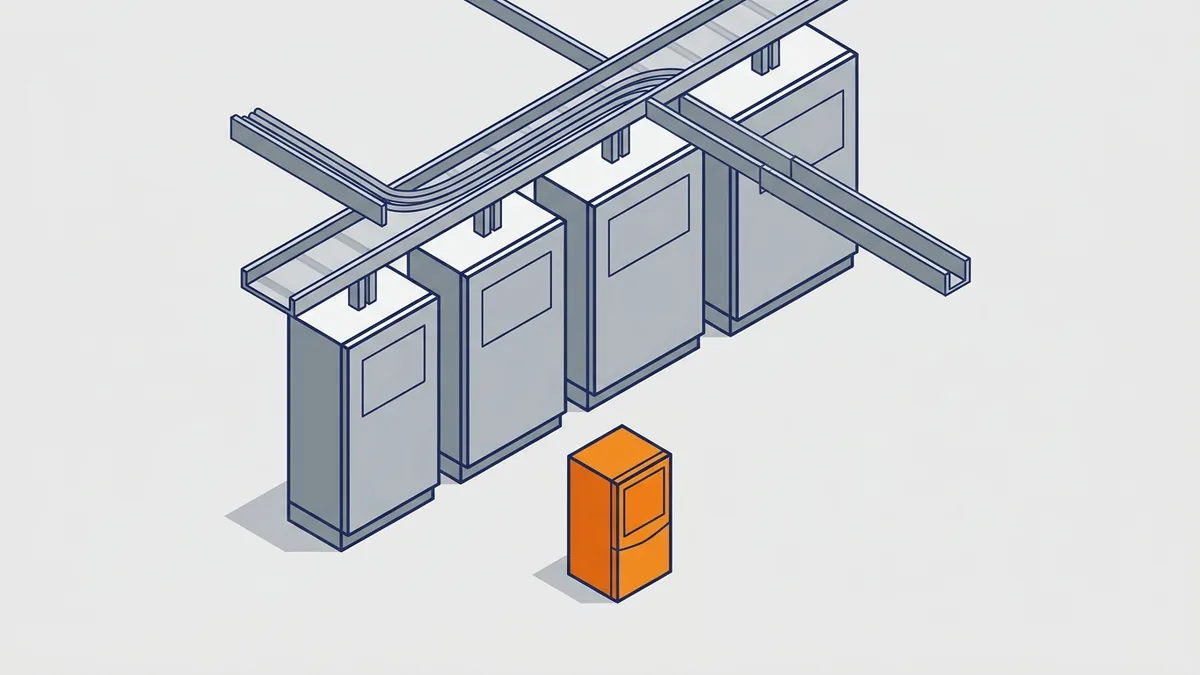
- DG1: for example, 10 HP at 480 V and 16 A in NEMA 1 or NEMA 12, and 100 HP at 140 A. These cover sizes beyond the DC1.
- H-MAX: Eaton’s HVAC family, in NEMA 1 and NEMA 12.
- SPX9000: open chassis drives up to 1000 HP, for high-power needs.
In fact, none of these is a drop-in swap for a DC1. Control wiring, parameters and mounting all need re-engineering. So if a DC1 has failed, send us the nameplate and catalog number, and we will help you match it.
Eaton DC1 documents, software and accessories
Where do I find Eaton DC1 manuals and the parameter list?
First, get them from Eaton. These are the documents to pull:
- Eaton’s DC1 product page and the catalog sheet PA040003EN, for ratings.
- The installation manuals MN040023_EN and MN04020003Z_EN.
- The parameter manual MN04020004Z_EN, for the parameter list.
- The spec sheet on the Eaton SKU page for your exact model.
- Eaton’s one-hour DC1 product overview training deck.
In addition, accessories include plug-in relay modules, a SmartWire-DT module and the DX-COM-STICK Bluetooth stick for DA1 and DC1 drives. However, one distributor lists the stick as unavailable and being discontinued. As a result, check supply before you plan around it.
Common Eaton DC1 mistakes and when to repair or replace
What are common Eaton DC1 mistakes?
- Sizing by horsepower and ignoring derating.
- Switching the drive with a line contactor more than once every 30 seconds.
- Leaving the enable contact closed at power-up.
- Expecting a keypad start without the enable at DI1.
- Ordering from a partial number without checking the filter, brake chopper and enclosure suffix.
- Using a DC1 for loads that need high starting torque for several seconds, or closed-loop feedback.
When should I repair it versus replace it?
For an older unit, first check parts and lead time. Then compare the repair cost with a new drive. In addition, our repair service handles failed drives. Finally, for units that sat in storage a long time, plan on reforming the capacitors before use.
Frequently asked questions
What is the Eaton DC1 drive?
It is the compact variable frequency drive in Eaton’s PowerXL series, built for simple applications such as fans, pumps and conveyors. In addition, it commissions with 14 basic parameters and comes in IP20 and IP66 versions.
What is the Eaton DC1-349D5NB-A20CE1?
It is a DC1 series drive with IP20 protection and 480 V input / 460 V output. It is rated 5 HP at 9.5 A and also carries enhanced firmware.
What overload can it handle?
First, Eaton rates the DC1 for 150 % for 60 seconds and 175 % for 2 seconds. In other words, it is a constant-torque rated drive.
How do I access the extended parameters?
Only the basic parameter group is visible as supplied. To change that, use parameter P-14 to enter the password and reach level 2. Also, the default password in Eaton’s manual is 101.
Should I use an Eaton DC1 or a DG1?
First, the DC1 suits small, simple machine duty, with 480 V models up to 30 HP. The DG1 is Eaton’s universal drive, with 200 % for 2 s, an internal DC choke, onboard Ethernet protocols, STO and an onboard PLC, and it goes to much higher power. So choose the DG1 for larger motors or when you need those features.
The Eaton DC1 is a good fit for small, simple machines, as long as you size it on current, derate it for your site and wire the enable correctly. If you need a larger or more capable drive, or help matching a DC1 part number, contact Precision Electric for a quote, a repair or advice on our Eaton DG1, H-MAX and SPX9000 drives.