








Invertek Optidrive ODE-3: How to Read Part Numbers and Ratings
If you need to replace or quote an invertek optidrive ode-3, the long part number holds most of the answers. This guide shows you how to read that number, which ratings and enclosures exist, and how the drive compares with other Invertek lines. Also, it lists what to check before you order.
On this page
- What the Invertek Optidrive ODE-3 is
- How to read an ODE-3 part number
- Ratings and frame sizes
- Precision Electric’s 0.5 HP ODE-3 models and where each fits
- IP20 vs IP66: switched and non-switched ODE-3 drives
- Single-phase input, single-phase output and 110 V models
- Control, communications and options
- ODE-3 compared with E4, P2 and Eco
- What to check before you order
- Common mistakes and troubleshooting
- Manuals, datasheets, software and support
- Frequently asked questions
What the Invertek Optidrive ODE-3 is
What is the Invertek Optidrive ODE-3?
ODE-3 is the model prefix of the Optidrive E3, Invertek’s general-purpose variable frequency drive (VFD). A VFD controls motor speed by changing the power frequency it sends to the motor. In short, the E3 is the third generation of the E series and a direct replacement for the Optidrive E2.
The range covers 0.37 to 37 kW (0.5 to 50 HP) at 110 to 480 V. Also, it accepts single-phase or 3-phase input. For background, Invertek builds it in Wales, and Invertek is part of Sumitomo Heavy Industries.
Is “Invertek ODE 3” the same as the Optidrive E3?
Yes. People type Invertek ODE 3, ODE-3 drive, Optidrive E3 and Invertek E3 VFD, and all of them mean the same product line. In fact, the name “ODE-3” is simply what appears on the label and in the part number.
Key traits of the E3
- 14 basic parameters and fewer than 60 in total
- Modbus RTU and CAN on board as standard
- Internal PI control and dual analog inputs
- Operation up to 50°C
- CE, UL and RCM approvals
- Control of IE2, IE3 and IE4 permanent magnet and synchronous reluctance motors
This guide does not repeat wiring and startup steps. Instead, Precision Electric‘s E3 training lessons cover those, and the Invertek user guide is the final word.
How to read an ODE-3 part number
What does ODE-3 mean in Invertek part numbers?
The first part, “ODE-3,” names the product family and generation: the E series, third generation. Then the rest of the number describes size, voltage, current, input phases, options and enclosure.
How do I decode an ODE-3 model number such as ODE-3-120043-1F12-01?
Invertek datasheets follow this order: family, generation, frame size, voltage code, output current, input phases, EMC filter, brake and IP rating. For example, take ODE-3-120043-1F12 and read it piece by piece.
- ODE-3: the Optidrive E3 family.
- 1: frame size 1.
- 2: voltage code. 2 means 230 V and 4 means 400 V.
- 0043: output current of 4.3 A.
- 1: single-phase input.
- F: internal EMC filter.
- 1: no brake transistor.
- 2: IP20 enclosure.
The datasheets show a pattern worth knowing. First, a “1012” ending means IP20 with no filter and no brake. Next, a “1F12” or “3F12” ending means IP20 with a filter. Then a “3F42” ending means IP20 with a filter and a brake. Finally, a “301B” ending means IP66 switched.
For IP66 drives, the last character is a letter. From the shop‘s listings, A is IP66 outdoor non-switched and B is IP66 outdoor switched. However, the Invertek E3 user guide has an official model-number key. It covers the voltage, phase, filter (0/F), brake (1/4) and IP-rating (2, A/B, or X/Y in older guides) positions. So use that key, and confirm each part on the Invertek datasheet.
What about the “-01” suffix?
Some listings end in “-01,” as in ODE-3-120043-1012-01. Invertek’s datasheet for that part sits under “Optidrive E3 for Single Phase Motors.” It is a 0.37 kW (0.5 HP), 4.3 A, 1PH-input drive for PSC or shaded-pole single-phase motors. The “-01” marks that single-phase-motor version, so check the exact part number on the datasheet before you buy.
One more tip: the current is in the number. As a result, you should match amps, not just horsepower.
Ratings and frame sizes
What power, voltage and current ratings does the ODE-3 come in?
IP20 drives come in frame sizes 1 to 5 and cover the full range up to 37 kW (50 HP). In contrast, IP66 drives come in sizes 1 to 4, up to 22 kW (30 HP). The table below shows example ratings from Invertek datasheets.

| Part number | Power | Output current | Supply | Frame |
|---|---|---|---|---|
| ODE-3-120023-301B | 0.37 kW (0.5 HP) | 2.3 A | 200-240 V, 3-phase input | 1 |
| ODE-3-120043-1012 | 0.75 kW (1 HP) | 4.3 A | 200-240 V, single-phase input | 1 |
| ODE-3-140041-3F12 | 1.5 kW (2 HP) | 4.1 A | 380-480 V, 3-phase input | 1 |
| ODE-3-220070-1042 | 1.5 kW (2 HP) | 7 A | 200-240 V, single-phase input | 2 |
| ODE-3-240095-3F42 | 4 kW (5 HP) | 9.5 A | 380-480 V | 2 |
| ODE-3-320180-3042 | 4 kW (5 HP) | 18 A | 200-240 V, 3-phase input | 3 |
| ODE-3-340240-3F42 | 11 kW | 24 A | 380-480 V | 3 |
| ODE-3-440300-3F42 | 15 kW | 30 A | 380-480 V | 4 |
| ODE-3-440390-3F42 | 18.5 kW (25 HP) | 39 A | 380-480 V | 4 |
Notice the 4.3 A drive in the table is listed by Invertek as 0.75 kW (1 HP). However, the shop lists its single-phase-output 4.3 A drives as 0.5 HP. Because of that gap, do not trust a horsepower label alone. Instead, check the Invertek datasheet and the motor nameplate.
Input current and fuses
Input current differs from output current, so size the supply side from the datasheet. For example, the 4.3 A drive on single-phase 230 V draws 7.5 A and needs a 10 A fuse or Type B MCB. Likewise, the 2.3 A IP66 drive draws 3.4 A and uses a 6 A device. In addition, the 7 A single-phase drive draws 12.9 A and uses a 16 A device.
How big are the ODE-3 frame sizes, and which have a brake transistor?
Frame size 2 and above has a built-in brake transistor. However, frame size 1 does not. The brake transistor sends braking energy to an external brake resistor. Next, these sizes come from the datasheets:
| Frame | Example | Size (H x W x D) | Weight |
|---|---|---|---|
| 1 (IP20) | ODE-3-140041-3F12 | 173 x 83 x 123 mm | 1 kg |
| 1 (IP66) | ODE-3-120023-301B | 232 x 161 x 162 mm | 2.3 kg |
| 2 | ODE-3-240095-3F42 | 221 x 110 x 150 mm | 1.7 kg |
| 3 | ODE-3-320180-3042 | 261 x 131 x 175 mm | 3.2 kg |
| 4 | ODE-3-440390-3F42 | 420 x 171 x 212 mm | 9.1 kg |
For the frame 4 example, the maximum supply and motor cable size is 16 mm² and the maximum motor cable length is 100 m.
Precision Electric’s 0.5 HP ODE-3 models and where each fits
Which ODE-3 model do I need for a 0.5 HP motor on 120 V, 240 V or 480 V?
First, start with three facts: your supply voltage, your motor type and phase, and where the drive will mount. Then use the table, which lists the 0.5 HP Invertek Optidrive ODE-3 models we stock, as the shop lists them.
| Part number | Input | Output | Current | Enclosure |
|---|---|---|---|---|
| ODE-3-110023-1012 | 110-115 V, 1-phase | 230 V, 3-phase | 2.3 A | IP20 |
| ODE-3-110023-101A | 110-115 V, 1-phase | 230 V, 3-phase | 2.3 A | IP66 non-switched |
| ODE-3-110023-101B | 110-115 V, 1-phase | 230 V, 3-phase | 2.3 A | IP66 switched |
| ODE-3-120023-1F12 | 208-240 V, 1-phase | 240 V, 3-phase | 2.3 A | IP20 |
| ODE-3-120023-1F1A | 208-240 V, 1-phase | 240 V, 3-phase | 2.3 A | IP66 non-switched |
| ODE-3-120023-1F1B | 208-240 V, 1-phase | 240 V, 3-phase | 2.3 A | IP66 switched |
| ODE-3-110070-1F12-01 | 110-115 V, 1-phase | 120 V, 1-phase | 7.0 A | IP20 |
| ODE-3-120043-1F12-01 | 208-240 V, 1-phase | 240 V, 1-phase | 4.3 A | IP20 |
| ODE-3-120043-1F1A-01 | 208-240 V, 1-phase | 240 V, 1-phase | 4.3 A | IP66 non-switched |
| ODE-3-120043-1F1B-01 | 208-240 V, 1-phase | 240 V, 1-phase | 4.3 A | IP66 switched |
| ODE-3-140012-3F1A | 400-480 V, 3-phase | 480 V, 3-phase | 1.2 A | IP66 non-switched |
| ODE-3-140012-3F1B | 400-480 V, 3-phase | 480 V, 3-phase | 1.2 A | IP66 switched |
How to choose
First, match the motor. A 3-phase motor needs a model with 3-phase output, which means the 2.3 A models at 240 V or the 1.2 A models at 480 V. However, the shop lists the 7.0 A and 4.3 A “-01” models with single-phase output, so those suit single-phase motors. Also, confirm that in the Invertek guide.
Next, match the supply. Use 110-115 V input on a 120 V supply, 208-240 V input on a 240 V supply, and 400-480 V input only on a 3-phase supply. In addition, note that the 400-480 V models we list are IP66 only.
Finally, match the location. Choose IP20 for a panel, and IP66 for a machine-mounted or washdown spot. Then compare the amps on the motor nameplate with the drive’s output current.
IP20 vs IP66: switched and non-switched ODE-3 drives
What is the difference between IP20, IP66 switched and IP66 non-switched?
IP20 drives are made for a panel or cabinet. For best results, install them in a pollution degree 1 or 2 environment. Also, mount them vertically on a flat, flame-resistant surface. On frame sizes 1 and 2, you can also use DIN rail clips.
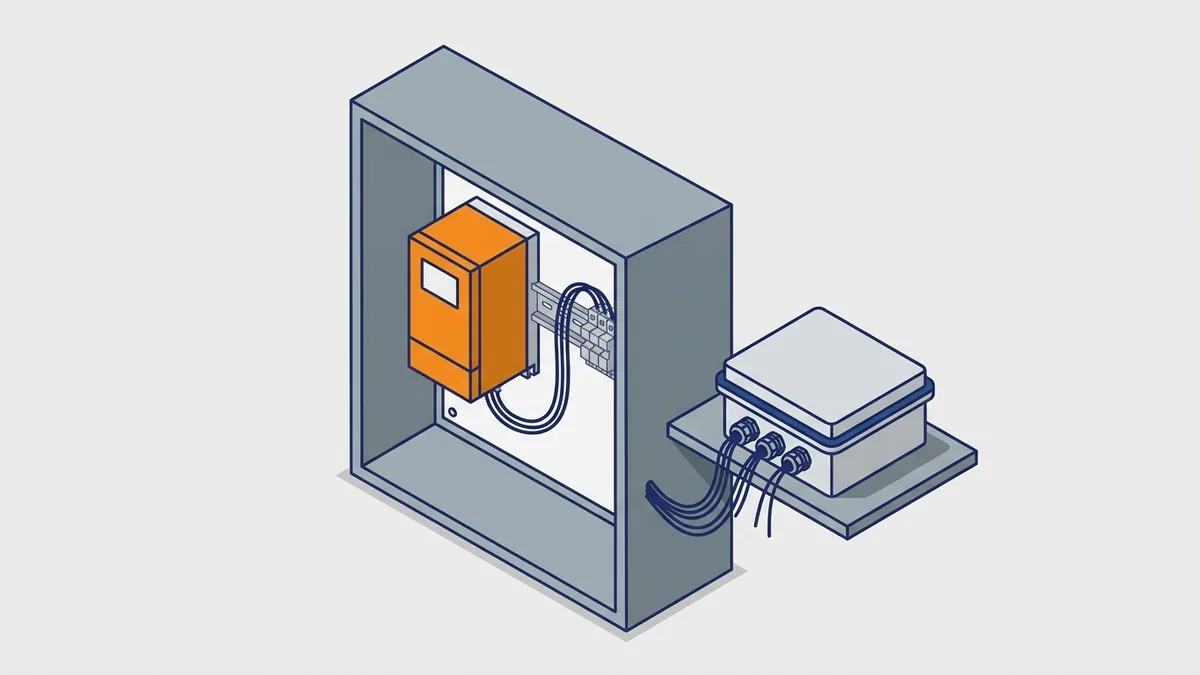
IP66 drives, also rated NEMA 4X, have a tough polycarbonate enclosure. In addition, they are dust tight and washdown ready, and the circuit boards are conformally coated as standard. As a result, you can mount them right on the machine, and Invertek offers a sun shade for outdoor use. Likewise, mount them vertically.
IP66 switched versus non-switched
Both versions are IP66 (NEMA 4X) enclosures. However, a switched drive adds built-in operator controls and an isolator disconnect. In contrast, a non-switched drive leaves control and disconnect to external devices.
So pick switched when you want a local disconnect and speed or direction controls on the drive. On the other hand, pick non-switched when a remote station or PLC already handles that job. Either way, the IP66 version has the same functions and wiring layout as the IP20 version.
Single-phase input, single-phase output and 110 V models
Can the ODE-3 run a 3-phase motor from a 110-120 V single-phase supply?
Yes. For example, Invertek rates the 110 V class drives at 110-115 V (±10%) single-phase input, as on the ODE-3-110043-1012 datasheet. The 2.3 A models with 3-phase output are 110-115 V in and 230 V out. As a result, they let you run a small 3-phase motor where only 120 V is available. Because you size the drive by output current, check that the motor’s full load amps (FLA) on the nameplate are within 2.3 A.
Can the ODE-3 control a single-phase motor?
Yes, but only through the single-phase-motor version of the E3. It is for PSC (permanent split capacitor) or shaded-pole induction motors. Also, it covers 0.37 to 1.1 kW (0.5 to 1.5 HP) on 110 to 240 V single-phase input.
This version suits fans, blowers, centrifugal pumps and fume extractors, where high starting torque is not needed. However, do not use it on a capacitor-start motor without checking the Invertek guide. In addition, Invertek publishes a separate E3 1PH user guide for these units.
Control, communications and options
Does the ODE-3 have an EMC filter, braking and communications built in?
It depends on the model. First, the part number shows whether a drive has an internal EMC filter and a brake transistor. Also, frame size 2 and above always has the brake transistor. When a drive lacks them, external EMC filters, brake resistors, input chokes and output filters are available.
On communications, the Optidrive E3 includes Modbus RTU and CAN on board as standard. In addition, other fieldbus options, such as Profibus, BACnet IP and Ethernet/IP, add through gateways. To see which options fit each drive family, check Invertek’s communication interfaces page.
When should I disconnect the internal EMC filter?
Disconnect it when the drive runs from an IT supply, which is an ungrounded or high-impedance-grounded supply. The internal filter connects to ground, so on that kind of supply it can cause faults or damage. The Invertek user guide shows how to disconnect the filter for each frame size. For the EMC category and cable length limits of each model, check the datasheet.
Inputs and protection
The E3 has two dedicated digital inputs. Also, it has two analog inputs that can act as digital inputs. Then parameter P-15 selects the input function. In addition, the drive has internal PI control, and its motor overload protection and current limit are set at 150% of FLA.
For fast setup on several drives, Optistick Smart clones parameters over Bluetooth or NFC. Also, the terminals are 5 mm rising clamp types.
Can one ODE-3 run more than one motor?
Yes, with limits. First, choose the drive on the total motor current, which is the sum of the rated currents of all connected motors. Also, keep within the total cable length limit in the user guide. Finally, read the multiple-motor entry in Invertek’s iKnow FAQ before you commit.
ODE-3 compared with E4, P2 and Eco
How does the E3 compare with the E4, P2 and Eco?
Invertek’s range has several lines. For a quick view, the table gives the basics.
| Line | Range | Intended use |
|---|---|---|
| E3 (ODE-3) | 0.37-37 kW, 110-480 V | General purpose, IP20 and IP66 |
| E4 | 0.37-4 kW (0.5-5 HP), 110-480 V, 3-phase input | General purpose with added diagnostics and connectivity |
| P2 | 250-600 V, up to 250 kW (400 HP) | High performance |
| Eco | 200-600 V, up to 250 kW (400 HP) | HVAC and pump applications |
The E4 adds extended diagnostics, a built-in “flight recorder” that logs operating data, and integrated industrial Ethernet. Also, it supports induction and hybrid permanent magnet motors. However, its first release is IP20 frames 1 and 2, from Q3 2026. By comparison, the Invertek Optidrive E3 variable frequency drive still offers more sizes, IP66 enclosures and a single-phase-motor version.
One distributor guide recommends the P2 for high-inertia, high-starting-torque or dynamic loads. However, that is the distributor’s opinion, not an Invertek statement. Also, parameter numbers differ between lines. For example, P2 and Eco use groups such as P1-13, so do not carry E3 settings straight over.
Is the ODE-3 being discontinued or replaced by the E4?
No. Invertek says the E4 does not replace the E3, and the E3 remains in production for general-purpose use. As a result, you can order the ODE-3 series with confidence.
What to check before you order
What should I check before ordering an ODE-3?
- Motor nameplate: note the FLA, voltage and phase.
- Supply: confirm voltage and phases.
- Output current: match it to the motor FLA, and check input fusing on the datasheet.
- Enclosure and location: IP20 for panels, IP66 for wet, dusty or outdoor spots.
- Control method: keypad, potentiometer, remote signals or a switched drive.
- Filter and brake: decide whether you need an internal EMC filter or brake transistor.
- Communications: confirm Modbus RTU, CAN or another fieldbus.
- Ambient temperature and cable length: stay within the operating range (IP20: -10 to 50°C; IP66: -20 to 40°C, with -20 to 50°C derated) and the datasheet cable limit.
- Part number: confirm it against the Invertek datasheet.
Also think about the load. For example, constant-torque loads suit the E3 well. However, high-inertia or high-starting-torque loads point toward a P2 or an oversized drive.
As proof of what a drive can do, one case study fitted an E3 IP66 drive to a 15 HP exhaust fan. In another part of that study, replacing damper control with Optidrive VFDs on the drying fans cut energy use in that process from 19,423 kWh to 7,789 kWh, a 60% drop.
Common mistakes and troubleshooting
What are common mistakes when choosing or installing an E3?
- Using a single-phase-output model on a 3-phase motor, or the reverse.
- Ordering IP20 for a washdown or outdoor location.
- Choosing by HP only and ignoring amps.
- Mounting the drive in any position other than vertical.
- Leaving the internal EMC filter connected on an IT supply.
Where do I find fault codes and how do I reset the drive to factory defaults?
The Invertek user guide has a troubleshooting section with fault code messages. In addition, it covers UL compliance and the EMC filter disconnect. For a factory reset, the Easy Start Guide from Inverter Drive Supermarket explains the steps. However, it is third-party, so it complements the manufacturer manual and does not replace it.
When should I repair rather than replace an ODE-3?
Call for help when the drive trips repeatedly, when the power stage looks damaged, or when the display stays blank. In addition, a repair often makes sense for larger frames or drives that are hard to swap. However, for a small, low-cost unit, replacement may be quicker. Either way, Precision Electric can look at your drive and tell you which route fits.
Manuals, datasheets, software and support
Where do I download ODE-3 manuals, datasheets and software?
First, start with Invertek’s E3 documentation page. It lists the IP20 user guide, the IP66 indoor and outdoor user guides, the IP66 quick start guide, the fieldbus guide and the IP66 sun shade guide. Also, it offers the Optidrive Passport. For single-phase-motor units, use the separate E3 1PH guide on the E3 Single Phase page.

Each part number has a datasheet on invertekdrives.com. Next, download the latest guide from Invertek, not an old copy, because older manuals may be out of date. In addition, you can find E3 resources on the Invertek Store, answers in the iKnow FAQ, and fieldbus compatibility on the communication interfaces page.
How do I wire and set up an ODE-3?
Use Precision Electric’s E3 training lessons for startup, wiring and programming. Then confirm the details in the Invertek user guide for your enclosure type. As a result, you stay on the manufacturer’s steps for terminals, parameters and safety.
Frequently asked questions
What is the Invertek Optidrive ODE-3?
ODE-3 is the model prefix of the Optidrive E3, Invertek’s general-purpose VFD. It covers 0.37-37 kW (0.5-50 HP) at 110-480 V with single- or 3-phase input. In addition, enclosures are IP20 and IP66/NEMA 4X.
What is the difference between IP66 switched and non-switched ODE-3 drives?
Both are IP66 (NEMA 4X) outdoor enclosures. However, switched versions add built-in operator controls with an isolator disconnect. In contrast, non-switched versions leave control and disconnect to external devices.
Does the Optidrive E4 replace the E3?
No. Invertek says the E4 does not replace the E3, and the E3 remains in production for general-purpose use. Instead, the E4 adds diagnostics, connectivity and hybrid PM motor support. Also, it was announced for IP20 frames 1-2, 0.37-4 kW, from Q3 2026.
Can an ODE-3 run a single-phase motor?
Yes, but only through the single-phase-motor version, which is for PSC or shaded-pole induction motors. It suits fans, blowers and centrifugal pumps where high starting torque is not needed. However, do not use it on a capacitor-start motor without checking the Invertek guide.
Where do I download the ODE-3 manual?
Invertek’s E3 documentation page has the IP20, IP66 indoor and IP66 outdoor user guides, the quick start guide and the fieldbus guide. Also, single-phase-motor units have a separate E3 1PH guide. In addition, each part number has a datasheet on invertekdrives.com.
The invertek optidrive ode-3 gives you a wide, flexible range once you can read its part number and match amps, supply and enclosure. So check the datasheet, confirm the motor nameplate, and the right model is easy to find. Contact Precision Electric for a quote, a repair, or help choosing an ODE-3, or browse our Invertek drives.