NEMA Enclosures Guide: Types, Ratings and How to Choose
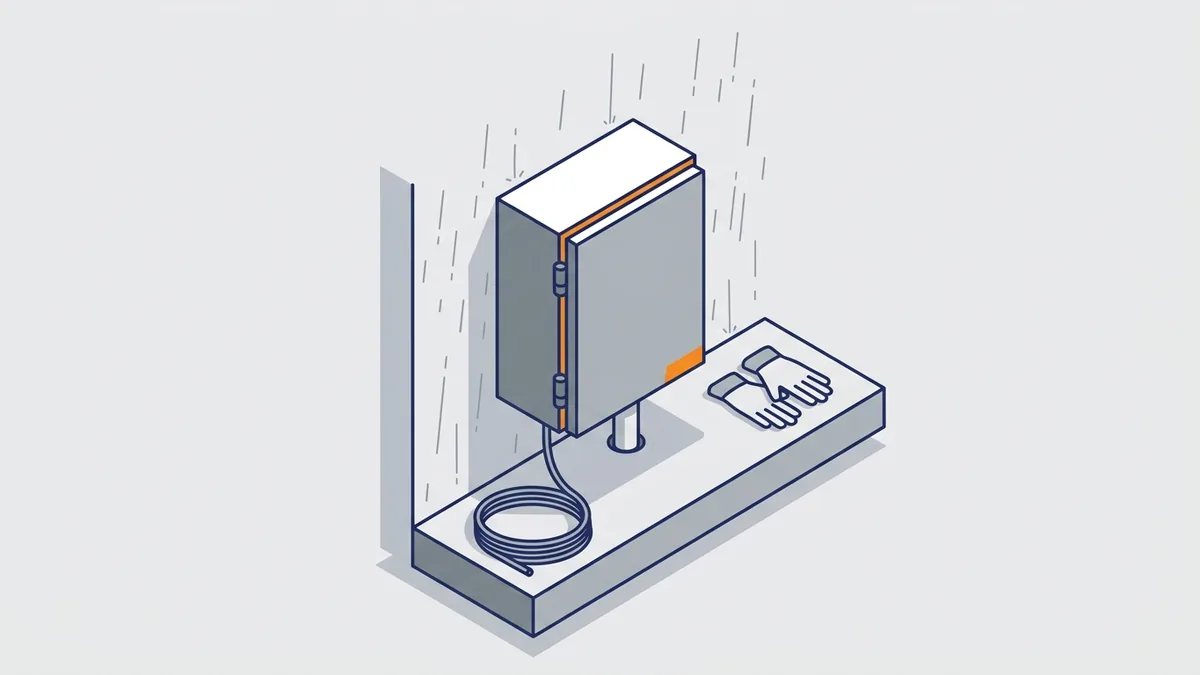
Picking the wrong box for a panel is a costly mistake, so you need to know what NEMA enclosures really protect against. This guide explains what each rating means, defines the common types, and shows you how to choose one for your site. In addition, it covers the traps that cause trouble in the field.
On this page
- What is a NEMA enclosure?
- How NEMA enclosure types are organised
- NEMA enclosure types chart
- What NEMA types are for hazardous locations?
- What is a NEMA 3R enclosure?
- What is a NEMA 4 enclosure?
- What is a NEMA 4X enclosure?
- NEMA 3R vs 4 vs 4X vs 12: how to choose
- NEMA ratings vs IP codes
- Who certifies a NEMA rating, and how to check it
- Keeping the rating intact on site
- Other factors when you buy: material, temperature and cost
- When to replace, upgrade or call for help
- Frequently asked questions
What is a NEMA enclosure?
A NEMA enclosure is an electrical enclosure built and rated to one of the Type classes in NEMA 250. The standard is titled Enclosures for Electrical Equipment (1000 Volts Maximum). In practice, the Type tells you what the closed enclosure keeps out or withstands, such as contact with live parts, dust, water, ice, oil or corrosion.
What a Type does and does not describe
A Type describes protection. However, it does not set the size of the box, and it is not a material. Each Type lists enclosure characteristics, but you can find a given Type in many sizes and builds. In short, the rating describes the finished enclosure under specified test conditions.
Who writes the standard
NEMA, the National Electrical Manufacturers Association, writes NEMA 250. NEMA 250 has been redesignated EN 10250, so you may see either name. Check for the newest edition, because sources do not agree on which one is current. Even so, many people still say “NEMA 250,” and the Type names have not changed.
Why the rating matters on site
The wrong Type lets water, dust or corrosive air reach live equipment. As a result, you can see failed drives, tripped controls, failed inspections and warranty disputes. Also, a few minutes spent on the Type before you order saves a lot of repair time later.
How NEMA enclosure types are organised
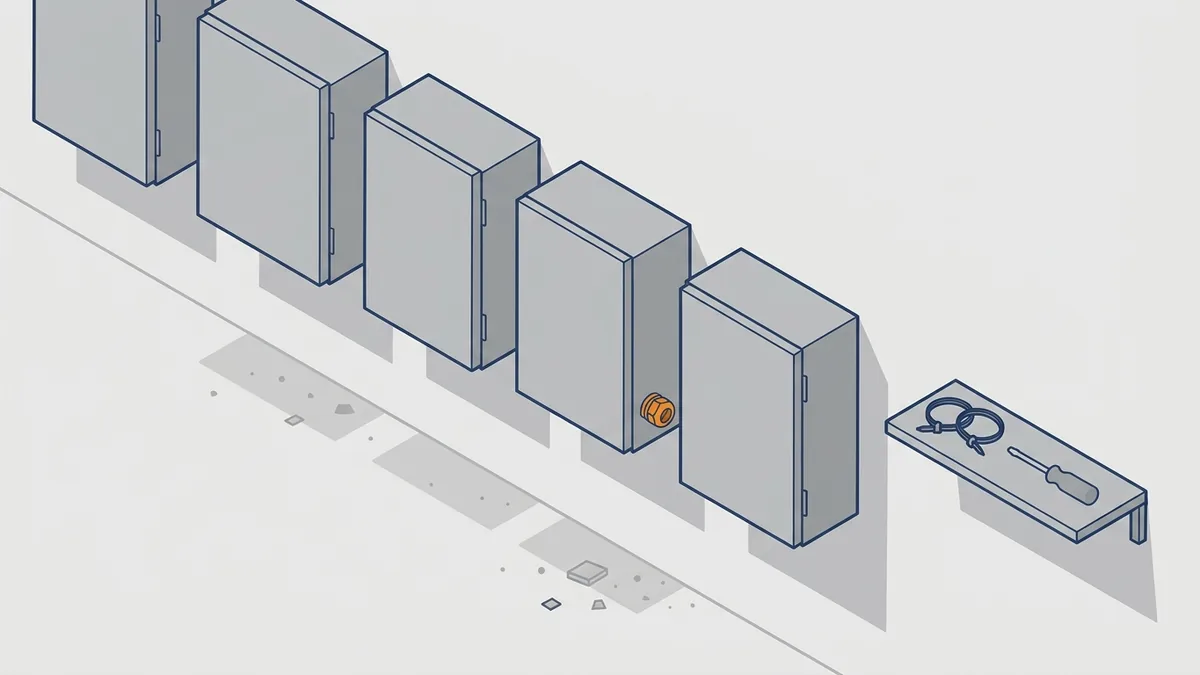
NEMA enclosure types fall into groups by where you can use them. First, every Type gives some protection against access to hazardous parts and against falling dirt. However, other protections belong only to certain Types. For example, only Type 6P covers occasional prolonged submersion.
What are the different NEMA enclosure types?
ANSI/NEMA 250-2020 sorts the types like this:
- Indoor only: Types 1, 2, 5, 12, 12K and 13.
- Indoor or outdoor: Types 3, 3X, 3R, 3RX, 3S, 3SX, 4, 4X, 6 and 6P.
- Hazardous (classified) locations: Types 7 to 10 in the NEMA list. However, the ANSI summary names Types 7 and 9.
What do the letters R, X, S, K and P mean?
The letters add a feature to the base number. Next, here is what each one means:
- R: rainproof.
- X: corrosion resistance.
- S: external mechanisms still work when the enclosure is ice-laden.
- K: knockouts. For example, Type 12K is Type 12 with knockouts.
- P: prolonged submersion, as in Type 6P.
What are Types 5, 3X, 3RX and 3SX?
Type 5 is an indoor type. It protects against falling dirt, settling airborne dust, lint, fibers and flyings. It also protects against dripping and light splashing of non-corrosive liquids.
Types 3X, 3RX and 3SX are the corrosion-resistant versions of Types 3, 3R and 3S. For example, Type 3RX gives Type 3R protection plus corrosion resistance. In the same way, 3X and 3SX add corrosion resistance to their base Types.
Type 6 vs 6P: how deep and how long?
Type 6 covers temporary submersion at a limited depth. Type 6P covers prolonged submersion at a limited depth. In NEMA 250 testing, both use about 6 feet (1.8 m) of water. Type 6 is tested for 30 minutes, while Type 6P is tested for 24 hours. So if a box may sit underwater for hours or days, you need 6P.
Is a higher NEMA number a better rating?
No. Because the numbers are categories, they are not a ranking from good to better. For example, Type 12 is indoor only, so it gives less weather and washdown protection than Type 3R or 4X. Likewise, Type 3R is outdoor rated but has no dust rating. So always match the Type to the hazard, not to the size of the number.
NEMA enclosure types chart
This chart sums up the common Types in plain words. First, use it for a quick check. However, it does not replace the official text.
| Type | Location | Protects against | Typical use |
|---|---|---|---|
| 1 | Indoor | Contact with hazardous parts, falling dirt | Dry indoor areas |
| 2 | Indoor | Type 1 protection plus dripping water | Heavy condensation, such as cooling and laundry rooms |
| 3 | Indoor or outdoor | Rain, sleet, windblown dust, external ice | Outdoor sites with blowing dust |
| 3X | Indoor or outdoor | Type 3 protection plus corrosion | Dusty outdoor sites with corrosive air |
| 3R | Indoor or outdoor | Falling dirt, rain, sleet, snow, external ice | Outdoor disconnects, junction boxes, panels |
| 3RX | Indoor or outdoor | Type 3R protection plus corrosion | Outdoor panels in corrosive air |
| 3S | Indoor or outdoor | Windblown dust, rain, sleet; external mechanisms work when ice-laden | Outdoor gear that must operate in ice |
| 3SX | Indoor or outdoor | Type 3S protection plus corrosion | Icy, corrosive outdoor sites |
| 4 | Indoor or outdoor | Windblown dust, rain, splashing and hose-directed water, external ice | Car washes, food processing, loading docks |
| 4X | Indoor or outdoor | Type 4 protection plus corrosion | Coastal, chemical, food and wastewater sites |
| 5 | Indoor | Falling dirt, settling dust, lint, fibers, dripping and light splashing | Dusty indoor areas |
| 6 / 6P | Indoor or outdoor | Temporary (6) or prolonged (6P) submersion | Equipment that may sit underwater |
| 12 / 12K | Indoor | Circulating dust, lint, fibers, dripping and light splashing | Indoor panels in dusty plants |
| 13 | Indoor | Dust, lint, spraying water, oil and coolant seepage | Machine areas with oil or coolant |
Where do I find the official NEMA type definitions?
The official wording is in the NEMA Enclosure Types PDF on the NEMA website. Also, the NEMA 250 page in the NEMA standards section lists the standard. Use these when you write a spec or settle a dispute, because charts from other sources can word things differently.
What NEMA types are for hazardous locations?
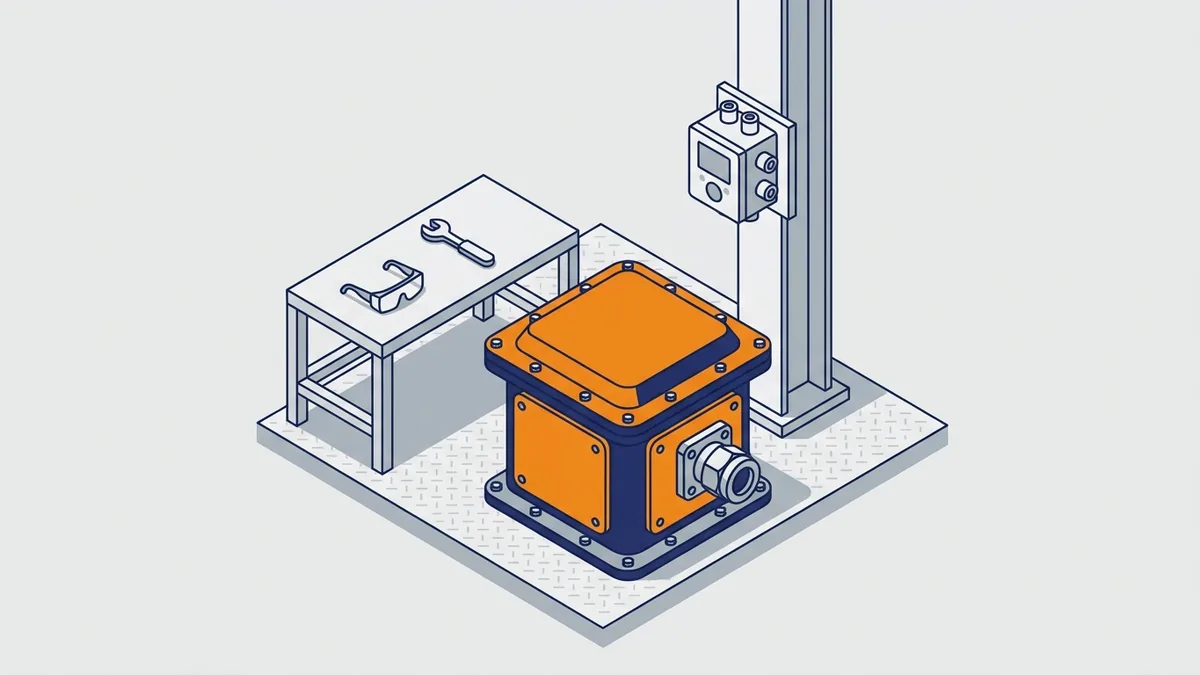
Types 7 to 10 are for hazardous locations. For example, Type 7 enclosures contain an internal explosion without causing an external hazard. Meanwhile, Type 8 prevents combustion by using oil-immersed equipment. Type 9 prevents the ignition of combustible dust.
How do Class, Division and Group affect the choice?
The area’s classification sets the Type. Three terms define it:
- Class: the kind of hazard. Class I is flammable gas or vapor, Class II is combustible dust, and Class III is fibers and flyings.
- Division: how often the hazard is present. Division 1 means it can be present in normal operation. Division 2 means it appears only in abnormal conditions.
- Group: the specific material. Class I uses Groups A to D, and Class II uses Groups E to G.
Type 7 is for Class I, Division 1 locations, Groups A, B, C or D. Type 9 is for Class II, Division 1 locations, Groups E, F or G. Type 8 is also for Class I, Division 1, using oil-immersed equipment.
What is Type 10?
Type 10 is different. It is for mines, and it meets the requirements of the Mine Safety and Health Administration (MSHA). So do not treat it as a general gas or dust rating.
Which standard covers hazardous-location enclosures?
UL 1203 covers explosion-proof and dust-ignition-proof enclosures. To choose a box, first get the area classification from the site owner or safety team. Then match the Class, Division and Group to the markings on the enclosure label.
What is a NEMA 3R enclosure?
A NEMA 3R enclosure is for indoor or outdoor use. It gives a degree of protection against falling dirt, rain, sleet and snow, and external ice does not damage it. In general, think of it as the standard choice for outdoor boxes that only face weather from above.
Is NEMA 3R waterproof or outdoor rated?
It is outdoor rated, but it is not waterproof. In other words, a NEMA 3R enclosure is rainproof, not watertight. For example, beating rain or a stream of water can let water in under some conditions. It also has no rating for windblown dust, hose-directed water or corrosion. So do not use a Type 3R box where crews hose down equipment, where dust blows hard, or where the air is corrosive.
Why many 3R boxes are vented or drained
A 3R box does not need a gasketed sealing surface, and it is not dust-tight. Because of that, many designs use sloped roofs, shielded vents and drain holes. Together, these features keep rain out and let condensation leave. As a result, this design suits outdoor disconnects, meter bases, junction boxes and panels.
What is the difference between NEMA 3, 3R and 3S?
All three are outdoor types, but each covers a different need:
- Type 3: protects against rain, sleet, windblown dust and damage from external ice.
- 3R: the same as Type 3, but without the windblown dust protection.
- 3S: protects against windblown dust, rain and sleet, and lets external mechanisms work when ice-laden.
Also, remember that 3R is a protection rating, not a material. In fact, what counts is passing the rain and ice tests, not which metal the maker used.
What is a NEMA 4 enclosure?
A NEMA 4 enclosure is for indoor or outdoor use. It protects against falling dirt, windblown dust, rain, sleet, snow, splashing water and hose-directed water. Also, external ice formation does not damage it.
Sealed and gasketed construction
A Type 4 box is sealed, usually with a gasket around the door. In fact, that sealing is the main difference from a vented 3R box. As a result, you see Type 4 in washdown areas such as car washes, food processing plants and loading docks.
Painted steel and Type 4
A standard painted carbon-steel enclosure can reach Type 4. However, it cannot reach Type 4X. Because the steel underneath will rust if the paint chips, this choice has limits. In a dry or mildly wet site that may be fine. In a corrosive site, however, it will fail over time.
NEMA 4 vs NEMA 12
Type 4 handles outdoor weather and hose-down. However, Type 12 is indoor only. For example, use Type 12 for indoor panels exposed to dust, dirt and dripping non-corrosive liquids. In contrast, use Type 4 or 4X where the panel is outdoors or faces washdown.
What is a NEMA 4X enclosure?
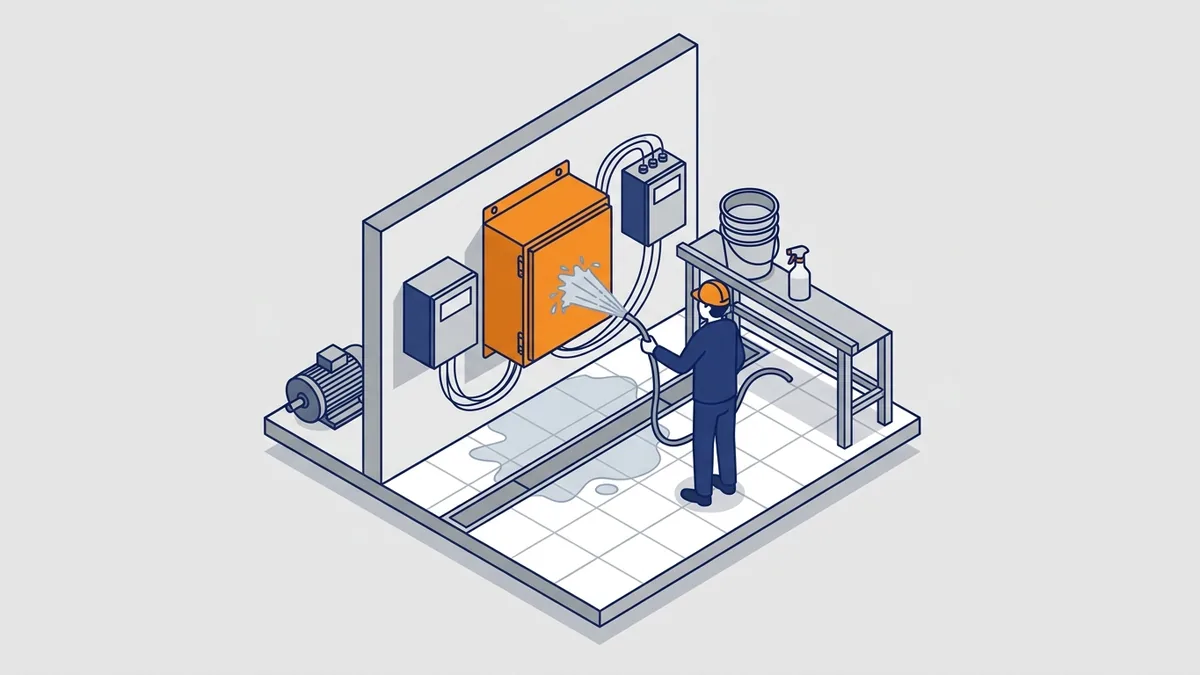
A NEMA 4X enclosure gives all the Type 4 protection, plus corrosion resistance. That means dust, rain, splashing water, hose-directed water and ice are covered, and so is attack from corrosive air or cleaners. As a result, a NEMA 4X enclosure is a common pick for harsh sites.
Materials and what the rating means
Makers build 4X boxes from stainless steel, aluminum, fiberglass or polycarbonate. Common stainless grades are 304 and 316. Still, 4X does not mean stainless steel only. In short, the rating describes how the finished enclosure performs, not the name of the material.
How is Type 4X corrosion resistance tested?
NEMA 250 uses a salt-spray test. Outdoor Types must pass 600 hours of salt spray. Type 4X must also pass an extra 200-hour salt-spray test, run against 304 stainless steel. So 4X sets a higher bar than the other outdoor Types.
Which material fits which chemical: 304, 316, 316L or fiberglass?
The right material depends on what touches the box. Here is a general guide:
- 304 stainless: a good fit for food plants and mild washdown.
- 316 stainless: adds molybdenum, so it resists salt and chlorides better. Use it near the coast or with chloride cleaners.
- 316L stainless: a low-carbon 316. It resists corrosion at welds better, which helps on welded seams.
- Fiberglass: resists salt and many chemicals, and it does not rust. However, some solvents and strong chemicals attack it.
Because chemicals vary, ask the box maker for a chemical resistance chart. Then check your exact cleaner or process chemical against it.
Where you see Type 4X
You often find a NEMA 4X enclosure in these places:
- Coastal and marine sites with salt air
- Food and drug plants that wash down with cleaners
- Chemical plants
- Wastewater sites
- Pool equipment rooms
What is the difference between NEMA 4 and 4X?
The water and dust protection are the same. However, the 4X adds corrosion resistance. So if your site has salt air, chemicals or harsh cleaners, pick 4X. If it only needs hose-down, Type 4 is enough. Also, for drives in 4X cabinets, see our existing post on NEMA 4X drives.
NEMA 3R vs 4 vs 4X vs 12: how to choose
The best way to pick a NEMA enclosure type is to work from the hazard. First, ask the questions below in order, and stop when you find a clear answer.
Which NEMA enclosure type do I need for my location?
- First, is the site indoor or outdoor?
- Next, is there dust, and does it blow or circulate?
- Then, what kind of water is present: drips, rain, hose spray or submersion?
- Also, is the air corrosive, or do washdown chemicals touch the box?
- Is it a hazardous location? If so, match the Class, Division and Group to Types 7 to 10.
- Finally, how much heat does the gear make, and does it need airflow?
Next, use this table as a starting point:
| Location | Likely Type |
|---|---|
| Dry indoor area | 1 |
| Indoor with heavy condensation or drips | 2 |
| Dusty indoor area, or oil and coolant | 12 or 13 |
| Outdoor rain, sleet and snow | 3R |
| Outdoor with windblown dust | 3 |
| Hose-down or washdown | 4 |
| Salt air, chemicals or washdown chemicals | 4X |
| Submersion | 6 or 6P |
What is the difference between NEMA 3R and NEMA 4 or 4X?
Type 3R keeps out falling rain, sleet and snow, and it may be vented. In contrast, Type 4 is sealed, so it also stops windblown dust, splashing water and hose-directed water. On top of that, 4X adds corrosion resistance. Therefore, 3R suits a plain outdoor disconnect, while 4 or 4X suits a wet or harsh site.
Can a NEMA 12 enclosure be used outdoors?
No. Type 12 is an indoor rating. It covers circulating dust, lint, fibers, dripping and light splashing. Because it is not made for rain or ice, use 3R, 4 or 4X outdoors instead.
Mistakes to avoid
- Putting a Type 12 box outdoors
- Choosing Type 3R where crews use hoses
- Installing painted steel in a corrosive site
- Assuming a higher number means more protection
Heat and ventilation trade-offs
Sealed Types trap heat. However, vented 3R and some Type 12 designs let air move. So if your box holds a drive, plan for cooling before you choose a sealed Type. Also, our post on NEMA cabinet ratings for a VFD covers drive cooling in detail.
How do you cool a sealed enclosure?
Start with the heat load. Add up the heat, in watts, that each device gives off. You can find it on the data sheets. Then compare the total with how much heat the box can shed on its own, and check the maximum air temperature each device allows inside.
If the box cannot shed enough heat, you have four common options:
- Fans with filters: simple and low cost, but they pull in outside air.
- Heat exchangers: move heat through a sealed loop, so inside and outside air never mix.
- Air conditioners: cool the inside below the outside air temperature.
- Larger enclosures: more surface area sheds more heat.
Does adding cooling change the Type rating?
It can. A fan and filter cuts a hole in the box, so the rating holds only if the kit is rated for the same Type. Heat exchangers and air conditioners keep the box sealed, so they work for Type 4 or 4X when the unit carries that same Type. Always check the cooling unit’s Type marking before you cut the door or wall.
NEMA ratings vs IP codes
NEMA ratings and IP codes are different systems. In fact, NEMA 250 requirements are wider than the IP degrees of protection in IEC 60529, and some NEMA tests are not in IEC 60529 at all. For example, NEMA Type 3 requires an outdoor corrosion test, a gasket aging test, a dust test and an external icing test. However, the IEC rating does not require those.
Is NEMA 4X the same as IP66, and can I convert IP to NEMA?
Not exactly. Types 4 and 4X meet or exceed IP66. However, an IP66 box does not necessarily meet Type 4X, because NEMA also tests corrosion and icing. In short, NEMA 4X implies IP66, but IP66 does not ensure NEMA 4X.
The conversion works one way
You can assign an IP code to a type-rated enclosure. However, you cannot assign a NEMA Type to an IP-rated enclosure. In addition, ANSI/NEMA 250-2020 includes a cross reference and warns against using it in reverse. Also, NEC 110.28 says IP ratings are not a substitute for Enclosure Type ratings.
NEMA to IP table
NEMA 250 gives the cross reference in Annex A, Table A-1. Each Type meets or exceeds the IP code shown:
| NEMA Type | Meets or exceeds |
|---|---|
| 1 | IP10 |
| 2 | IP11 |
| 3R | IP14 |
| 5 | IP53 |
| 12 / 12K | IP52 |
| 13 | IP54 |
| 4 / 4X | IP66 |
| 6 / 6P | IP67 |
Some vendor sources list Type 4 and 4X at a different value. However, Table A-1 gives IP66 for both, so use that number.
Use the NEMA table, not a vendor chart
Vendor charts disagree. For example, some show Type 3R as IP14, others as IP24 or IP54. However, the NEMA 250 cross reference says Type 3R meets or exceeds IP14. So when you need a number, cite the NEMA table. For the full crosswalk, see our existing post on NEMA enclosure ratings and IEC protection codes.
Who certifies a NEMA rating, and how to check it
NEMA writes the standard, and pass/fail testing runs under UL 50 and UL 50E. Still, a claimed NEMA Type is not automatically an independent UL or CSA certification. In fact, a maker can print a Type on a box without third-party proof.
Who sets and tests NEMA enclosure ratings?
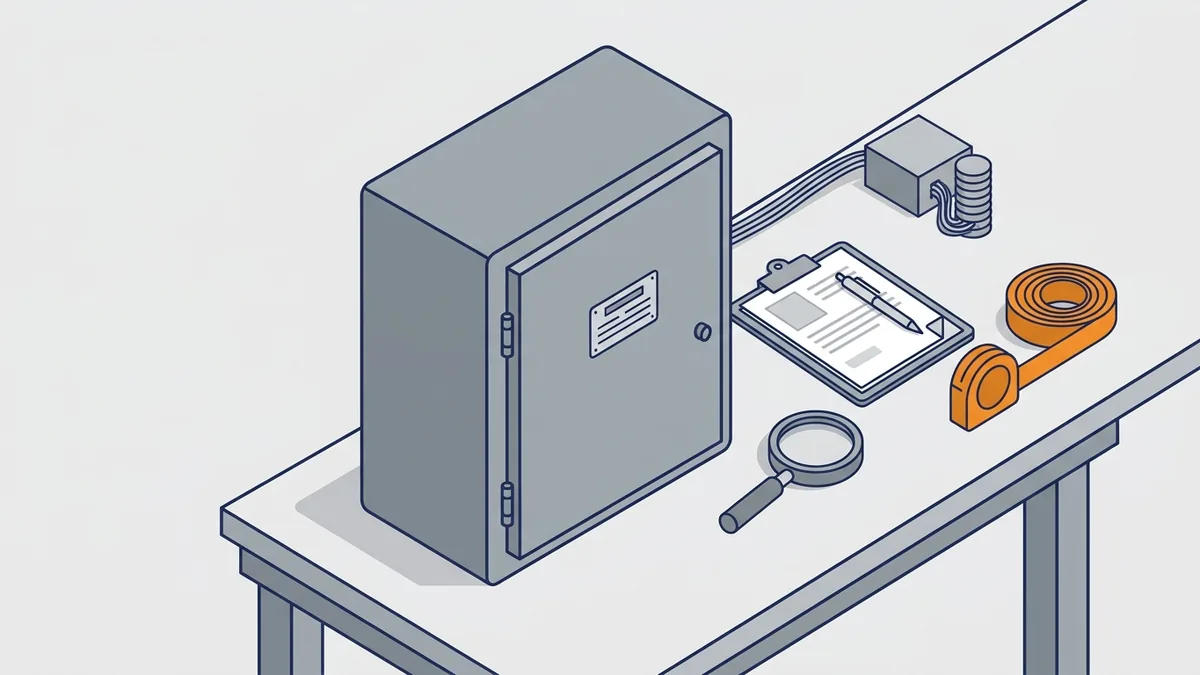
NEMA sets the ratings in NEMA 250. Then test labs run the tests under UL 50 and UL 50E. Because these are two separate jobs, keep them apart when you read a data sheet.
Does a NEMA type guarantee a UL listing?
No. A NEMA enclosure rating does not mean the box also meets the same UL enclosure rating. So do not assume the two match because the numbers look alike. Instead, look for an actual listing mark.
What is the Canadian equivalent?
In Canada, the enclosure standard is CSA C22.2 No. 94.2. It uses Type designations that look much like NEMA’s. However, the two standards are not word-for-word the same. So on a job in Canada, look for the CSA marking and Type on the box.
How to check a box
- First, read the nameplate or catalog page for the Type marking.
- Next, look for a listing mark from a test lab.
- Finally, ask for test evidence on third-party or custom enclosures.
Keeping the rating intact on site
The Type rating covers the completed, properly installed enclosure. However, it does not rescue an install with unsuitable conduit entries, open doors, missing plugs, damaged gaskets or accessories never evaluated with the box. As a result, any of these can void the protection.
What can void an enclosure’s rating after installation?
- Cut-outs or conduit entries that do not match the Type
- Doors left open or latches not fully closed
- Missing plugs in unused openings
- Gaskets that are damaged, aged or out of place
- Accessories that were never evaluated with the enclosure
Which fittings, hubs and cutouts keep the rating?
Every opening you add must keep the box’s Type. That includes conduit hubs, cord grips (glands), plugs and cutouts for switches or windows. To confirm a conduit hub is Type 4X rated, look for the Type marking on the hub or its package. Otherwise, check the maker’s data sheet. Also use the sealing washer or O-ring that comes with it.
In the field, remember this rule: the assembly is only as good as its weakest part. A Type 4X box with a Type 3R hub is not a 4X installation. Likewise, a hole cut in the wrong place or size can break the seal.
Install checklist
- First, use hubs and fittings rated for the same Type as the box.
- Next, close every unused opening with a proper plug.
- Then check the gasket for gaps, cracks and flat spots.
- Also, close and latch the door fully.
- Finally, for a 3R box, keep the vents and drain holes in the right position.
Inspection checklist
Check boxes on a regular schedule. For example, look for aged gaskets, rust at scratches on painted steel, pooled water and condensation. Because catching these early costs far less than replacing a drive or a control board, make the check a habit.
Other factors when you buy: material, temperature and cost
The Type is only part of the choice. Material, climate and budget also matter, so weigh them before you order.
What are the cost and size trade-offs between materials?
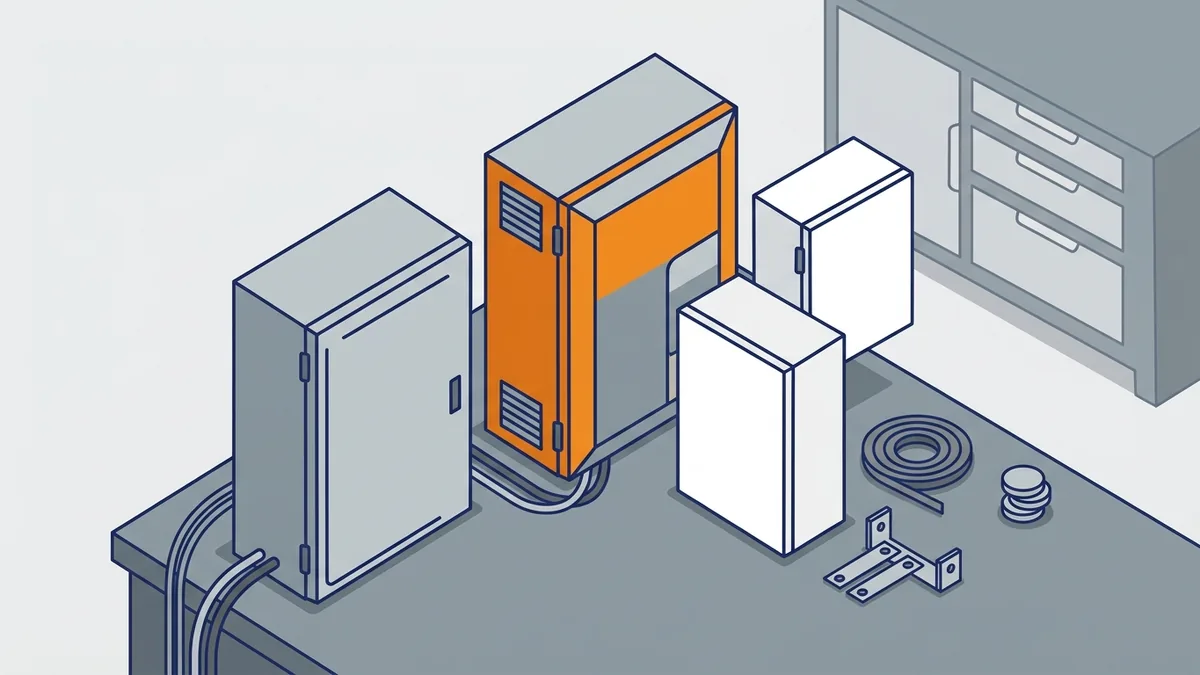
Each material has strengths and limits:
- Painted steel: usually the lowest cost and widely available in large sizes. However, it rusts if the paint chips.
- Stainless steel: resists corrosion and cleans easily. However, it costs more and is heavy in large sizes.
- Fiberglass: light, does not rust and does not conduct electricity. It suits corrosive sites in mid to large sizes.
- Polycarbonate: light, non-metallic and often clear-lidded. It is common in smaller sizes.
Does the Type set a temperature range?
No. A Type does not give an operating temperature range. So check the ambient limits of the equipment inside. Also ask the maker about gasket and material limits in very hot or cold sites.
Does sunlight harm polymer boxes?
Yes, it can. Ultraviolet (UV) light from the sun can age polymer boxes outdoors, making them brittle or faded over time. So for fiberglass or polycarbonate outdoors, ask the maker whether the material is UV stabilized and rated for outdoor use.
When to replace, upgrade or call for help
Some signs tell you the rating is wrong for the site. For example, look for water or rust inside, dust on circuit boards, and nuisance drive or controller faults after washdown. If you see any of these, review the Type.
Common upgrade paths
- 3R to 4: when hose-down or windblown dust is present.
- 4 to 4X: when corrosion attacks the box.
- Indoor Type 1 to 12: when dust builds up.
When should I upgrade an enclosure or get help with water-damaged equipment?
Upgrade as soon as you see repeat moisture, dust or rust inside a box. Also, do not wait for the next failure. However, if water has already reached drives, motors, controls or other parts, have a repair shop inspect them before you power them up again. In that case, Precision Electric can help with repair and sourcing for this kind of damage.
Frequently asked questions
What is a NEMA enclosure?
It is an electrical enclosure built and rated to one of the Type classes in NEMA 250. The Type says what the closed enclosure protects against, such as contact with live parts, dust, water, ice, oil or corrosion. However, it does not set size or material.
What is a NEMA 4 enclosure?
A Type 4 enclosure is for indoor or outdoor use. It protects against windblown dust and rain, splashing water and hose-directed water, and external ice does not damage it. For example, people use it in washdown places such as food processing and car washes.
What is a NEMA 3R enclosure?
Type 3R is for indoor or outdoor use. It protects against falling dirt, rain, sleet and snow, and external ice does not damage it. However, it is not rated for windblown dust or hose-directed water, so it is rainproof but not watertight.
What is a NEMA 4X enclosure?
Type 4X gives all the Type 4 protection (dust, rain, splashing and hose-directed water, ice) plus corrosion resistance. It is typically made of stainless steel, fiberglass, polycarbonate or aluminum. As a result, you find it in coastal, chemical, food and wastewater sites.
Is a higher NEMA number better?
No. Because the numbers are categories, they are not a ranking. For example, Type 12 is indoor only, so it gives less weather and washdown protection than Type 3R or 4X.
Is NEMA 4X the same as IP66?
Not exactly. Types 4 and 4X meet or exceed IP66. However, an IP66 enclosure does not necessarily meet Type 4X, because NEMA also tests things IP does not, such as corrosion and icing. Also, the conversion works from NEMA to IP only.
NEMA enclosures come down to matching the Type to the hazard: weather, dust, water and corrosion. First, check the Type and the listing mark, and then keep gaskets, fittings and doors in good shape so the rating holds. If you need help choosing an enclosure, repairing water-damaged equipment or getting a quote, contact Precision Electric.