Three Phase to Single Phase Converter: Wiring Methods Explained
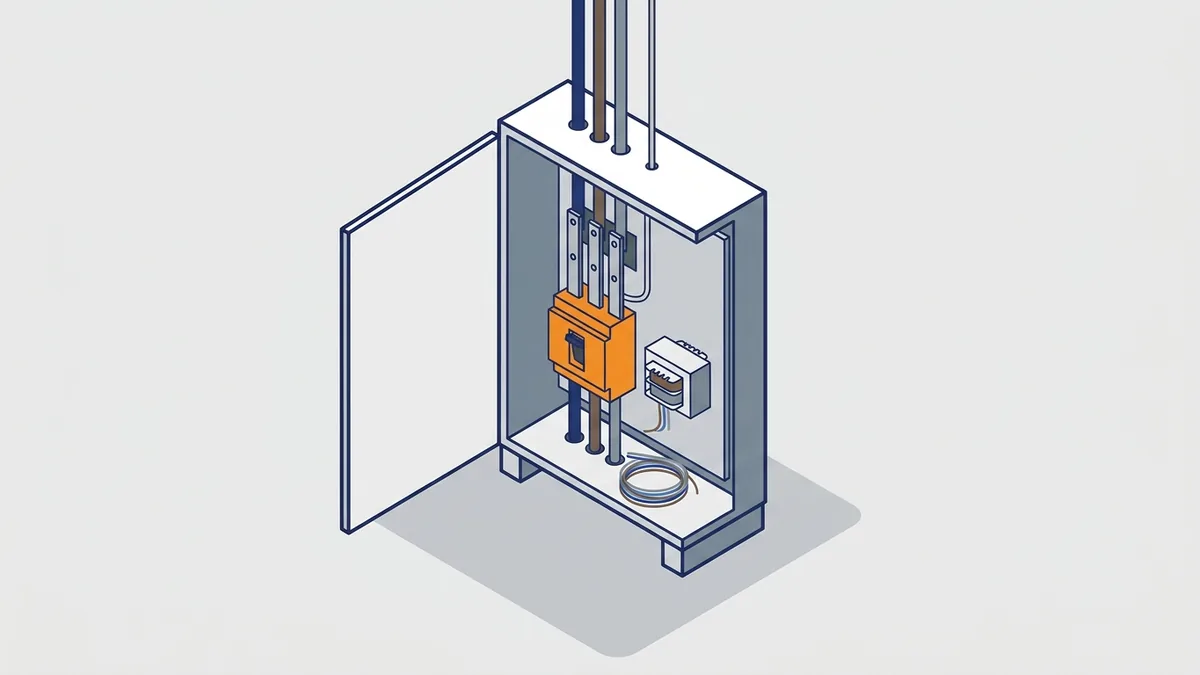
If you search for a three phase to single phase converter, you probably have a three-phase supply and need single-phase power from it. The good news is that most jobs need no special box at all. This article explains how single-phase power comes out of a three-phase supply, which method fits your load, and what it does to your equipment.
On this page
- What a three phase to single phase converter is (and which direction you need)
- Key terms in plain words
- How single-phase power comes out of a three-phase supply
- Method 1: one phase to neutral (wye supply)
- Method 2: line-to-line (any two phases)
- How much power does 240V equipment lose at 208V?
- How do I get 120V or 240V single phase from a delta supply?
- Method 3: a single-phase transformer on one phase-to-neutral or two lines
- Method 4 and 5: open delta, Scott-T and dedicated transformers
- How is open-delta capacity worked out, and what are the limits?
- Choosing the right method
- What it means for your supply and equipment
- What does single-phase loading do to my three-phase supply and motors?
- How do I balance single-phase loads across three phases?
- How do I size breakers and conductors for single-phase loads on a three-phase panel?
- What does a sizing example look like for a 208V single-phase load?
- What breaker voltage ratings and pole counts do I need?
- Which NEC articles apply?
- If you actually need single phase to three phase
- Common mistakes and when to call for help
- Documents and parts to have before you start
- Frequently asked questions
- Do I need a three phase to single phase converter?
- Can a transformer convert single phase to three phase?
- How do I get 120V or 208V single-phase from a 208Y/120V three-phase panel?
- What is a Scott-T transformer and does it make single phase?
- What happens if I put a lot of single-phase load on a three-phase supply?
- I have single-phase power and a three-phase motor. What do I use?
What a three phase to single phase converter is (and which direction you need)
What is a three phase to single phase converter?
In plain words, it is not usually a device. A three-phase supply already contains single-phase circuits. Instead, you take single-phase power by connecting a load to one phase and neutral, or across two phases. Also, you add a transformer only when you need a different voltage.
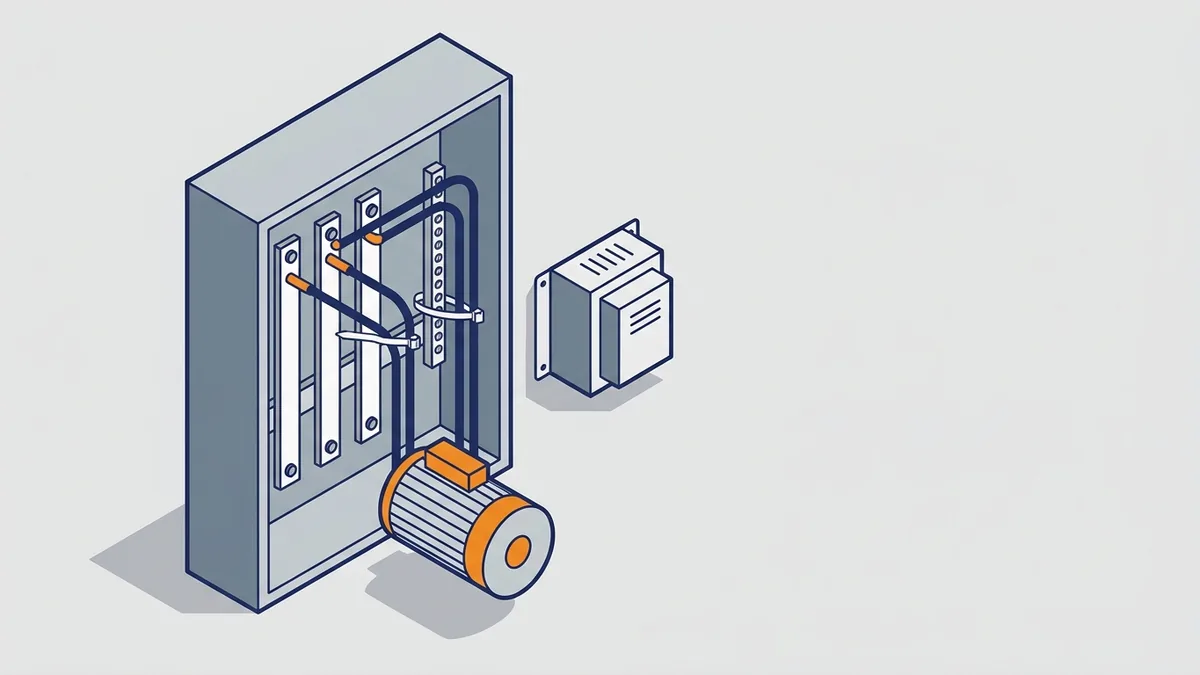
So when people say “convert 3 phase to single phase,” they usually mean “tap” it. The three phase to single phase converter you need is often just the right breaker and wiring.
Do I actually need a converter to get single phase from three phase?
Usually not. For example, on a 208Y/120V wye system, one panel can feed 120V loads, 208V single-phase loads and 208V three-phase loads. A wye system has three hot conductors and a neutral. However, if you need a voltage the panel does not offer, a single-phase transformer covers it.
The direction trap
Going from three phase to single phase is routine. However, going the other way is not. A transformer cannot create three-phase output from single-phase input, so that job needs a phase converter or a VFD (variable frequency drive) that accepts single-phase input. Later sections point you to our posts on that topic.
Quick decision guide
- Three-phase supply, single-phase load: tap the supply, as this article explains.
- Single-phase supply, three-phase motor: use a static converter, a rotary converter or a VFD with single-phase input.
- Different voltage needed: add a single-phase transformer.
Is 208V single-phase the same as 240V single-phase?
No. First, a 208V load connects across two legs of a three-phase wye system, and those legs sit 120° apart. A 120/240V residential service is split-phase. It uses a center-tapped single-phase transformer, and its two legs sit 180° apart.
Both give 120V from a leg to neutral. However, 208V line-to-line power is single-phase power taken from a three-phase source. So do not call it three-phase. Also check the equipment nameplate, because some 240V-rated gear does not run well at 208V.
One more caution: some utilities offer a 120/208V single-phase three-wire service. So seeing 208V line-to-line does not prove you have full three-phase service.
Key terms in plain words
What do line-to-neutral, line-to-line, wye and delta mean?
- Line-to-neutral: the voltage between one phase conductor and the neutral. It is 120V on 208Y/120V and 277V on 480Y/277V.
- Line-to-line: the voltage between any two phase conductors. It is 208V on a 208Y/120V system.
- Wye (Y): a connection with a neutral point, so you get both voltages.
- Delta: a connection with no neutral point in its basic form.
Line-to-line voltage equals line-to-neutral voltage times the square root of 3, about 1.732. For example, 120V times 1.732 is about 208V.
Single-phase, split-phase and three-phase
First, single-phase power is one alternating voltage. Next, split-phase gives two legs 180° apart, as in a 120/240V home. Finally, three-phase gives three legs 120° apart, as in a 120/208V commercial building.
Three more terms
Derating means using equipment below its full rating. kVA is the apparent power a transformer can deliver, while hp is the output of a motor. Phase balance means each phase carries about the same current.
How single-phase power comes out of a three-phase supply
There are five recognised ways to get single phase from three phase. They run from simplest to most specialised:
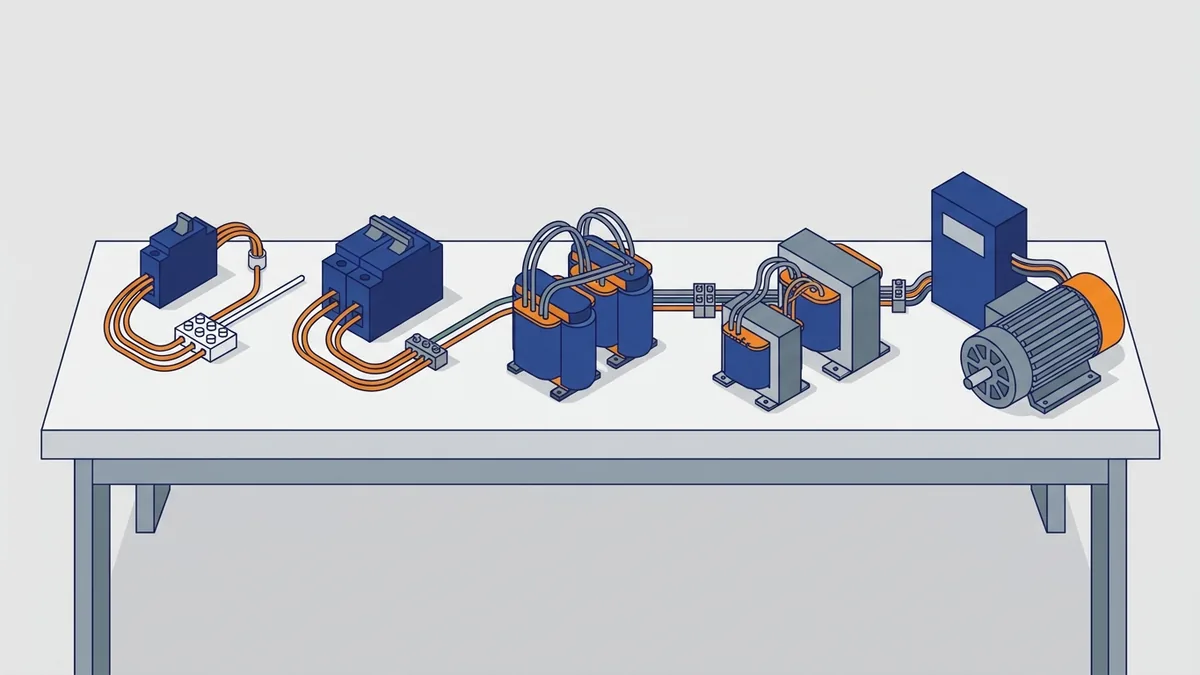
- Phase to neutral.
- Line to line, using a center-tapped secondary where needed.
- Open delta (V connection).
- Scott-T connection.
- A dedicated three-phase to single-phase transformer.
The next sections cover each one. Methods 1 and 2 need no transformer at all.
Method 1: one phase to neutral (wye supply)
This is the simplest way to convert 3 phase to single phase. On a four-wire wye system, connect the load between one phase and neutral. As a result, you get 120V on 208Y/120V or 277V on 480Y/277V. For example, typical uses are lighting, controls and receptacles.
How do I take 120V from a three-phase panel?
First, use a 1-pole breaker with one phase and the neutral. You need a neutral, so this works only on a wye source. Then spread these circuits across all three phases.
Method 2: line-to-line (any two phases)
For 208V single phase on a 208Y/120V system, connect the load across any two phases.
How do I take 208V single phase from a three-phase panel?
First, use a 2-pole breaker across two phases. Purely resistive loads, such as water heaters, do not need a neutral. Next, check the nameplate for 208V single-phase acceptance. Also remember that a line-to-line load pulls current from only two phases, so plan your balance.
How much power does 240V equipment lose at 208V?
A resistive heater loses about 25% of its output. Heater power follows the square of the voltage, so the output at 208V is (208 ÷ 240)², or about 0.75, of the 240V rating. For example, a 5,000W element at 240V gives about 3,750W at 208V.
Motors and electronic loads react differently, so check the nameplate before you connect anything. Look for these signs:
- A rating that lists 208V, or a range such as 208-240V.
- Separate wattage or current figures for each voltage, which many heaters print.
- A statement in the manual that the unit accepts 208V single phase.
If the nameplate lists only 240V, ask the maker before you use it on 208V. A heater that runs at 75% output may never reach its set temperature.
How do I get 120V or 240V single phase from a delta supply?
A basic delta has no neutral. As a result, you cannot take 120V from one phase to neutral. You can still connect a single-phase load across any two lines. On a 240V delta that gives 240V, and on a 480V delta it gives 480V.
A four-wire “high-leg” delta works differently. The utility center-taps one transformer winding to make a neutral. Then you get these voltages:
- 240V between any two phases.
- 120V from each of two phases to neutral.
- About 208V from the third phase, the high leg, to neutral (240V times 0.866).
Never connect a 120V load to the high leg. It is marked orange so you can spot it. If you need 120V from a delta with no neutral, add a single-phase transformer, such as 480V down to 240/120V.
Method 3: a single-phase transformer on one phase-to-neutral or two lines
Add a transformer when you need a different voltage. Its primary connects across two lines, or across one line and neutral on a wye system. For example, a single-phase transformer can step 480V delta down to 240/120V. In addition, the secondary can be whatever single-phase voltage you need. A control power transformer is the small-scale version.
For sizing, start with the continuous load and add margin. Then round up to the next standard kVA. One vendor guide suggests 125% of the continuous load, such as 15 kVA for a 12 kVA load. Treat that as vendor guidance, not a code value. Also, check the current NEC and local code before you size.
Method 4 and 5: open delta, Scott-T and dedicated transformers
What are open delta and Scott-T connections and when are they used?
Open delta (V connection) and Scott-T are specialised connections. A Scott-T uses two transformers: a center-tapped main unit and a teaser unit with a ratio of about 86.6%. It turns a balanced three-phase supply into two single-phase outputs 90° apart.
It suits large loads such as electric furnaces and traction, where the draw from the three-phase source must stay balanced. However, it balances the supply only when both outputs are loaded equally. It cannot balance a load that is itself unbalanced. Also, a Scott-T is bulkier and heavier than a normal three-phase transformer of the same rating.
For safety, leave open-delta and Scott-T banks to an electrician or engineer. They are not DIY jobs.
Can I use a three-phase transformer for a single-phase load, and how much capacity do I get?
Yes, but you lose capacity. One vendor says a three-phase transformer used this way delivers only 33–58% of its nameplate kVA, depending on the connection. However, that is vendor guidance, not a standard.
Three more points apply:
- The tapped winding carries the full load current by itself.
- The connection must match the secondary type, delta or wye.
- You must resize protection for the unbalanced current.
For large loads, or where balance matters, a dedicated three-phase to single-phase transformer loads the primary evenly. One vendor guide suggests this above 75 kVA, and also recommends a dedicated single-phase transformer for single-phase loads over 5 kVA.
How is open-delta capacity worked out, and what are the limits?
An open delta uses two transformers instead of three. Their primaries connect across two pairs of lines, and their secondaries connect the same way. The third side of the delta stays open.
The bank delivers about 1.73 times the kVA of one unit. That equals 57.7% of what three of those units would give in a closed delta, and 86.6% of the two units’ combined rating. For example, two 25 kVA transformers give about 43 kVA, not 50 kVA.
Each transformer carries the full line current. So size the overcurrent protection for the bank as a two-unit V connection, following NEC Article 450 and the transformer nameplate. Also have an engineer confirm the load, because you cannot add a third unit’s worth of capacity by assumption.
Choosing the right method
How do I tell what service I have?
First, read the nameplate on the service panel, the transformer or the meter label. It usually lists voltage, phases and wires, such as “3 phase, 4 wire.” Then have a qualified person confirm it with a properly rated meter. Compare the readings with this table:
| Service | Line-to-line | Line-to-neutral |
|---|---|---|
| 208Y/120V wye | 208V between each pair | 120V on all three phases |
| 480Y/277V wye | 480V between each pair | 277V on all three phases |
| 120/240V high-leg delta | 240V between each pair | 120V on two phases, about 208V on the high leg |
| 240V delta, no neutral | 240V between each pair | No neutral |
| 120/208V single-phase, three-wire | 208V between its two hot legs | 120V on each hot leg |
Also count the hot legs. A full three-phase service has three, while a two-phase-plus-neutral service has only two. If the readings do not match any row, ask your utility before you wire anything.
Which method should I choose for my load?
| Method | Output | Neutral needed | Best for |
|---|---|---|---|
| Phase to neutral | 120V or 277V | Yes | Lighting, controls, receptacles |
| Line to line | 208V on 208Y/120V | Not for resistive loads | Heaters, 208V single-phase gear |
| Single-phase transformer | Any voltage you need | No | Different voltage, control power |
| Open delta or Scott-T | Specialised | No | Engineered jobs, large loads |
| Dedicated 3-phase to 1-phase transformer | Any voltage you need | No | Large loads, balanced primary |
As a rule of thumb, tap the panel directly for small control and receptacle loads. For large single-phase loads, use a dedicated transformer or feeder.
What does it cost and how long does it take?
We cannot give honest figures here, because cost and timing depend on your voltage, load size and site. So contact Precision Electric with your nameplate data and we can help you scope the job.
What it means for your supply and equipment
What does single-phase loading do to my three-phase supply and motors?
Because single-phase loads unbalance a three-phase system, the most loaded phase runs hottest, and the neutral carries the difference. Neutral current is the vector sum of the three phase currents, and it is zero when the phases are balanced.
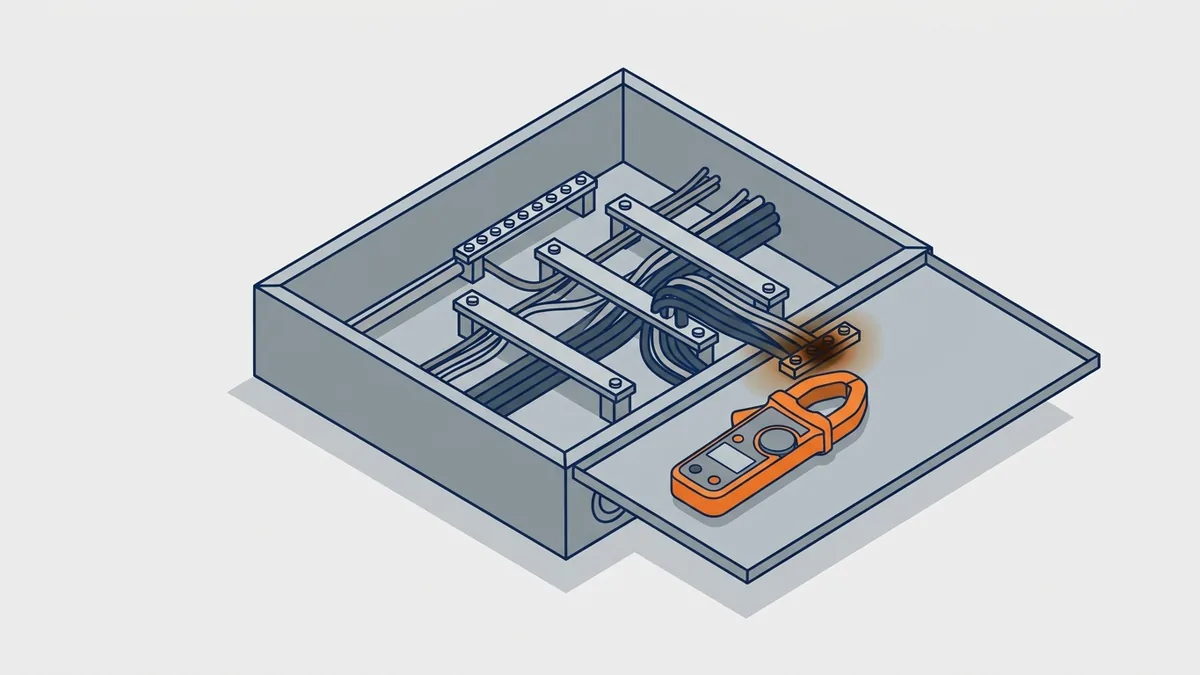
Unbalance also brings these problems:
- Heating and nuisance trips.
- Lower efficiency and reliability.
- Extra losses in induction motors and power-electronic converters.
With single-phase electronic loads, third-harmonic currents add in the neutral. As a result, the neutral can carry more than a phase current.
How do I balance single-phase loads across three phases?
First, divide loads as evenly as practical. Then review the split during installation, expansion and maintenance. These habits help:
- Alternate breaker positions across the phases.
- Group similar loads.
- Give large single-phase loads, over about 30% of capacity, a dedicated feeder.
- Re-check the balance after you add loads.
One calculator source suggests keeping imbalance within about 10–20%. That is general good practice, not a code limit.
How do I size breakers and conductors for single-phase loads on a three-phase panel?
For sizing, use the maximum phase current, not the average. For a line-to-line load, current flows only between the two connected phases, so use single-phase formulas. Continuous loads often carry a multiplier, typically 125%. Check the current NEC and local code for the rules that apply to you.
What does a sizing example look like for a 208V single-phase load?
Take a 9 kW resistive heater that runs continuously on 208V single phase. Follow these steps:
- Current: 9,000W ÷ 208V = about 43.3A. Do not multiply by 1.732, because this is a single-phase load.
- Continuous load: 43.3A × 1.25 = about 54.1A.
- Breaker: the next standard size above 54.1A is 60A, so use a 60A 2-pole breaker.
- Conductor: 6 AWG copper is rated 65A in the 75°C column of NEC Table 310.16, so it covers 54.1A.
The heater pulls 43.3A on each of the two phases you connect. Before you build it, confirm the terminal temperature ratings and any rules on the heater nameplate. This is a sample, not a design for your site.
What breaker voltage ratings and pole counts do I need?
A 2-pole breaker on a three-phase panel connects to two different phases, because neighboring positions sit on different phases. On a 208Y/120V panel, it gives 208V. A 3-pole breaker serves three-phase loads, and a 1-pole breaker serves a phase-to-neutral circuit.
Breaker voltage ratings matter just as much. Follow these points:
- Slash-rated breakers, such as 120/240V or 277/480V, work only on solidly grounded systems. The voltage to ground must not exceed the lower number, and the line-to-line voltage must not exceed the higher one (NEC 240.85).
- Straight-rated breakers, such as 240V, suit any circuit up to that voltage.
- For a 277V circuit on a 480Y/277V system, use a 1-pole breaker rated for 277V, such as a 277/480V slash rating.
- Do not use a 120/240V slash-rated 1-pole breaker on the 208V high leg of a delta, because the voltage to ground is too high.
Also use only breakers listed for your panel.
Which NEC articles apply?
The NEC has no single rule for balancing branch circuits, so these articles work together. Check the edition your area has adopted, because local amendments vary.
- Article 210 (branch circuits): covers circuit ratings, the 125% continuous-load rule and multiwire branch circuits, which need all ungrounded conductors to disconnect together.
- Article 220 (load calculations): covers neutral sizing for feeders in 220.61. A neutral that carries harmonic currents from nonlinear loads may not get the usual reduction.
- Article 250 (grounding): covers separately derived systems, such as a transformer secondary, in 250.30.
- Article 450 (transformers): covers transformer overcurrent protection.
- Article 240 (overcurrent protection): covers breaker ratings and standard sizes.
When you add a transformer, you usually create a new separately derived system. As a result, its neutral, grounding and bonding need their own plan under Article 250.
If you actually need single phase to three phase
However, some readers arrive with the opposite problem. If you need to convert single phase to three phase, this section is a short bridge. Our existing posts on single-phase to three-phase converters, rotary converters and VFD derating cover the details. They also cover the topics of converting from single phase to three phase and the conversion of single phase to three phase.
Can a transformer convert single phase to three phase?
No. A transformer cannot create three-phase output from single-phase input. You need a phase converter (static, rotary or digital) or a VFD with single-phase input.
What is a one phase to three phase converter and how do static and rotary types differ?
A one phase to three phase converter makes a third leg so a three-phase motor can run on single-phase power. A static converter uses capacitors and a relay to start the motor. Then the motor runs on single phase at about two-thirds of rated hp. However, it handles one motor per unit and suits no sensitive loads.
A rotary converter uses an idler motor with capacitors to make the third leg all the time. When sized correctly, it can run a motor at full rated hp. It can also feed several machines.
Can a VFD convert single phase to three phase and how much must I derate it?
Yes, a VFD can run a three-phase motor from single-phase input. It rectifies the input and re-creates three-phase output. On single phase, the input section works harder, so a three-phase-rated drive needs derating. Or you can choose a drive listed for single-phase input.
Published derating factors vary by maker, so the drive manual governs. In fact, some models forbid single-phase input entirely. Follow the manual on input phase-loss protection, which often must be disabled. Also size the feeder and protection for the single-phase input current.
What are typical VFD single-phase derating numbers, and where do I find them?
You will often see a rule of thumb that cuts the drive’s rating to about 50%. In other words, you pick a drive with roughly twice the motor’s current rating. The reason is that for the same power, single-phase line current runs about 1.73 times the three-phase current.
Treat those numbers as a starting point only. To find the real figure, check these places in the manual:
- The specifications table, for an input current or hp rating listed for single-phase input.
- The installation and wiring chapter, which names the input terminals to use.
- The parameter list, for the input phase-loss setting.
- The drive selection tables, which may list separate single-phase models.
If the manual lists no single-phase rating, do not assume the drive can do it.
Common mistakes and when to call for help
What are common mistakes with three-phase to single-phase connections?
- Calling a 208V line-to-line supply “three-phase,” or assuming 208V proves full three-phase service.
- Expecting a transformer to make three-phase from single phase.
- Loading one phase heavily.
- Using a three-phase transformer’s full nameplate kVA for a single-phase load.
- Wiring a drive’s single-phase input, or changing phase-loss settings, without reading the manual.
When should I call an electrician, engineer or repair shop?
Call an electrician or engineer for large single-phase loads on a three-phase service. Also call one for any Scott-T or open-delta bank, or for utility-side balancing. If a drive faults on phase loss, send it to a repair shop such as ours.
Documents and parts to have before you start
What documents and data do I need before choosing equipment?
First, gather the nameplate data: voltage, phase, hp or kW, and full-load amps (FLA). Then find the drive and motor manuals. They hold the derating tables and phase-loss parameters.

You can find drive manuals in the makers’ own libraries. For example, check the Yaskawa V1000 microdrive product page, the AutomationDirect IronHorse ACN VFD page and the Eaton drives catalog, which lists the DG1 and other drives. Precision Electric can also help match a drive, motor or transformer to your application.
Frequently asked questions
Do I need a three phase to single phase converter?
Usually not. A three-phase supply already contains single-phase circuits. Connect a load between one phase and neutral on a wye system (120V on 208Y/120V), or between any two phases (208V). A single-phase transformer covers other voltages.
Can a transformer convert single phase to three phase?
No. A transformer cannot create three-phase output from single-phase input. That job needs a phase converter (static, rotary or digital) or a VFD with single-phase input.
How do I get 120V or 208V single-phase from a 208Y/120V three-phase panel?
For 120V, use a 1-pole breaker with one phase and the neutral. For 208V, use a 2-pole breaker across two phases. A purely resistive 208V load needs no neutral. Finally, spread the circuits across all three phases.
What is a Scott-T transformer and does it make single phase?
It is a two-transformer connection that turns balanced three-phase into two single-phase outputs 90° apart. For example, large loads such as furnaces and traction use it. However, it balances the supply only if both outputs are loaded equally.
What happens if I put a lot of single-phase load on a three-phase supply?
As a result, the phases become unbalanced. The most loaded phase runs hot, and the neutral carries the difference. Also, induction motors and drives see extra losses. So divide loads evenly, give large loads a dedicated circuit, and size protection for the worst phase.
I have single-phase power and a three-phase motor. What do I use?
Use a static converter for one lightly loaded motor, about two-thirds hp. However, use a rotary converter for full power or several machines. You can also use a VFD with single-phase input, derated per its manual. See our posts on single-phase to three-phase converters and VFD derating.
In most cases, a three phase to single phase converter is just a correct tap from your panel, with a transformer when the voltage differs. Pick the method that fits your voltage and load, and keep the phases balanced. If you need help choosing a drive, motor or transformer, or you have a drive that needs repair, contact Precision Electric.