








US Motor Guide: Brands, Nameplates and Repair Decisions
If you have a US motor on your plant floor, the nameplate might say U.S. Electrical Motors, Emerson or Nidec. That mix of names makes it hard to find parts, manuals or a replacement. This guide explains the brand, how to read the nameplate, how the Varidrive works, where parts come from and when to repair or replace.
On this page
- What “US Motor” means: U.S. Electrical Motors, Emerson and Nidec
- US electric motor product families
- How to identify a US Motors motor from the nameplate
- US Varidrive motor: what it is and how it works
- Operating and maintaining a Varidrive
- Installation checks for US Motors horizontal motors and gearmotors
- What should I check when installing a US Motors horizontal motor or gearmotor?
- Condensate drains and shaft-up mounting
- How do I wire a US Motors motor?
- How do I reverse rotation, and what about TEFC fan direction?
- Which bearings should not be relubricated?
- What bearings, grease and relubrication intervals apply?
- US electric motor parts: how to find the right ones
- Repair, rewind or replace a US motor
- Should I repair, rewind or replace a US Motors motor?
- What efficiency rules apply to a replacement motor?
- What is the payback compared with repairing?
- Where do I get rewind data?
- Inverter-duty motors and the rewind tag
- What are the warranty terms for US Motors motors?
- How do I make a warranty claim on a US Motors motor?
- When should I call a repair shop?
- What a US Motors motor or Varidrive costs
- Common mistakes with US Motors and Varidrives
- Frequently asked questions
What “US Motor” means: U.S. Electrical Motors, Emerson and Nidec
What is a US motor?
A US motor is a motor sold under the U.S. MOTORS brand. Today, Nidec Motor Corporation makes it. On older gear, the same brand shows up as U.S. Electrical Motors. So, when people say “US Motors,” they usually mean this one brand, not any motor built in the United States.
Who makes US Motors now, and who owned the brand before?
The brand started in March 1908 as the United States Electrical Manufacturing Company. It began with 17 employees in a 4,000 square foot building in Los Angeles. In 1935, the company became U.S. Electrical Motors, Inc. Then, in 1962, it became the U.S. Electrical Motors Division of Emerson Electric Co.
Finally, in 2010, Nidec Corporation bought Emerson’s motors and controls business, including this brand. That deal formed Nidec Motor Corporation, which makes US Motors today. The original company no longer exists, but the brand lives on. Also, Emerson no longer makes US Motors, so current support comes from Nidec.
| Year | Name you may see on paperwork or nameplates |
|---|---|
| 1908 | United States Electrical Manufacturing Company |
| 1935 | U.S. Electrical Motors, Inc. |
| 1962 | U.S. Electrical Motors Division of Emerson Electric Co. |
| 2010 to today | U.S. MOTORS brand of Nidec Motor Corporation |
Is U.S. Electrical Motors the same as US Motors?
Yes. U.S. Electrical Motors is the older company name for the same brand. However, the name matters when you search. The same US motor may appear under U.S. Electrical Motors, Emerson U.S. Motors, US Motors or Nidec U.S. Motors. So, try each name when you look for manuals, parts or old catalog pages.
Better yet, search with the ID number from the nameplate. We cover that number in the nameplate section below.
Brand firsts that explain older US Motors equipment
The brand added several features that you still find on older units. For example:
- 1925: ball bearings became standard on all its motors.
- 1931: Syncrogear motors arrived for low-speed, high-torque jobs.
- 1932: the Varidrive came out as the first enclosed unit pairing a constant-speed motor with a variable-speed transmission.
- 1970: the UNIMOUNT extruded aluminum frame motor appeared, and the line grew to 42 inch diameters (9600 frame) up to 4,000 HP.
- 1983: the ALLGUARD motor quality system started.
- 1997: the WORLD MOTOR launched.
So, if you see Syncrogear, Varidrive or Unimount on a tag, you are looking at a US Motors product line.
US electric motor product families
Nidec builds the US Motors line for a wide range of jobs. This section helps you place your motor in the right family. For how motors work in general, see our Electric Motor Basics post.
What types of US electric motor are there?
Each US electric motor family targets a type of job. First, find the family that matches your nameplate and application.
| Family | What it covers |
|---|---|
| General purpose | Everyday industrial and commercial loads, in ODP or TEFC enclosures |
| Definite purpose | Motors built for one job, such as pump motors, vertical HOLLOSHAFT pump motors, U frame motors and hazardous-location brake motors |
| Severe duty | Harsh, dirty or wet plant areas |
| Explosion proof | Hazardous locations with flammable gas or dust |
| IEC metric | Metric frames for IEC-standard equipment |
| Medium voltage | Larger motors fed from medium-voltage supplies |
| Large TITAN | The brand’s large motor line for heavy industry |
| Permanent magnet | Motors that use magnets in the rotor instead of induced current |
| EC (ECM or BLDC) | A brushless permanent magnet motor with a built-in electronic control module |
A few terms need a quick note. ODP means open dripproof, an open frame that lets air through but blocks dripping water. TEFC means totally enclosed fan cooled, a closed frame cooled by an outside fan. Also, a HOLLOSHAFT motor has a hollow shaft, so the pump shaft passes through the motor.
In practice, you find these motors on pumps, including NFPA 20 electric fire pumps. You also see them in HVAC, refrigeration, pool and spa, water treatment and mining. In addition, distributors offer dimension prints and manuals for many models.
What size range do US Motors cover?
A Nidec partner page says Nidec Motor Corporation makes general and special purpose motors from 1/4 HP to 4000 HP. However, Nidec’s own US Motors About Us page gives the range as 1/30 HP through 4000 HP, so the lower limit is 1/30 HP. The partner page also lists three-phase IEC motors in IEC 90 to 280 frames, from 0.75 to 225 kW. Those IEC motors use cast-iron frames with an IP55 severe duty rating. IP55 means the motor is protected against dust and water jets.
However, the IEC details come from a partner, not a current Nidec catalog, and the line can change. So, check the U.S. MOTORS eCatalog for the exact sizes offered today.
Efficiency and general purpose features
Nidec says the US Motors line meets or exceeds NEMA Premium standards. NEMA Premium is a high efficiency level set by the motor industry group NEMA. Nidec also publishes a DOE standards brochure that covers inverter-duty and vertical HOLLOSHAFT motors. The general purpose catalog lists these features:
| Feature | What the catalog lists |
|---|---|
| Enclosure | ODP or TEFC |
| Service factor | 1.15 or greater, so the motor can carry a bit more than rated load |
| Insulation | Class B or F |
| Efficiency | Premium or NEMA Premium |
| Marks and listings | CE mark on the nameplate for 180 frame and larger; UL recognized; CSA certified |
| Frequency | WORLDMOTOR runs on 60 Hz and 50 Hz without derating |
How to identify a US Motors motor from the nameplate
The nameplate is your best tool. Every supplier and service shop will ask for its data first. So, clean it, photograph it and write down every field.
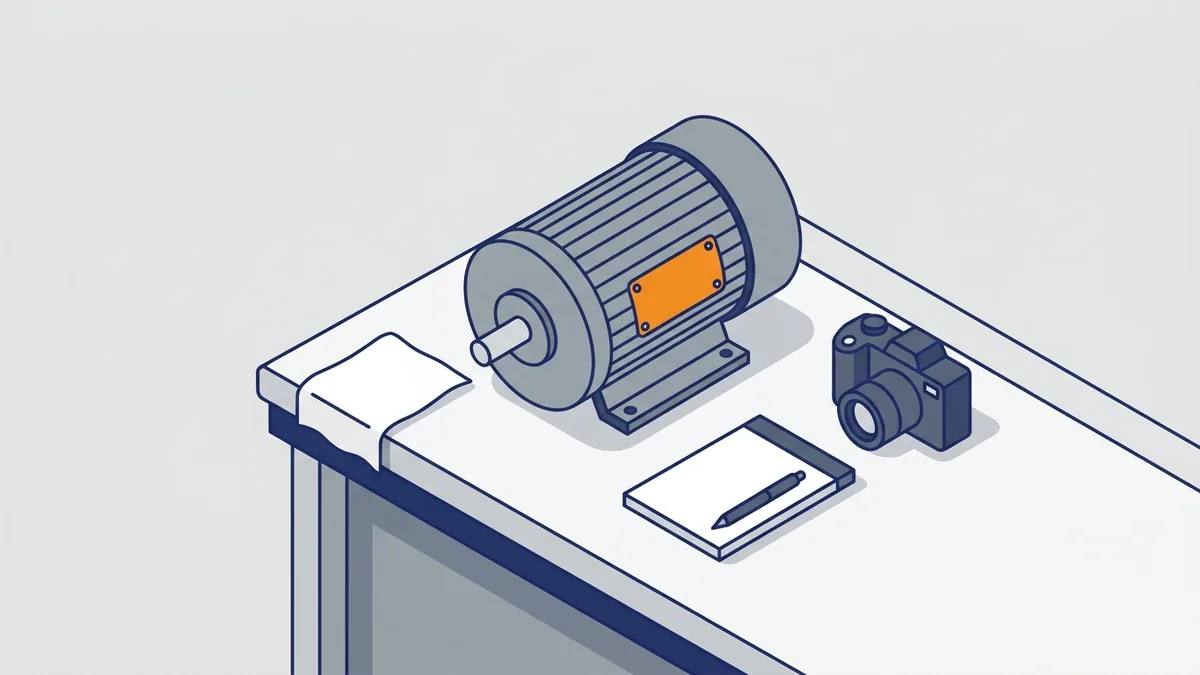
How do I read a US Motors nameplate?
Start near the top, where the model number usually sits. Then work through the ratings below.
| Field | What it tells you |
|---|---|
| Voltage | The rated voltage or voltages |
| Full-load amps | Current draw at full load, listed for each voltage |
| Frequency (Hz) | The supply frequency the motor is built for |
| Phase | Single-phase or three-phase |
| Full-load speed | Shaft RPM at rated load |
| Insulation class | The winding temperature limit |
| Ambient | The highest surrounding air temperature for rated output |
| Horsepower | Rated output power |
| Frame | A size code for the mounting dimensions |
| Model and catalog number | The model number is usually near the top; replacement motors also show a catalog number |
Keep in mind that model and catalog numbers are different things. If you only have the model number, the cross reference tool on usmotors.com can help you find the catalog number.
How do I decode the model and catalog number prefixes?
We can’t give you a reliable prefix-by-prefix code, because the letters and digits change by product line and by year. Guessing from a pattern can send you to the wrong part. Instead, copy the model number, the catalog number (if shown) and the full ID number exactly as printed. Then look them up in the U.S. MOTORS eCatalog or ask a distributor to match them.
What is the ID number and why do suppliers ask for it?
The ID number is the complete unit identification number on the nameplate. A full ID number is the whole string printed there, not just the model number or a few characters of it. The U.S. MOTORS Product Service Manual asks you to include it whenever you contact Nidec or a service shop. Because it points to one exact build, it removes the guesswork that a brand name or horsepower leaves.
For example, EIS/Holden uses the ID number to find fractional HP parts. So, copy the full ID number and photograph the whole nameplate. Then keep both in your maintenance records.
Date and plant codes
Nidec gives XL18X as a sample date code. The X characters are possible plant codes. They may or may not appear on your nameplate. So, don’t worry if your code is shorter than the example.
What does class B on a US Motors nameplate mean?
Insulation class tells you how hot the windings can safely run. Nidec builds all its motors with class F insulation or better. So, a class B nameplate does not mean class B materials. Instead, it means the motor is designed to stay within class B temperature-rise limits, which gives the windings extra heat margin.
Check the nameplate against your supply
When a new or spare US motor arrives, inspect it for shipping damage first. Next, compare the nameplate speed, horsepower, voltage, hertz and phase with your power supply and driven equipment. If any value doesn’t match, stop and sort it out before you wire the motor.
Finding the tag on a Varidrive
On some used Varidrive systems, the motor tag sits between the motor and the drive assembly. As a result, you may not be able to read it easily. Try a mirror, a flashlight or a phone camera before you remove anything. Also, record the Varidrive module nameplate, which carries its own model and speed data.
US Varidrive motor: what it is and how it works
What is a US Varidrive motor?
A US Varidrive motor is a motor and a mechanical variable-speed transmission in one enclosed unit. U.S. Electrical Motors introduced it in 1932 as the first enclosed unit of its kind. Today, you mostly find Varidrives on older machines and in used or surplus listings.
So, before you plan around one, confirm current availability and support with a distributor or authorized service station. Nidec’s current US Motors pages that we reviewed only describe the history and the instructions.
How does a Varidrive change speed?
The main motor runs at a constant speed. Then a sliding Varidisc mechanism changes the speed of the driven shaft. You set the output speed with a handwheel or a speed control. Because the motor speed stays the same, the speed change happens inside the mechanical unit, not in the power supply.
Inside, a belt runs on pulley discs, and the driven discs are spring-loaded. In addition, many units pair the Varidrive with a Syncrogear reducer. That gear unit lowers the output speed further and raises the torque.
Example Varidrive nameplate data
The data below comes from used-equipment listings. Use it only to compare against your own nameplate.
| Unit | Input | Output speed range |
|---|---|---|
| Varidrive VAH module, model K01 F712 R, frame 6, with Syncrogear GDP reducer | Max 2 HP at 1750 RPM | 428 to 4275 RPM |
| Emerson Varidrive motor, 5 HP, 3-phase, 230/460 V, 13.7 gear ratio | 1730 RPM | 37.09 to 292.0 RPM |
Notice how much the output range shifts with the reducer and gear ratio. So, always match the module model and ratio when you replace parts or a whole unit.
Varidrive or motor with a VFD?
A VFD, or variable frequency drive, changes motor speed electronically by changing the supply frequency. Neither choice fits every job. Instead, weigh these points:
- Keep the Varidrive if it runs well, parts are still available and your process is built around it.
- Consider a motor with a VFD if parts are hard to find or the belt and discs keep wearing out.
- Also consider a VFD if you need precise or remote speed control.
- Check the load’s torque needs at low speed before you switch.
For drive wiring and setup, see our 3 Phase Motor VFD guide.
Operating and maintaining a Varidrive
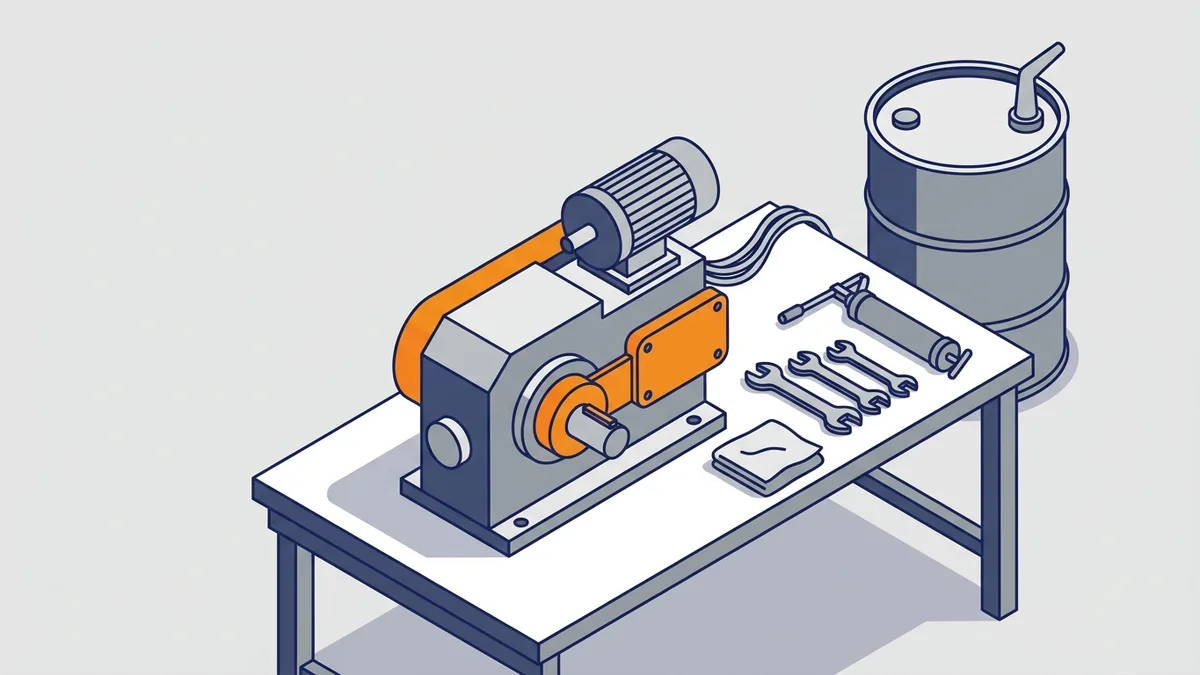
The U.S. MOTORS Gearmotors/Varidrive Installation, Operation and Maintenance Instructions give clear care rules. Follow them, along with the full Varidrive installation and maintenance manual for your unit.
How do I maintain a Varidrive?
- Run the Varidrive through its entire speed range once a week.
- Check whether your unit has ENDOLUBE construction. If so, the sliding Varidisc needs no lubrication. Otherwise, follow the instruction plate on your unit.
- Keep the unit clean and its ventilation openings clear.
- Stay inside the speed limits on the nameplate at all times.
How do I troubleshoot a Varidrive that slips, makes noise or won’t hold speed?
Start with the easy checks. Make sure the load is within the nameplate horsepower and that you have run the unit through its full speed range. A unit that sits at one setting for a long time can stick or slip.
Next, look for the usual causes:
- Slipping or lost speed: a worn or glazed belt, worn disc faces, or an overload.
- Noise: a damaged belt, worn discs or worn bearings.
- Speed that drifts: a slipping belt or a loose control setting. Also remember that the handwheel is only a relative speed indication.
You can often call a belt worn if it looks cracked, frayed or shiny on its sides. We don’t have a published wear limit, so check your manual for belt width limits. Because the driven discs are spring-loaded, never take them apart yourself. Call a repair shop instead.
Reading Varidrive speed accurately
Handwheel position is only a relative speed indication. So, don’t treat a handwheel mark as an exact RPM. For precise speed, use a direct speed-sensing accessory. Also, the factory does not calibrate electric remote speed indicators, so you must calibrate them on site.
What should I never do to a Varidrive?
- Don’t force the control wheel past the nameplate speed limits. The maker designed the mechanism and belt for nameplate speed and horsepower only.
- Never take apart or repair the driven pulley discs. Spring tension can release and injure you.
- Skip generic belt-change guides. Instead, use the Varidrive installation and maintenance manual. We can’t list belt or Varidisc part numbers here, so match them to your module model and ratio.
- Avoid using instructions for other makers’ units. For example, SEW warns not to adjust its Varigear speed unless the main motor runs. That rule is for SEW’s product, so check your Varidrive manual for the US Motors guidance.
Installation checks for US Motors horizontal motors and gearmotors
What should I check when installing a US Motors horizontal motor or gearmotor?
- Inspect the unit for shipping damage when it arrives.
- Compare nameplate speed, horsepower, voltage, hertz and phase with your supply and equipment.
- Set the condensate drain plugs for your mounting position.
- Check the bearing type before you add any grease.
- Keep the unit clean and its ventilation openings clear.
- Read the instruction sheet for your product.
For standard motors, use the Nidec Horizontal Motors Installation, Operation and Maintenance Instructions. For gearmotors and Varidrives, use the U.S. MOTORS Gearmotors/Varidrive Installation, Operation and Maintenance Instructions.
Condensate drains and shaft-up mounting
Condensate is water that forms inside a motor as it heats and cools. First, remove the drain plugs from the lower drain holes in the bracket and outlet box. Next, keep all upper drain holes plugged. Also, fit the external umbrella seal when the shaft points up.
How do I wire a US Motors motor?
Always follow the connection diagram on the nameplate or inside the conduit box. It overrides any general rule. Still, many three-phase dual-voltage motors use the standard NEMA lead markings T1 through T9. Lines L1, L2 and L3 connect to T1, T2 and T3 in both cases.
| Voltage | Connection (9-lead wye) |
|---|---|
| Low voltage (such as 230 V) | Join T4, T5 and T6 together. Tie T1 with T7, T2 with T8 and T3 with T9, and connect each pair to its line. |
| High voltage (such as 460 V) | Connect L1, L2 and L3 to T1, T2 and T3. Join T4 with T7, T5 with T8 and T6 with T9, and insulate each joint. |
Check that the nameplate lists both voltages before you use this table. Also, lock out and tag out the power before you open the conduit box.
How do I reverse rotation, and what about TEFC fan direction?
On a three-phase motor, swap any two of the three line leads to reverse rotation. For a single-phase motor, reversing depends on the model, so follow the nameplate diagram. Before you couple the load, bump the motor briefly to confirm the direction.
Fan direction on a TEFC motor depends on the fan design. Some fans work in both directions, while others cool well in one direction only. Check the motor’s instruction sheet or nameplate for a rotation arrow before you reverse a TEFC motor.
Which bearings should not be relubricated?
Bearings numbered XXXX-2RS are double sealed. The 2RS part means the bearing has a seal on each side. Don’t relubricate these bearings. So, check the bearing number in the motor data or on the bearing before you reach for a grease gun.
What bearings, grease and relubrication intervals apply?
US Motors have used ball bearings as standard since 1925. For the exact grease type, amount and interval, follow the lubrication plate on your motor and the Nidec instructions for your product. We don’t give a single interval here, because it depends on frame size, speed and duty. In general, don’t over-grease, and don’t mix grease types unless the maker says they are compatible.
Bearing replacement needs the right pullers and press fits, and it must not damage the shaft or end bells. For that reason, many plants send the job to a repair shop.
US electric motor parts: how to find the right ones
Where do I find US electric motor parts?
Start every request with the complete ID number from the nameplate. Then contact the channel that matches your US Motors product. Fractional HP means under 1 HP, and integral HP means 1 HP and up.
| Motor type | Where Nidec sends you for US electric motor parts |
|---|---|
| Fractional HP HVAC or general purpose | EIS/Holden (800-367-1212), using the motor ID number |
| Pool and spa | EIS/Holden or Parts Company of America (800-323-0620) |
| Integral HP | Distributors listed on Nidec’s distributor search |
| Old motors or motors under warranty | A part-stocking distributor, per the U.S. MOTORS Product Service Manual |
For more detail, check the U.S. MOTORS Service and Support FAQ and the Nidec Motors FAQ.
How do I cross-reference another brand’s motor to a US Motors replacement?
Use the U.S. MOTORS eCatalog. You can search by catalog or model number. Also, its cross-reference search takes an OEM or competitor product and finds the US Motors replacement.
For common commercial motors, use the Top Replacements for General Purpose Commercial Motors chart. It matches another brand’s motor number to a US Motors catalog number. In addition, it lists HP, volts, RPM, amps, capacitor MFD (microfarads), bearing type and a Marathon cross reference.
How do I get prints, manuals and wiring diagrams for older or discontinued models?
First, gather the full ID number and the model number. Then try these sources in order:
- The U.S. MOTORS eCatalog and the cross reference tool on usmotors.com.
- The instruction sheets Nidec posts, such as the Horizontal Motors and Gearmotors/Varidrive manuals.
- A distributor from Nidec’s distributor search, since many offer dimension prints and manuals.
- A part-stocking distributor for old motors, as the U.S. MOTORS Product Service Manual advises.
Also, for any wiring diagram, check the nameplate and the inside of the conduit box cover first. Search under U.S. Electrical Motors, Emerson and Nidec, since older paperwork uses the older names.
Where do I find Varidrive parts?
Older Varidrive modules, Varidisc assemblies and small parts show up as used or surplus items on resale sites. However, first ask a distributor or authorized service station what is still available. Before you buy anything, confirm the module model and ratio match your nameplate.
Verify US motor parts before you order
Parts can look the same yet differ slightly in size and shape. So, verify the part number against your model before you order. Also, Precision Electric can help you identify a US motor from nameplate photos. Call us to confirm what we can supply or repair before you plan downtime.
Repair, rewind or replace a US motor
Should I repair, rewind or replace a US Motors motor?
Nidec’s service manual gives a clear rule of thumb. Standard ODP motors through 320 frame and standard TEFC motors through 280 frame should generally be replaced, not rewound, when stock is available. Rewinding means replacing the copper windings in the stator, the fixed part of the motor.
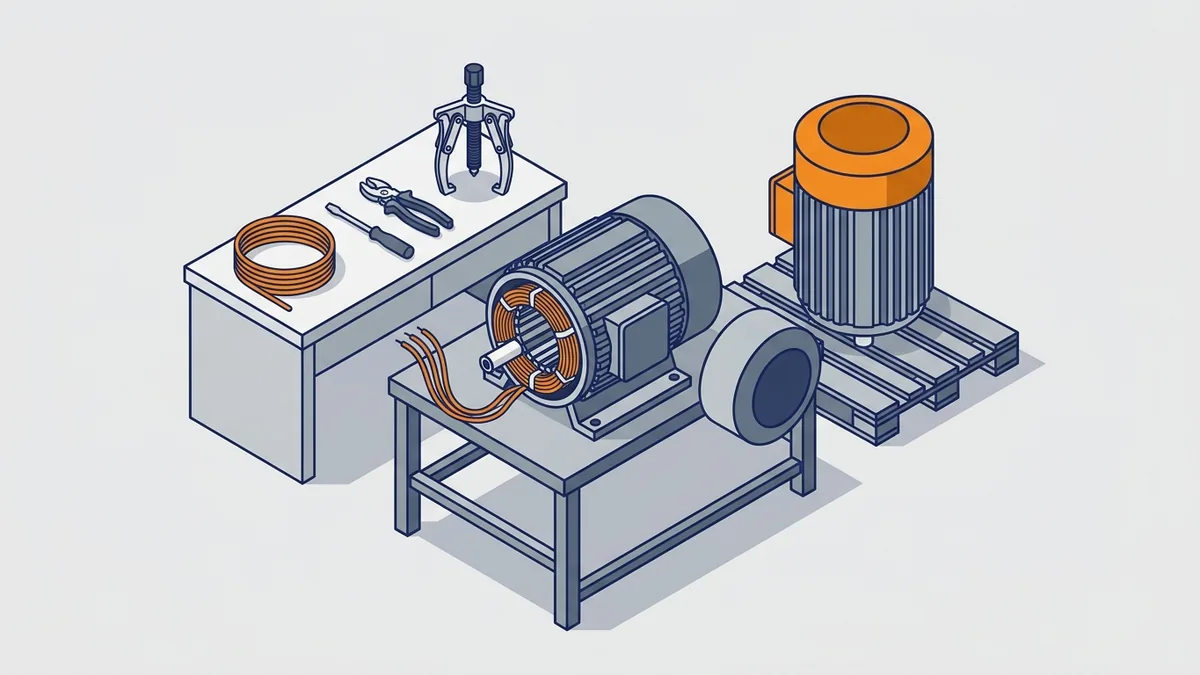
For larger, special or definite purpose motors, a repair or rewind may make more sense. So, gather the ID number and ask your distributor or repair shop to compare both paths.
What efficiency rules apply to a replacement motor?
The U.S. Department of Energy (DOE) sets minimum efficiency levels for many general purpose motors, and a new replacement must meet the level that applies to its type and size. Nidec publishes a DOE standards brochure that covers inverter-duty and vertical HOLLOSHAFT motors, so start there. Also, Nidec says the line meets or exceeds NEMA Premium. Check the nameplate efficiency on any motor you buy.
What is the payback compared with repairing?
Payback depends on your numbers, so we won’t quote a single figure. To estimate it, compare the yearly energy savings of the new motor with the extra cost over a repair. Divide that extra cost by the yearly savings to get the years to payback. Motors that run many hours a year, at high load, pay back faster. Include your downtime cost as well.
Where do I get rewind data?
Authorized service shops get rewind data from Nidec’s Southaven distribution center at 662-342-7373. Other shops must go through a part-stocking distributor. So, if your local shop isn’t authorized, expect the request to route through a distributor.
Inverter-duty motors and the rewind tag
Inverter-duty motors are built to run on a VFD. Nidec has separate rewind guidance for them, so follow it closely. After a rewind, the service station must fit a tag that shows the rewind date.
What are the warranty terms for US Motors motors?
Warranty length and terms vary by product line and by sale, so we can’t state a typical term. Check the written warranty that came with your motor, or ask the distributor that sold it. Nidec’s Product Service Manual covers how to make a claim.
How do I make a warranty claim on a US Motors motor?
- Gather the complete nameplate data, including the ID number.
- Contact the nearest distributor or authorized service station.
- For a warranty replacement, remove the nameplate from the motor.
- Return that nameplate with the invoice and warranty report.
When should I call a repair shop?
Some problems are past the point of in-house fixes. Call a repair shop when you see any of these:
- A Varidrive with worn discs or a worn belt
- New or rising noise or vibration
- A motor that runs hotter than normal
- A large motor or a vertical HOLLOSHAFT motor
- Any hazardous-location or explosion proof motor, since work must protect its rating
For background on how shops handle big jobs, see our 800 HP DC motor repair post and our Electric Motor Basics post.
What a US Motors motor or Varidrive costs
How much does a US Motors motor or Varidrive cost?
Prices change often, so get a current quote rather than trusting an old listing. Still, the listings we found show a wide spread. For example, one distributor showed a new fractional US motor at a special price near half its regular price. On the same site, another model was marked obsolete, with alternates shown.
Used and surplus Varidrive items vary even more. Single small parts list for a small fraction of what complete modules and units ask. Keep in mind that these are asking prices on resale sites, not market values.
Several factors drive the cost of a new US Motors unit:
- Horsepower and frame size
- Enclosure type, such as ODP, TEFC or explosion proof
- Efficiency class
- Special options, such as a duplicate nameplate, which adds cost by frame size
- Customer tagging, which can put up to 20 characters on the main nameplate
Rewind cost versus replacement
We didn’t find a reliable published figure for rewind cost or turnaround. So, get quotes for both paths. Then weigh Nidec’s frame-size guidance, your downtime cost and the efficiency of a new motor.
Common mistakes with US Motors and Varidrives
These errors cost time, money and sometimes safety. Avoid them:
- Searching by brand name alone instead of the complete ID number
- Assuming class B on the nameplate means class B insulation, when it means class B temperature rise
- Relubricating sealed 2RS bearings
- Leaving drain plugs in the lower holes or out of the upper holes
- Forcing a Varidrive past its speed limits
- Never cycling a Varidrive through its full speed range
- Taking apart a spring-loaded driven pulley
- Ordering a part by looks without checking the part number
- Rewinding a small standard US motor that Nidec’s guidance says to replace
Frequently asked questions
What is a US motor?
Usually, it means the U.S. MOTORS brand, made today by Nidec Motor Corporation. It began as the United States Electrical Manufacturing Company in 1908 and later became U.S. Electrical Motors. Then it became an Emerson division and was sold to Nidec in 2010.
What is a US Varidrive motor?
It is a motor combined with a mechanical variable-speed transmission in one enclosed unit. It came out in 1932 as the first enclosed unit of this kind. The motor runs at constant speed, and the Varidisc mechanism varies the output speed.
Where can I get US electric motor parts?
Start with the complete ID number from the nameplate. Nidec sends fractional HP HVAC and general purpose parts to EIS/Holden, and pool and spa parts to EIS/Holden or Parts Company of America. For integral HP US Motors parts, use the distributors on Nidec’s distributor search.
Should I rewind a US Motors motor or replace it?
Nidec’s service manual says standard ODP motors through 320 frame and standard TEFC motors through 280 frame should generally be replaced when stock is available. For larger or special motors, compare rewind and replacement quotes. Authorized shops get rewind data from Nidec, while others go through a distributor.
How do I care for a Varidrive?
Run it through its full speed range weekly, and keep it clean with its ventilation clear. Stay inside the nameplate speed limits, and never take apart the spring-loaded driven pulley discs. Units with ENDOLUBE construction don’t need the sliding Varidisc lubricated.
Whether your nameplate says U.S. Electrical Motors, Emerson or Nidec, the complete ID number is the key to the right parts, data and replacement. Follow the manufacturer’s care rules for Varidrives, and use Nidec’s frame-size guidance when you choose between rewind and replacement. Contact Precision Electric for help identifying your US motor, a quote on a replacement or a repair evaluation.