Motor Soft Starter vs VFD: Which One Does Your Motor Need?
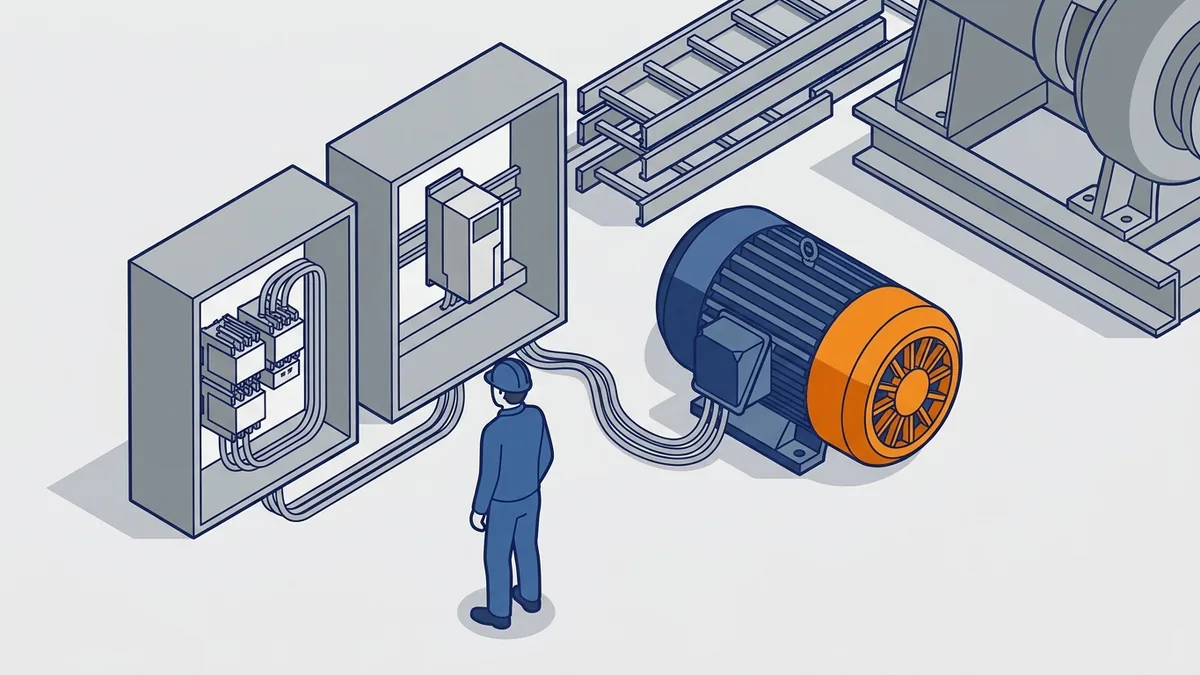
Choosing between a motor soft starter vs VFD comes down to one question: does the motor ever need to run at a different speed? This guide explains what each device does, compares them side by side, and gives a clear pick for each common load. You will also learn what changes at installation and what to check when you size a unit.
On this page
- Soft starter vs VFD: the short answer
- Why starting method matters: the inrush problem
- What is a motor soft starter?
- What is a VFD (variable frequency drive)?
- Soft starter vs VFD comparison table
- Where a soft starter wins
- Where a VFD wins
- Soft starter vs VFD by application
- How to choose: a seven-question checklist
- Sizing and selection details that trip people up
- Common mistakes when choosing between a soft starter and a VFD
- Installation, maintenance and when to call for repair
- Cost: soft starter vs VFD
- Frequently asked questions
Soft starter vs VFD: the short answer
What is the difference between a motor soft starter and a VFD?
A soft starter ramps voltage up during the start and down during the stop. Then a bypass contactor lets the motor run at line frequency, so you get no speed control. A VFD (variable frequency drive) changes frequency and voltage all the time. As a result, it controls speed as well as starting and stopping.
The rule of thumb
If the load runs at constant speed after the start and you only need a gentler start, use a soft starter. However, if you need speed, flow or pressure control, energy savings or frequent cycling, use a VFD. This rule works for most motors. The sections below cover the exceptions.
This article covers the motor soft start vs VFD choice as a decision tool. For how a VFD works inside, see our existing guide on AC motor VFDs.
Why starting method matters: the inrush problem
Why does a motor draw so much current at startup?
At standstill, an induction motor acts like a transformer with a shorted secondary. The rotor is not turning, so nothing opposes the current. As a result, a motor started direct-on-line (DOL, meaning full voltage straight from the line) can draw about five to eight times its full-load current. Current falls slightly as the motor speeds up, then drops faster once it passes roughly 70 to 80% of full speed.
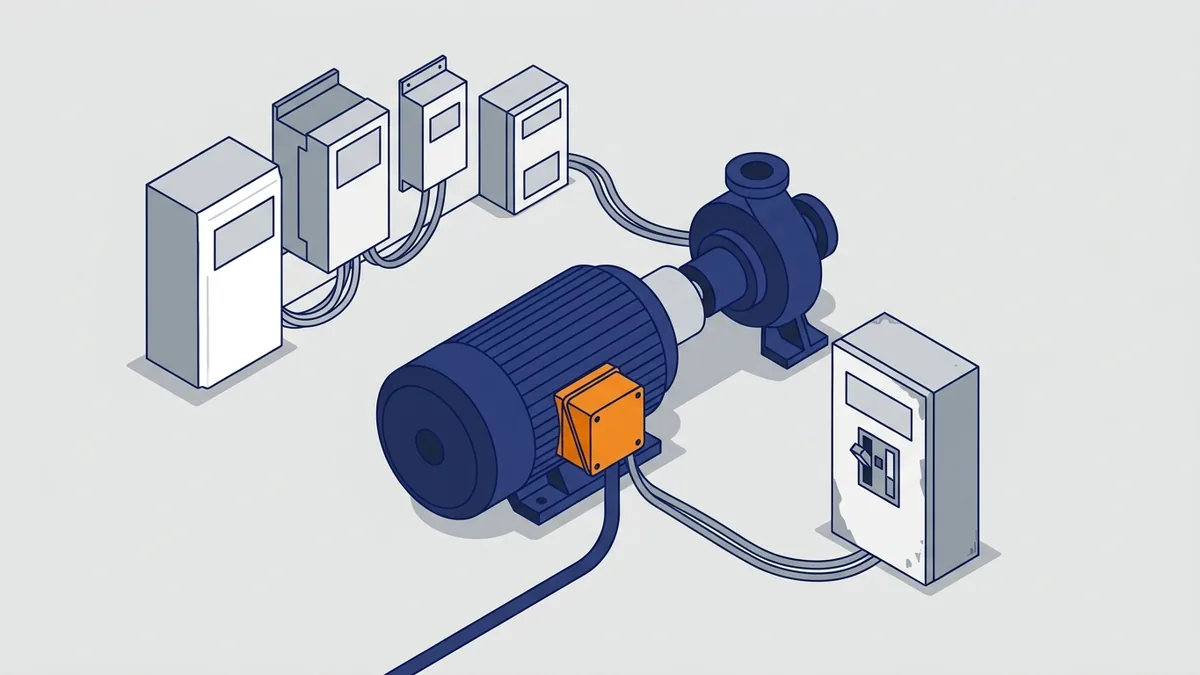
Sources give different multiples, such as 5-8x, 6-8x and up to 6-10x. So do not rely on one number. Instead, read the NEMA code letter on the nameplate, or ask the manufacturer for locked-rotor data. The code letter runs from A to V, and a higher letter means higher starting current. For example, a Code R motor draws about five times the current of a Code A motor.
What problems does high inrush cause?
- A voltage dip that can upset other equipment on the same supply
- Extra heat in the motor windings
- Shock to belts, couplings and gearboxes
- Water hammer, a pressure surge in pipes, when a pump starts or stops hard
- Trouble on generators and weak supplies
How does a soft starter compare to star-delta or DOL starting?
Reduced-voltage starting trades torque for current. Current falls roughly in line with voltage, but torque falls with the square of the voltage. So a lower start current always means less starting torque from a soft starter.
Star-delta is the older middle option. It cuts current and torque to about one third and needs six motor leads. It also causes a jerk in current and torque at the changeover. A soft starter gives a smooth ramp instead of that step, and a VFD goes further by controlling the whole start.
What is a motor soft starter?
What is a motor soft starter and how does it work?
A soft starter is a solid-state starter for a 3-phase AC motor. It uses back-to-back thyristors (also called SCRs, which are electronic switches) in each phase. They cut part of each half-cycle, so the voltage rises gradually. That limits inrush current and starting torque.
Frequency stays at line frequency the whole time. As Siemens puts it, a soft starter does not control frequency the way a frequency converter does. Therefore a soft starter gives no speed control while the motor runs.
What functions do soft starters offer?
Typical functions include a voltage ramp, a current limit, soft stop and pump stop. Higher-end models add torque control. Some also take over motor overload protection, which saves the wiring of a separate overload relay.
As an example, the Siemens 3RW5073-2AB14 data sheet (250 A, 200-480 V) lists a start voltage of 30-100%, a start ramp of 0-20 s, and a current limit of 130-700%. It also lists soft stop and pump ramp-down. Check the current manual for any unit you plan to buy.
Standard Siemens soft starters need only two controlled phases for a smooth start. An inside-delta connection needs all three.
What does the bypass contactor do in a soft starter?
The SCRs create heat while they carry motor current. So a bypass contactor typically closes at the end of the ramp and carries the current instead. That removes SCR losses and heat during running. For a soft stop, the bypass opens and the SCRs take control again.
Some units have a built-in bypass, and some need an external one. In one sizing example, the Schneider ATS480 has no internal bypass. Therefore, check this before you plan the panel.
How does inside-delta connection work?
In an inside-delta connection, you wire the soft starter in series with each motor winding inside the delta. It does not sit in the incoming line. As a result, the starter carries only the winding current, which is about 58% (1 divided by the square root of 3) of the motor line current.
This has two effects you must plan for. First, you need all six motor leads brought out to the starter. Second, the motor must be wired for delta at your supply voltage.
It is worth using when you want a smaller, cheaper starter for a large motor. It also suits a star-delta retrofit, because the six leads are already there. However, if you cannot reach all six leads, wire the starter in the line as usual.
What is a VFD (variable frequency drive)?
What is a VFD and how does it start a motor?
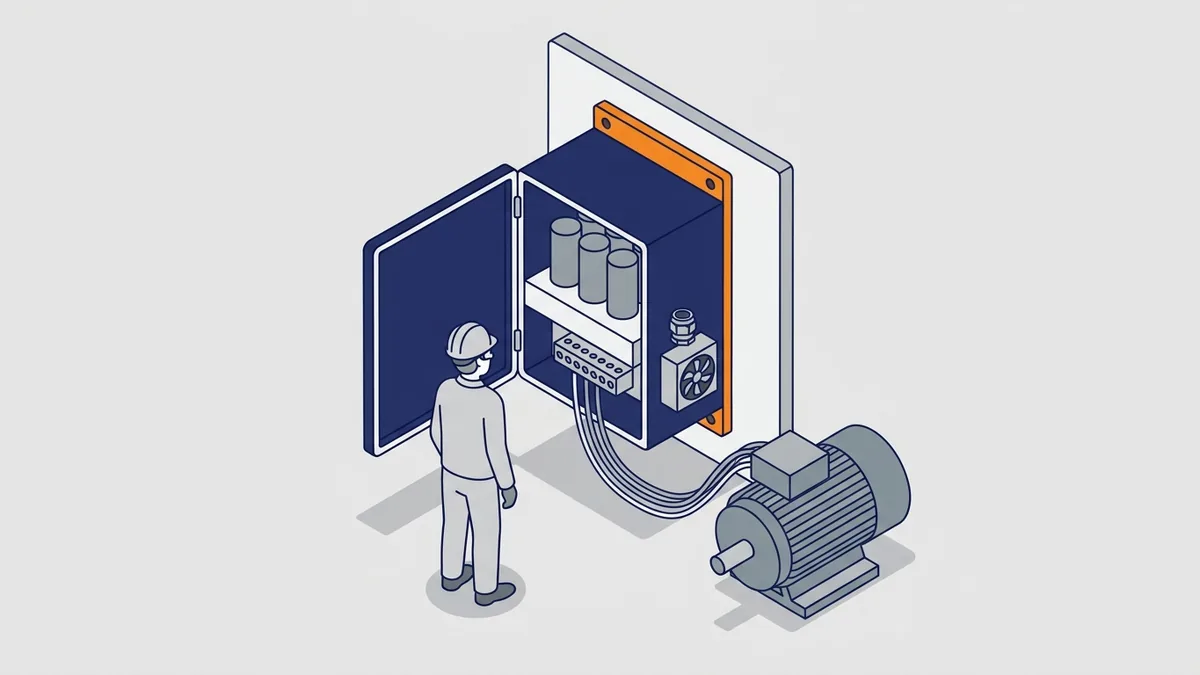
A VFD converts line power and then varies its output frequency and voltage. The motor runs at the speed you command. Soft starting is built in, because the drive starts the motor at low frequency and low voltage. As a result, start current can stay near full-load value while the motor still makes strong torque.
What else does a VFD add?
Beyond starting, a VFD gives speed and torque control, PID loops for pressure or flow, and diagnostics. It can also save energy on variable-torque loads such as pumps and fans. Many modern drives offer vector control and torque boost, which improve starting beyond what a soft starter can do.
What does a VFD cost you in the panel?
A VFD brings more heat, harmonics and EMC (electromagnetic interference) concerns than a soft starter. It also needs more cooling. So check enclosure and busbar sizing before you commit.
How do harmonics, EMC and cooling work in numbers?
Harmonics are extra current frequencies that a drive’s rectifier pushes back onto the supply. A line reactor, often rated at 3% or 5% impedance, is a common fix. A larger reactor cuts harmonics more but drops more voltage. For plant-wide limits, engineers compare results with IEEE 519 at the point where the plant meets the utility.
For EMC, IEC 61800-3 sets the limits for drives. In practice, use shielded motor cable, bond the shield at both ends, and fit an RFI filter if the drive does not include one. Check the manual for the filter class.
For heat, a drive often loses roughly 2 to 3% of its rated power as heat at full load. Use the loss in watts from the data sheet, since it varies. Then size the airflow with this common sea-level formula: airflow in CFM equals 3.16 times heat in watts, divided by the allowed temperature rise in °F.
For example, take 600 W of heat and a 20 °F rise. Then 3.16 × 600 ÷ 20 gives about 95 CFM. Add the heat from every device in the enclosure, not just the drive.
Which motors can run on a VFD?
Most standard 3-phase induction motors can run on a VFD, but four limits apply.
- Insulation: Drives send fast voltage pulses that stress windings. Inverter-duty motors, built to NEMA MG1 Part 31, have stronger insulation for this. Older or standard motors may fail early on 460 V drives.
- Long cables: Long leads cause reflected waves, which can lift the voltage at the motor to about twice the DC bus level. Keep leads within the drive maker’s length limit. Beyond it, add an output reactor or a dv/dt filter.
- Cooling at low speed: A TEFC motor (totally enclosed, fan cooled) has a shaft-mounted fan. At low speed, the fan moves less air. So a constant-torque load at low speed can overheat the motor unless you derate it or add a separate blower.
- Minimum speed: Variable-torque loads need little torque at low speed, so heat stays low. For constant-torque loads, check the motor maker’s rated speed range before you run slow for long periods.
Soft starter vs VFD comparison table
Soft starter vs VFD side by side
This table compares DOL, star-delta, soft starter and VFD. Treat the cost and current figures as rules of thumb. They vary by brand, setup and load.
| Feature | DOL | Star-delta | Soft starter | VFD |
|---|---|---|---|---|
| Speed control | No | None | Fixed speed only | Yes |
| Starting current | About 5-8x full load (check nameplate) | About one third of DOL | Adjustable; often 200-350% of full load | Can stay near full-load value |
| Starting torque | Full | About one third | Drops with the square of voltage | Full torque at low current |
| Stopping | Uncontrolled | Uncontrolled | Soft stop, pump stop | Controlled ramp |
| Energy savings | None | Minimal | Only during start and stop | Large on variable-torque loads |
| Cost | Lowest | Low | Often 30-50% below a VFD (rule of thumb) | Often 2-3x a soft starter (rule of thumb) |
| Panel space and heat | Small | Moderate | Small; bypass cuts heat | Larger; more heat |
| Harmonics and EMC | None | Minimal | Some during the ramp | Needs attention |
| Commissioning | Simple | Easy | Basic setup | More work |
| Motor protection | Separate relay | Separate relay | Some models built in | Built-in protection and diagnostics |
How much starting current does a DOL, soft starter and VFD draw?
DOL draws the most, often five to eight times full-load current. A soft starter typically limits it to 200-350% of full-load amps. A VFD can hold it near full-load value. For exact numbers, use the manufacturer’s data for your motor and unit.
Is a soft starter or a VFD better for starting torque?
The VFD wins here. A soft starter lowers current by lowering voltage, so torque falls faster than current. A VFD keeps torque up at low current. Siemens says its soft starter suits drives that need no particularly high starting torque and no start-up near nominal current.
Where a soft starter wins
Constant-speed loads that need a gentler start
Soft starters fit pumps, fans, compressors and long conveyor belts that always run at one speed. On a pump, the soft stop also reduces water hammer. Also, a soft starter reduces belt slip, gearbox wear and transmission peaks, as ABB’s comparison chart shows.
High-inertia loads, tight budgets and retrofits
Crushers and mills are heavy loads that run at fixed speed. A VFD of the same rating would cost far more. In addition, soft starters are simpler and need less space. So they suit tight panels, simple commissioning and retrofits of DOL or star-delta starters.
Does a soft starter save energy?
Only during starting and stopping. At full speed, the motor runs on line power. The benefit is indirect: less mechanical stress and less demand on the electrical system. A soft starter can also lower utility demand charges when motor starts trigger them.
Weak supplies and generators
Some sources prefer a soft starter on weak supplies because its current limit helps. Others recommend a VFD there. We cover that disagreement in the application section below.
Where a VFD wins
Processes that need speed control
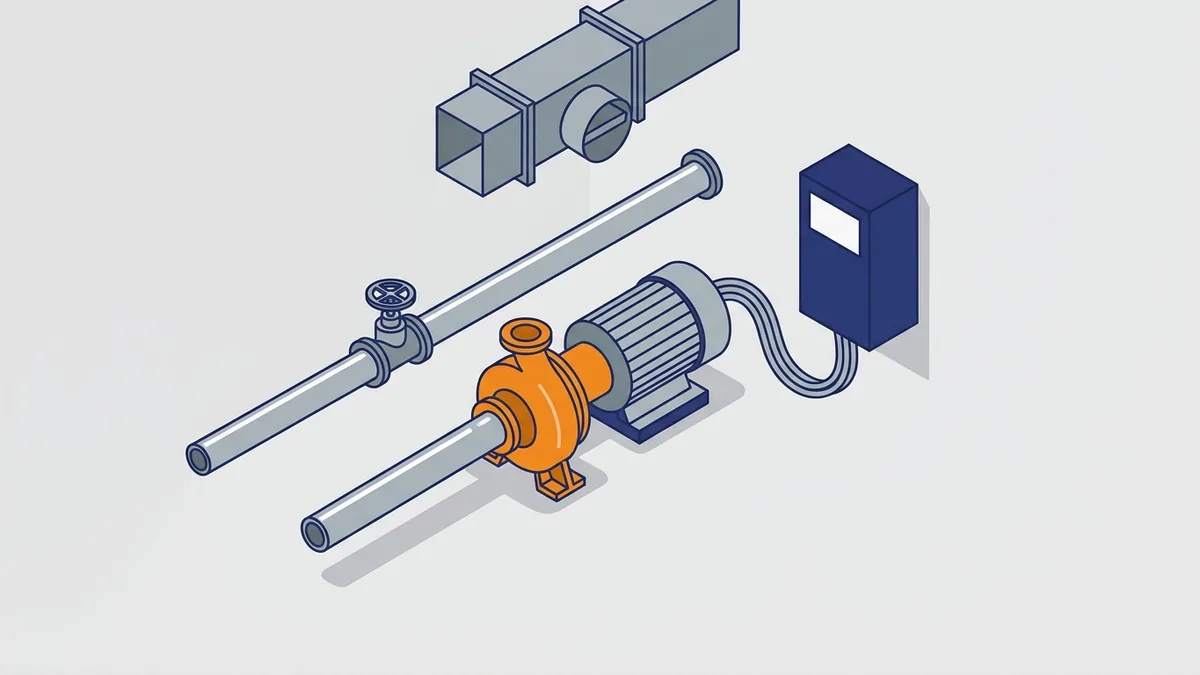
If the process needs speed, flow or pressure control, you need a VFD. That includes PID pump systems, HVAC fans and process lines. A VFD can also remove throttling valves, dampers and mechanical gear.
Energy savings on variable-torque loads
Pumps and fans at partial load can save a lot of energy with a VFD. Vendors quote paybacks of 18-36 months, or 1-3 years. Treat those as typical claims, not guarantees. Your own hours of running and load profile decide the real result.
How do you calculate VFD energy savings and payback?
Use the affinity laws for centrifugal pumps and fans. Flow changes in line with speed, and power changes with the cube of speed. So a small speed cut saves a lot of power:
- At 90% speed, power falls to about 73%.
- At 80% speed, power falls to about 51%.
- At 50% speed, power falls to about 13%.
These are ideal figures. Drive and motor losses, and any fixed pump head, reduce the real savings.
For a worked example, say a pump draws 40 kW at full speed. It runs at 80% speed for 4,000 hours a year. Power at 80% speed is about 40 × 0.51, or 20.4 kW. The saving is about 19.6 kW, or roughly 78,400 kWh a year. At an example rate of $0.10 per kWh, that is about $7,840 a year.
The inputs you need are motor input power, speed profile, yearly run hours and your power rate. Then divide the extra cost of the drive and install by the yearly saving to get the payback in years. If the process runs at full speed most of the time, the saving shrinks.
Frequent starts and high starting torque
A VFD handles frequent starts and stops well. It also gives high torque near nominal current at start. Soft starters struggle with both.
Can a VFD be used as a soft starter?
Yes. A VFD can do a controlled soft start and soft stop, so it does everything a soft starter does. However, if you only need a gentle start at fixed speed, it adds cost, heat and commissioning work you will not use. Siemens makes the same point: soft starting with a converter makes sense only when you also want to change speed during operation.
Do I need a soft starter if I already have a VFD?
Generally no, because the VFD provides soft starting. The usual exception is a multi-motor system. There, one VFD controls overall speed while certain motors need their own soft starters for frequent start-stop cycles.
Soft starter vs VFD by application
Which is better for pumps: a soft starter or a VFD?
Use a VFD if flow or pressure varies. Use a soft starter if the pump always runs at design flow and you only need to limit inrush or pipe surge. ABB’s chart rates a drive best against water hammer when you stop a pipe system. A soft starter gives reduced protection.
Which is better for fans and compressors?
For fans, a VFD is nearly always the pick when airflow varies. A fixed-speed exhaust fan is fine with a soft starter. For compressors, use a soft starter at fixed speed. Choose a VFD if the compressor must modulate its output.
Which is better for conveyors, crushers and mills?
Fixed-speed belts suit a soft starter. If belt speed must change, use a VFD. Crushers, mills and mixers are heavy-duty starts, so size a soft starter for that duty. Choose a VFD only if you need speed control. One source notes that high-inertia crushers and mills needing 200-350% starting torque are a soft starter fit.
Which is better on a generator or weak supply?
Sources disagree. A VFD usually gives the lowest start current. Yet some suppliers prefer soft starters on weak supplies because of their current limit. Another source recommends a VFD for weak grids, generators and long cable runs.
So compare the soft starter’s current limit with the VFD’s start current. Then check the generator’s data and ask the manufacturer.
How to choose: a seven-question checklist
Soft starter vs VFD: which should I use?
Work through these questions in order. Each answer points toward one device.
- Does the process ever need a different speed? If yes, choose a VFD.
- How much starting torque do you need? High torque near nominal current points to a VFD.
- How strong is the supply? Check for a utility, a generator or a long cable run. Then compare both options with the manufacturer’s data.
- How many starts per hour? Frequent starts favor a VFD.
- Is the load variable-torque? Pumps and fans at partial load can save energy with a VFD.
- How much panel space, cooling and EMC budget do you have? Tight limits favor a soft starter.
- What are your budget and commissioning skills? A soft starter is simpler and usually cheaper.
A tie-breaker
A motor that needs no speed control and no unusual starting torque is the classic soft starter candidate. However, if you are unsure about future speed needs, price both options. A VFD costs more now but may save a later swap.
Sizing and selection details that trip people up
How do you size a soft starter for a heavy-duty start?
Start with the motor’s rated current from the nameplate. Then match a unit to it. Heavy-duty starts need a larger or heavy-duty-rated unit. These include fans with large flywheels, centrifugal fans, crushers, mills and long belts. ABB’s handbook says to choose a heavy-duty softstarter, and for some applications one size larger.
Normal-start guidance assumes a DOL start time under about 5 seconds. For units with built-in overload, ABB advises trip class 10 for normal starts. Also check whether you need a built-in or external bypass.
How many starts per hour can a soft starter or motor handle?
There is no single number. It depends on the unit, the motor, the start current and the start time. Each start heats the SCRs and the motor in proportion to current squared times start time. So a long, high-current start uses up far more of the allowance than a short, light one.
For the starter, read the maker’s starts-per-hour table or derating factor for your current level and ramp time. Rating data is also typically given at 40 °C ambient, so hotter panels need extra margin.
For the motor, NEMA MG1 sets a baseline for standard motors. It allows two starts in a row with the motor at room temperature, or one start with the motor at running temperature. Beyond that, the limit depends on horsepower, poles and load inertia. If you need more starts, ask the motor manufacturer for its thermal limit data.
How do you size a VFD?
Size a VFD by motor current, not just horsepower. First, read the full-load amps on the nameplate. Then pick a drive whose continuous output current is at or above that value.
Next, match the overload rating to the load. Many drives list two ratings: normal duty and heavy duty. A common pairing is 110% of rated current for 60 seconds for normal duty, and 150% for 60 seconds for heavy duty. However, ratings differ by brand, so read the data sheet. Use normal duty for variable-torque loads such as fans and pumps. Use heavy duty for conveyors, crushers and other constant-torque loads.
Then apply derating. Drive ratings assume a set ambient temperature, often 40 °C, though this varies. Hotter panels need a derate. High altitude also needs one, because thin air cools less. Many makers start to derate above about 1,000 m (3,300 ft). Follow the curve in the manual.
What does a VFD sizing example look like?
Say a conveyor motor shows 40 A on its nameplate and runs at constant torque. You need a heavy-duty drive with at least 40 A continuous output. Now suppose the site is high enough that the maker calls for a 10% derate. Divide 40 A by 0.90 to get about 44.4 A. So you need a drive rated at 45 A or more at heavy duty. The 10% here is only an example, so use the figure in your own manual.
Where can I find sizing tools and manuals for soft starters?
Go to the manufacturer. The ABB Softstarter Handbook and the ABB softstarter catalog cover selection by load type. ABB’s ProSoft program gives an optimized selection. Siemens publishes the SIRIUS 3RW44 and 3RW55 manuals, plus data sheets such as the 3RW5073-2AB14. Always use the current manual, because older catalog ranges change.
Common mistakes when choosing between a soft starter and a VFD
What are the common mistakes when choosing between a soft starter and a VFD?
- Buying a VFD only for a gentler start, which adds cost, heat and EMC work.
- Expecting a soft starter to control speed or save energy while running.
- Using a soft starter where you need high starting torque at low current.
- Undersizing for a heavy-duty start, or ignoring starts per hour.
- Forgetting the bypass, or the heat it removes, when you plan the enclosure.
- Expecting big energy savings on a constant-torque load.
Installation, maintenance and when to call for repair
What changes at installation?
A soft starter needs room for the bypass and some ventilation. A VFD needs more cooling and harmonic and EMC planning. For wiring steps, use the manufacturer manual and local code, or see our VFD wiring posts.
What upstream protection and wiring does each device need?
Both devices need short-circuit protection ahead of them. Size cable and protection from the manual and local code, such as the NEC in the US.
For a soft starter, SCRs can fail on a fault that a standard breaker clears too slowly. Therefore many makers publish fuse tables for Type 2 coordination, which means little or no damage after a short circuit. Use semiconductor fuses where the maker calls for them. Also add a line contactor or breaker if you want a way to isolate the starter. If the starter has no built-in overload, add an overload relay. The product standard for soft starters is IEC 60947-4-2.
For a VFD, use the fuse or breaker type the manual lists. Do not start and stop the motor by switching the input contactor over and over. Use the drive’s run command instead, because frequent switching wears the input stage. If you add an output contactor, interlock it so it opens only when the drive is stopped. The main drive standards are IEC 61800-5-1 for safety and IEC 61800-3 for EMC.
What fails on a soft starter, and when should I call for repair?
Common failures include a worn or failed bypass contactor and failed SCRs. A unit without a working bypass can overheat. Symptoms include a motor that will not ramp, overload trips, no bypass pull-in, or a unit that runs hot. On a VFD, watch for heat, harmonics, cooling problems and aging capacitors and fans. Check the drive manual for maintenance intervals.
What do fault codes mean, and how do you troubleshoot them?
Code numbers and names differ by brand, so read the fault table in your own manual. Still, most codes fall into a few groups. This table shows the groups and first checks.
| Fault type | Common causes | First checks |
|---|---|---|
| Overcurrent or short circuit | Motor or cable fault, ramp too fast, jammed load | Test motor and cable insulation; turn the shaft by hand; lengthen the ramp |
| Overvoltage (VFD) | Decel too fast, regen from a heavy load | Lengthen the decel time; consider a braking resistor |
| Undervoltage or phase loss | Supply dip, loose lug, blown fuse | Measure voltage on all three phases; check fuses and terminals |
| Overtemperature | Blocked fan, dirty heatsink, hot panel | Clean filters and fins; check fans and panel airflow |
| Motor overload | Overloaded driven machine, wrong setting | Compare running amps with the nameplate; check the overload setting |
| Bypass or SCR fault (soft starter) | Bad bypass contactor or coil, failed SCR | Check bypass pull-in and coil voltage; send the unit for SCR testing |
Follow these steps for any fault:
- Write down the exact code and the conditions when it tripped.
- Lock out the power. On a drive, wait for the DC bus capacitors to discharge before you touch anything.
- Check supply voltage, fuses and terminal tightness.
- Test the motor and cable with an insulation tester. First disconnect the leads from the drive or starter, or the test can damage it.
- Clean the unit and check the fans.
- Reset and run a test. If the fault returns, call for repair.
Before you call, gather these items:
- Model and rating of the starter or drive
- Fault code
- Motor nameplate data
- Load type
Precision Electric repairs drives, soft starters and controls.
Cost: soft starter vs VFD
How much do soft starters and VFDs cost compared to each other?
Vendors often say a soft starter costs 30-50% less than a VFD of the same rating. Others say a VFD costs two to three times as much. These are rules of thumb, not quotes. Prices vary by brand and size.
Look at total cost
Panel space, cooling, harmonic filters or reactors, EMC-compliant wiring and commissioning time all favor soft starters. Energy savings favor VFDs on variable-torque loads. To check payback, divide the price gap by your expected yearly energy savings in dollars. Use your own run hours and power rate, not a vendor’s example.
Frequently asked questions
What is the difference between a soft starter and a VFD?
A soft starter ramps voltage during start and stop. Then a bypass contactor lets the motor run at line frequency with no speed control. A VFD changes frequency and voltage continuously, so it controls speed as well as starting and stopping.
Can a VFD replace a soft starter?
Technically yes, because a VFD can do a controlled soft start and soft stop. But if the motor only needs a gentle start at fixed speed, a VFD adds cost, heat and commissioning work for features you won’t use.
Does a soft starter save energy?
Only during starting and stopping. At full speed the motor runs on line power. Meaningful energy savings come from a VFD slowing a variable-torque load such as a pump or fan.
Which is better for a pump or a fan, a soft starter or a VFD?
Use a VFD if flow, pressure or airflow varies or you want energy savings. Use a soft starter if the pump or fan always runs at one speed and you only need to limit inrush or pipe surge.
Is a soft starter or a VFD better on a generator?
Sources disagree. A VFD usually gives the lowest start current, while some suppliers prefer soft starters on weak supplies because of their current limit. Check the generator’s and starter’s data, and consult the manufacturer.
Do I need a soft starter if I already have a VFD?
Generally no, because the VFD provides soft starting. Only multi-motor setups are the usual exception. There, a VFD controls overall speed while certain motors need their own soft start.
In short, pick a soft starter for fixed-speed loads that only need a gentle start, and pick a VFD when speed, flow, torque or energy savings matter. Use the seven questions above, and check the maker’s data for your motor. If you need help choosing, or a soft starter or drive needs repair, contact Precision Electric for a quote or browse our products.